


Review: When We Are Married (Donmar Warehouse)
- All That Dazzles

- Dec 19, 2025
- 3 min read
Review: When We Are Married (Donmar Warehouse)
Review by Lily Melhuish
⭐️⭐️⭐️⭐️
If marriage is a contract, Donmar’s revival of J.B. Priestley’s When We Are Married, directed with nimble assurance by Tim Sheader, is a comedy of clauses, subclauses, and all the things hidden in the small print of domestic life. Set in Edwardian Yorkshire, three couples gather to toast their joint silver wedding anniversaries, only to discover their ceremonies were never legally valid. Suddenly, “’til death do us part” becomes “’til paperwork says we don’t,” and the room erupts into a free-for-all of home truths, bruised egos, and long-time-coming liberating honesty.

Peter McKintosh’s set is a delightful opening gambit: a wash of blinding buttercup yellow, punctuated by a comically towering aspidistra and a plush purple rug. It’s cheer meets chill, sunny surface over something stubborn and staid, which perfectly mirrors Priestley’s mission to pry open polite, middle-class marriages and let the air (and the laughter) in. The aspidistra - a symbol of resilient, respectable domesticity - looms like a leafy reminder of appearances to be kept at all costs, until the couple’s “I do” becomes “do we?” and the houseplant starts to feel like an unwelcome houseguest.
From the start, the unhappiness of the couples is palpable and absurdly funny. Marc Wootton’s Albert Parker is one patronising outburst away from self-injury, dismissing his wife Annie (Sophie Thompson) with smug assurance. Samantha Spiro’s Clara Soppitt is razor-sharp and unapologetically belittling; her arc is the evening’s most convincing as cracks widen and her control slips on her meek husband Herbert (Jim Howick), who rivetingly finds new spine - thanks to a generous pour of Dutch courage - and becomes a quiet revelation. John Hodgkinson’s Alderman Joseph Helliwell is more discreet and self-satisfied, yet arguably the worst offender with a penchant for infidelity, while Siobhan Finneran’s Maria floats above it all with a blissful, snobbish loftiness and main-character magnetism.

The production’s tempo feels just right, a jack-in-the-box farce that springs a new surprise precisely when the arguably thin plot threatens to tire. Sheader’s blocking keeps the Donmar’s intimate space nimble and alive; a revolving door of entrances and exits stirs the room with every new revelation, ensuring we’re not left staring at backs for long. Janice Connolly’s Mrs Northrop steals every scene with cheeky wickedness, gleefully weaponising gossip as a disgruntled former employee. Ron Cook’s Henry Ormonroyd, the steadily more-sozzled photographer, covers the full spectrum of tipsy bravado and drunken wisdom with relish, and his chemistry with Tori Allen-Martin’s Lottie Grady is charming and winsome, her late arrival injecting warmth and mischief as scandal accelerates.
And yet: some jokes feel like vows past their sell-by date. The comedy leans hard on gender and class stereotypes that, in 2025, land as basic and familiar. Priestley’s point about marriage as technical legality rather than companionship is persuasively staged, but the gag of “husbands bully, wives nag” can feel repetitive. To the production’s credit, it doesn’t pretend the play is something it’s not; it offers a window into what once was, and trusts us to laugh at the hypocrisy while noting how far we’ve come. Where contemporary sparkle does sneak in, it’s precise in its playfulness. Scene-change blasts of Beyoncé’s “Single Ladies” and RAYE’s “Where Is My Husband?” add an irresistible wink of self-awareness.
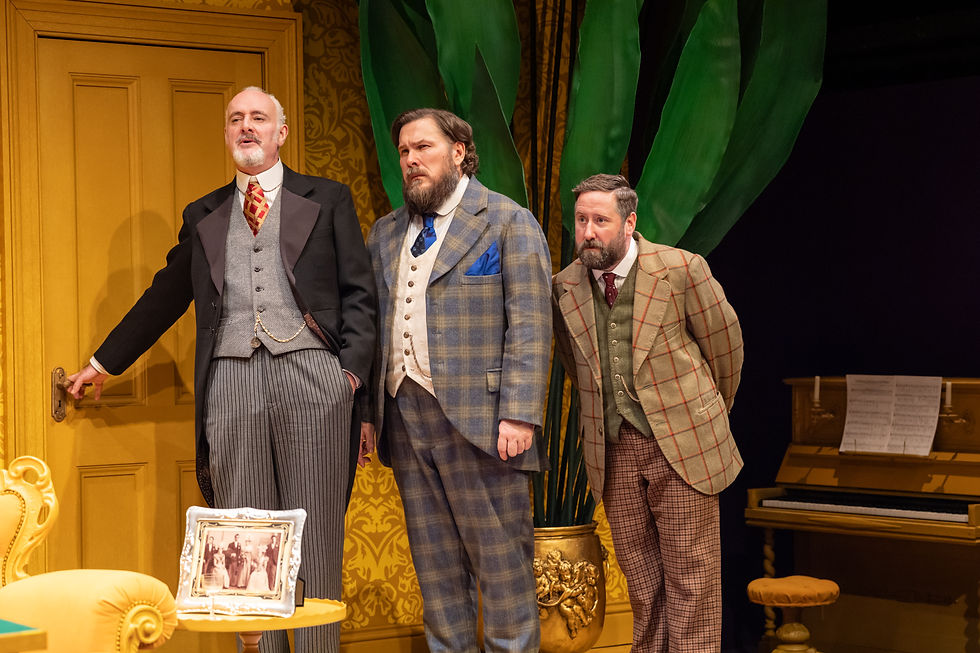
Performance-wise, the night belongs to Sophie Thompson’s Annie Parker, which is no small feat in this juggernaut ensemble. Her mid-show monologue - built patiently through dog-whistle humiliation and patronising dismissal - erupts with steel and assurance, landing to well-earned applause. Thompson calibrates pathos and punchlines like an experienced archer; every comic target falls in turn. Yet it’s her quivering lip and vulnerable stare that give the humour depth, revealing a woman defiant at breaking point, far more perceptive than her husband ever credited.
Beneath the farce, the play exposes the absurdity of holy matrimony, and asks the timeless question: what if everything you believed was a lie? For these couples, illegality becomes honesty, and honesty becomes a chance to renegotiate terms. The evening ultimately re-ties threads with kinder knots: fewer tyrannies, less infidelity, more mutual respect. It’s all a bit too neat and tidy, but we came for the chaos, not the conclusion. The only lesson to be learnt here is laughter.

If some of Priestley’s tropes feel “for better or worse,” Donmar’s revival lands firmly in the “for better.” A lively, well-drilled cast, bold design, and a director who keeps the fizz alive to deliver a joyous night that proves you can break the law of marriage and still keep the spirit of it. Consider it a silver anniversary polished to a warm shine, no registrar required.
When We Are Married plays at Donmar Warehouse until 7th February. Tickets from https://www.donmarwarehouse.com/whats-on/when-we-are-married-rg17
Photos by Johan Persson