


Review: Twenty Thousand Streets Under the Sky (Southwark Playhouse Borough)

Review by Ruth Sealey
⭐️⭐️
Humans, by our very nature, seek connections in life. Whether that is friendship, love or simply a desire to belong, it is a built-in need, but one that may not always lead us down the right path. Twenty Thousand Streets Under the Sky at Southwark Playhouse Borough explores the connections made by three individuals in 1920s London and the consequences of their actions and choices. Despite being over 100 years old, its themes of loneliness remain extremely relevant, as London and modern life in general can leave us feeling isolated. But would the play’s actions draw us into their story, or leave us disconnected in the end?

Twenty Thousand Streets Under the Sky is based on Patrick Hamilton’s trilogy of novels, first published in 1935 and later adapted for television in 2005. Taking place in 1929, it follows three Londoners as they search for love and a sense of belonging. Set against the backdrop of London’s seedy underbelly and its maze of winding streets, the story centres on the public house, the ‘Midnight Bell’. Barman Bob longs to become a writer but finds himself drawn to Jenny, a captivating prostitute, frittering away his savings in a misguided attempt to save her, while barmaid Ella harbours feelings for him that go unreturned. Jenny has her own story to tell, having been taken advantage of by men and she makes choices that have devastating consequences.
My underlying issue with this production, and Simon Reade’s adaptation, is the one-dimensional nature of the characters created. In theatre, we need to be shown, told or at the very least, given some context as to why we should care about these characters and become invested in their outcomes. Sadly, the writing here does very little to give us a real sense of who people are or why their lives should matter to us. This is frustrating because the individual storylines have the potential to be really interesting, but turning three books into a two-hour production feels like too much is left out to give the storytelling any real depth. The dialogue unfortunately does little to help, with stilted, awkward conversations that often do little to progress the story. At one point, a clunky phone conversation consists of little more than a hello, a time to meet and a goodbye. With so much story to fit into two hours, it is difficult to understand why moments like this are included when that time could surely be better spent building the characters and giving the story some momentum.

Matthew Iliffe’s direction goes some way to help this production, but I do question the choice to stage this in the round. Having seen many shows at Southwark Playhouse Borough, this feels like an odd choice when the space offers so many other options. We spend much of the time looking into a bar or a room in a house, while characters are often placed with their backs to at least one section of the audience. With a flurry of entrances and exits, and characters marching around the stage, it creates a frenetic feel that does not feel necessary for the story that is being told. Amid what sometimes feels chaotic movement on stage, Iliffe creates some stronger moments, particularly involving Jenny, and there is a genuine sense of dread as George plies her with drink at the close of Act 1. Splitting this scene is also effective, with Act 2 opening the following morning as Jenny wakes. It is a difficult scene to watch, but it also shows what this production could achieve when the writing and direction work together.
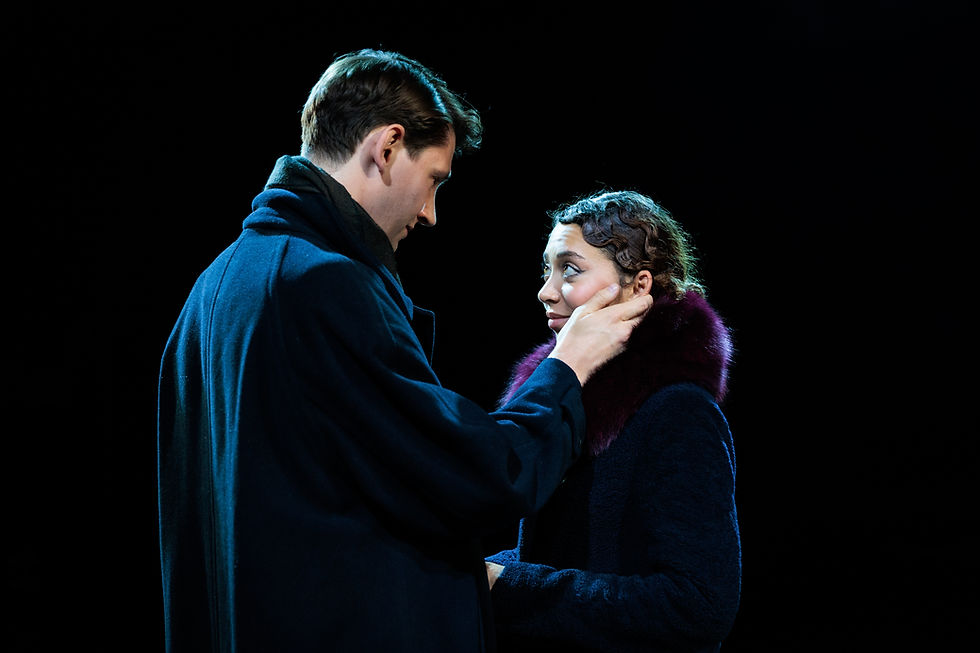
The cast work hard with the material but are never given an opportunity to reach deeper into their characters. Michael Maloney raises some laughs as Ernest Eccles, but is also a slightly uncomfortable presence as he forces kisses from a somewhat bemused Rosalind Lailey as Ella. I am still unsure why Ella is drawn to him, another sign of a lack of depth in the writing, which also fails to explore her unrequited love for Bob. George is an extremely unlikeable character, played with slightly juvenile glee by Alex Bhat. He is at his best when he plays more into the darker side of George, and seeing him tuck into a boiled egg while Jenny cringes and recoils from him following her assault the night before is a powerful moment.

Jordan Scowen as Bob never quite reaches his full potential and feels somewhat thinly drawn, despite being a character who should carry much of the weight of the production. However, there are glimmers of what he could be, especially in the opening and closing moments, when Scowen delivers his lines with real conviction. This makes it all the more frustrating, as these moments give a hint of what might have been with a more fully developed character. Yanexi Enriquez shines as Jenny, bringing both sass and vulnerability to the role. She makes excellent use of Jenny’s story arc and jumps in time to create the most rounded and believable character in the production.
There are some really interesting design choices by Ellie Wintour. The production opens with a beam descending from the ceiling which, with the clever positioning of Alex Musgrave’s lighting, allows a silhouette of London, complete with place names, to be projected onto the floor of the theatre. It is a visually impressive opening, but sadly peaks there, with the design then becoming somewhat restricted by the storyline it needs to follow. Wintour is also responsible for the costume design, which is one of the highlights, with real attention to period detail. Elizabeth Purnell’s sound is somewhat inconsistent, starting strong with the sound of the River Thames supporting the projection. However, some of the sound becomes a little grating as every scene change is accompanied by the roar of a car racing by, which seems out of keeping with the 1920s setting.
Twenty Thousand Streets Under the Sky has moments when its strengths come to the surface, with elements that show real potential and a distinctive design. Ultimately, however, the decision to condense three novels into two hours of theatre comes at the expense of character development and storytelling needed to make us care about the lives at its centre. Too much feels rushed or insufficiently explored, while dialogue often causes the story to stagnate. For a play concerned with the search for human connection, sadly it is that very connection that is missing between the action on stage and the audience.
Twenty Thousand Streets Under the Sky plays at Southwark Playhouse Borough until 17th October . Tickets from https://southwarkplayhouse.co.uk/productions/twenty-thousand-streets/
Photos by Mitzi de Margary