


.png)
Review: Twelfth Night (Barbican Theatre)

Review by Sam Waite
⭐️⭐️⭐️
With the show believed by many to have been written as festive entertainment, hence its title, it seems fitting that the Royal Shakespeare Company’s 2024 production of Twelfth Night has waited a full year for this London transfer, arriving at the Barbican for the 2025 holiday season. Among Shakespeare’s best known and most oft-produced comedies, director Prasanna Puwanarajah’s seemingly timeless take finds a new twist in original songs by Matt Maltese.

Twelfth Night finds siblings Viola and Sebastian separated by a mighty storm, with Viola washing ashore in Illyria while Sebastian is rescued by sea captain Antonio. Believing her brother to be drowned, Viola enters into the employ of Duke Orsino under the guise of a young man named Cesario. Gender becomes abstract, love triangles develop, and identities are mistaken as the two siblings come ever closer to a reunion neither expects to happen.
Although this central story is simple enough, despite the complexities for those involved, Twelfth Night of course features a number of other players, with a secondary plot of scheming, deception and tomfoolery concerning the household servants of the wealthy Olivia, object of Orsino’s desire. Puwanarajah has kept Shakespeare’s text intact, meaning ample time is provided to the fool Feste, and to his comrades in deceiving the dominating steward Malvolio. Funny as the company are, particularly Michael Grady-Hall as Feste, their sequences felt needlessly drawn out at times, feeling almost like a variety show and making Viola’s efforts to disguise herself and to avoid the affections of Olivia herself feel startlingly secondary.
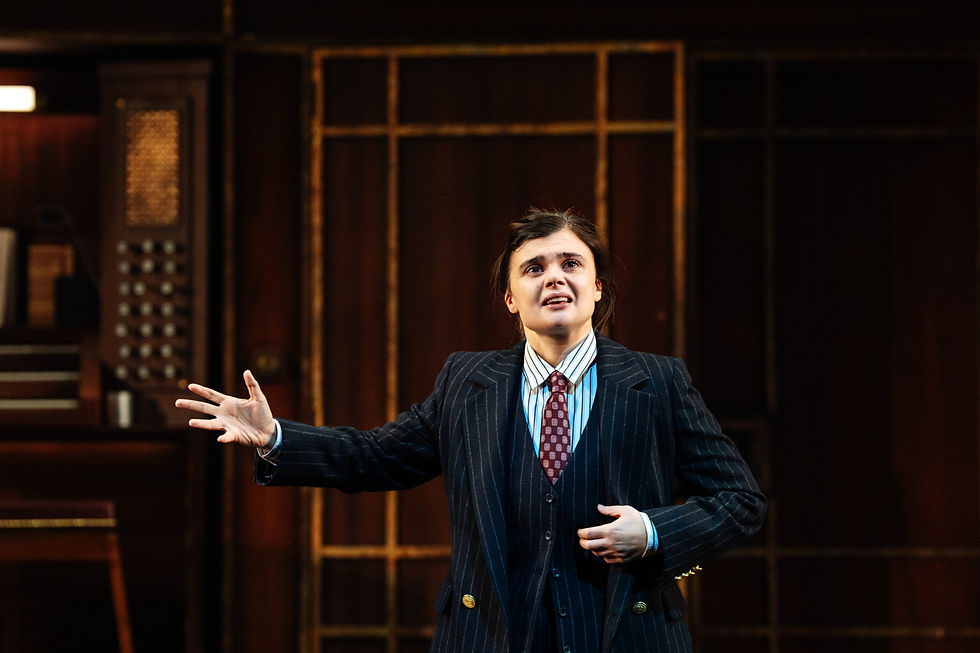
Fourth walls are often abandoned here, with Feste leading the supporting cast in directly engaging the audience. In a space like the RSC’s Royal Shakespeare Theatre there is an inherent intimacy, boosted by a thrust stage, which likely served these touches better – in the Barbican Theatre’s comparatively cavernous auditorium, these moments felt more flattened, reliant as they were on the response of the nearest audience members and easily lost by those further back and up above. Early on, an ad-libbed, “That killed ‘em in Stratford,” (apologies to paraphrase, I’m not much of a note taker!) helped reignite a moment which had found little response, but clever as many ad-libs and asides were, relying on them is far too risky a game to be playing.
Michael Grady-Hall is endlessly watchable as Feste, whether adorned in a bee costume, being lowered from the ceiling, hiding atop a colossal pipe organ overwatching the proceedings like a menacing puppet-master. His consistently strong work extends to a fine singing voice, which makes for both a humorous, invigorating entrance for the character, and a quiet, melancholy outro for the show as a whole. As the ill-fated steward Malvolio, Samuel West is also remarkably strong, leaning into the eccentricity of a famous scene involving stockings and garters, and delivering his final lines with a real sense of dread that condemns both his household and the audience for the cruelties done to him – both, impressively, with a powerful sense of presence and surety of performance.

Other actors are strong, but Puwanarajah’s production loses its tonal identity at times, leading to what was most interesting about a character’s interpretation being lost. As Duke Orsino, Daniel Monks enters with a swaggering, over-the-top quality, draped on top of a piano as he insists the food of love be played on, before quickly growing bored and rejecting Feste’s grand, wire-hanging entrance. Monks’ early scenes with Gwyneth Keyworth’s Viola, by now disguised as Cesario, also carry a degree of sensuality to them that hints at expansion on the attraction that already brews between Orsino and what he believes is another man, but these hints too fade away by the time we see him again. Monks is never less than commanding in his work, but these most interesting notes never reach their full potential.
James Cotterill’s design choices allow for the timeless quality to make itself known without overstating itself. Costumes are from a loosely-defined period of the 20th century, and the sets are more abstract that they are expository. Viola, saved by a sea captain, emerges onstage through what appears to be a large window, climbing into an evocatively dark, bare stage. This soon pulls up to reveal the site of Sebastian’s own arrival, a steep, sizeable, and visually appealing hillside, though this is seen only briefly before the colossal pipe organ comprising the main set is revealed. This sense of abstraction, and this visual allusion to the “music be the food of love” motif is a smart choice, and one which reveals itself nearly endless possibilities for comic flourishes and for character interactions.
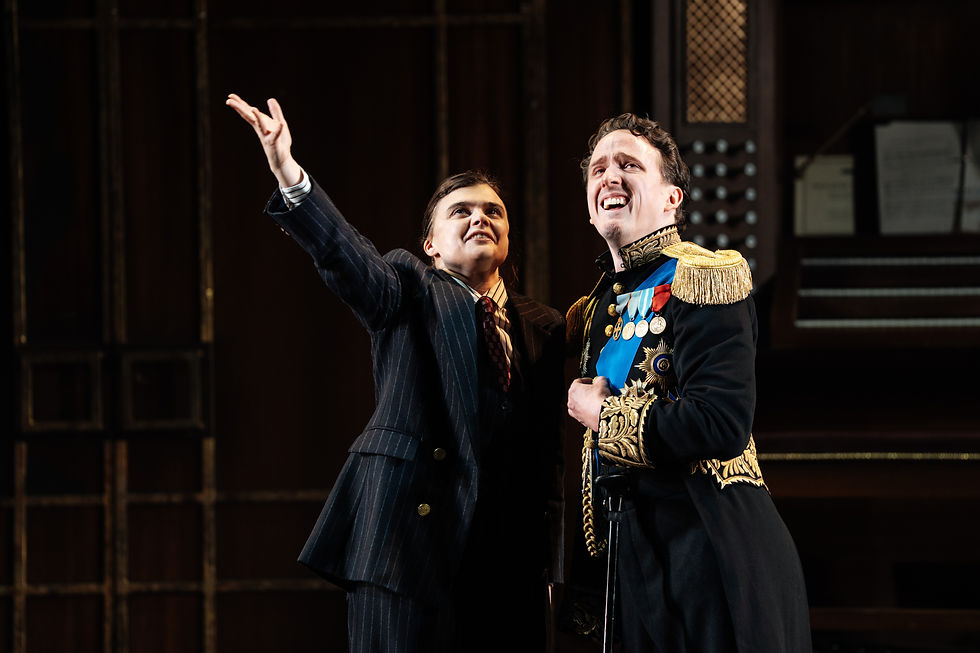
Giving one of the evening’s most consistent turns, Freema Agyeman is fiery and flirtatious as Olivia. With her passion for Cesario running deep, Agyeman is allowed ample opportunity to be cold and dismissive in the first act, and digs deliciously into sensuality and salaciousness for the second. When (spoiler) the twins’ identities are revealed, Puwanarajah and Agyeman lace the moment with sapphic touches of intrigue, following their already-placed thread of her thrill at learning there are two Cesarios running about the place. Though the extended, sometimes overlong time spend with the comedic supporting cast feels at times to have pushed these stories of mistaken identity and lustful misadventures to the background, once they reach the foreground they provide some of the most satisfying, stimulating moments in the performance.
Unfortunately, as I’ve mentioned, the tone feels inconsistent and even at odds with itself. The hollowness and hatred in Samuel West’s final lines make it hard to find any comedy in what the others have done to him, particularly as his turn as the steward feels more dissatisfied with his staff than he does cruel himself or as if he may mistreat them. Elsewhere the bombast of comedy in act one feels at odds with the sense of melancholy the muted lighting from Zoey Spurr and Bethany Gupwell, and the sombre, passionate music provided by Matt Maltese – his songs feel like standards of the early 20th century, with that sense of longing that populates much of these pieces.

With some genuinely clever ideas but some which feel disconnected from one another, Twelfth Night feels like a show built around its venue, which I suspect is exactly the case and why it failed to connect with me. Having moved from one very specific space to another, there are flourishes which touch on the specifics of the space – acknowledgement of the stalls’ many side doors among them – but at many points the productions simply doesn’t gel with the space. The cast are strong across the board, and the material as resonant as ever, but something seems to have been lost in the move from Stratford to London.
Twelfth Night plays at the Barbican Theatre until January 17th
For tickets and information visit https://www.barbican.org.uk/whats-on/2025/event/royal-shakespeare-company-twelfth-night
Photos by Helen Murray