


Review: The Tempest (Royal Shakespeare Theatre)

Review by Raphael Kohn
⭐️⭐️⭐️⭐️
It is an exciting moment when a British legend of theatre, such as Sir Kenneth Branagh, returns to the stage of the Royal Shakespeare Theatre. On press night, at least, the venue was filled with an excited buzz, ready to see a master at work as he treads the boards to deliver some of Shakespeare’s most famous words. It’s not been long, of course, since his Lear graced the West End, but it is quite another thing for him to return to Shakespeare’s birthplace. The stakes and expectations are, to say the least, rather high.
Thankfully, those expectations are met and, at times, exceeded. One of Shakespeare’s final plays, The Tempest, is a tale of revenge, power, and forgiveness. But intertwined into this is a critical narrative of colonialism, with the deposed Duke of Milan, Prospero (played by Branagh in this version), escaping to a remote island on which he enslaves the indigenous inhabitants and uses their powers to satisfy his will.
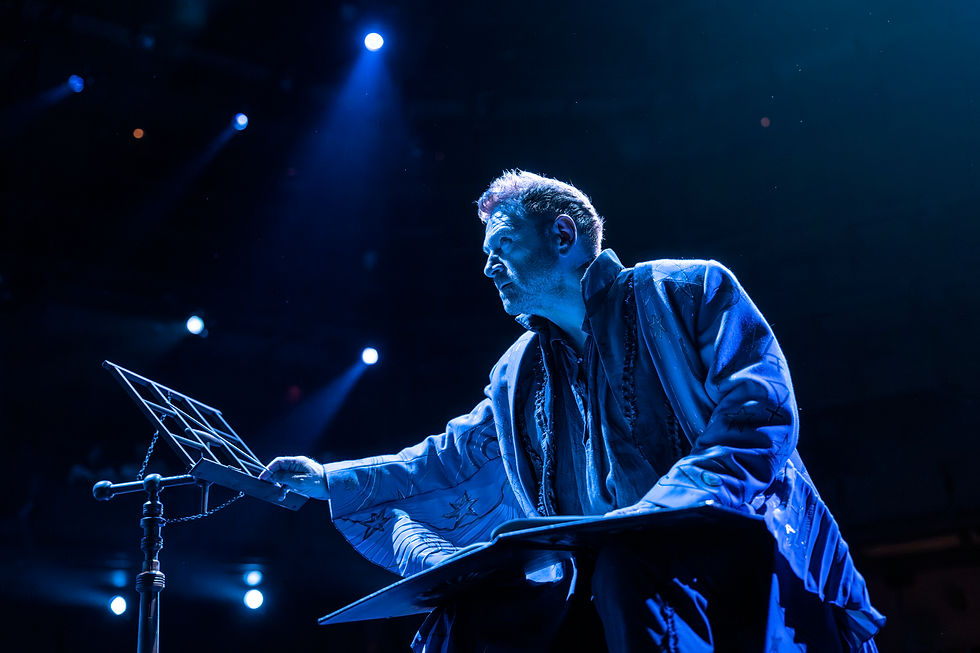
Famed director Richard Eyre, in his RSC debut, hardly shies away from the post-colonial narrative, casting Branagh’s Prospero firmly into a grey area between hero and villain. Yes, Prospero is the protagonist, and he shows great kindness and humanity to some characters. But there is no escaping his tyrannical behaviour towards Caliban (an enslaved inhabitant) and Ariel (an enslaved spirit), who bow to his beck and call. At a time when critical reflection on these narratives is all too important, it feels like the right approach for this play.
Noticeable as they are, the colonial reflections are something of a subplot, however. Primarily, this is still a play of magic, power, and revenge. And magical it is, in a dazzling visual spectacle of light and projections. From their very first moments, Akhila Krishnan’s projections illuminate the set with painting-like tableaus, dancing with Hugh Vanstone’s lighting to form some gorgeous effects. It’s all paired with Akintayo Akinbode and Stephen Warbeck’s score, played by a live band in the circle in a mix of folky guitars and guembris and percussive drums.
In something of a twist, the actual theatrical playing space is diminished to a rather small circle in the middle of the theatre’s truncated thrust stage. Bob Crowley’s set takes a slightly minimalist approach at times, condensing the action onto the tilting disc. At others, though, it opens up to display some gorgeous setpieces, fully realised in fabric and lighting. Matching Fotini Dimou’s quasi-period costumes (which are, admittedly, embellished with a few modern touches), it all looks gorgeous and balanced throughout.

It’s not unfair, though, to say the production is heavily centred around Branagh’s Prospero. And it is no exaggeration to say that Branagh is spectacular. From the very first moments, taking to the stage like an orchestral maestro to quite literally conduct the shipwreck that sets the play’s events in motion, his control not only over the plot but the performance too is clearly set out. And it is a joy to see such a master at work, the lines pouring from him as he wrote them himself, joyfully making his way through Shakespeare’s soliloquies. At times, he almost slips into over-indulgence - but with his experience and expertise, how can you not?
For a lead character, though, he’s often off-stage or stalking the perimeter as the other plot threads develop. Which is something of a shame, as in such a Branagh-focussed production, it feels as if something is slightly lost in his absence. Powering through, however, is Ruby Stokes as Miranda and Fred Woodley Evans as Ferdinand, the romantic duo at the heart of the plot who keep the story grounded.

It is, however, the rightful inhabitants of the island who truly make the production click. Ashley Zhangazha’s Caliban is nothing like the monstrous, ogre-like depictions of the past. Instead, he is brought to life with intelligence, amusing himself by manipulating the shipwrecked crew to meet his own aims. Meanwhile, Amara Okereke is a tremendously aerial Ariel, dangling from the rafters throughout and only making contact with the floor almost as the curtain falls for the final time. It’s hard not to be impressed by anyone singing and acting while flipping over and over - it’s especially hard not to be impressed when it’s done so well.
For all its technical wizardry in flying Okereke around, tilting the set in the storm and projecting gorgeous visuals around, it still feels grounded in the text and actor-focused. And for a night out at the RSC, what more could you look for than some of the best performers this country can offer, giving their all in a balanced, visually sumptuous show. Ultimately, it’s nothing if not impressive, with more than a touch of magic throughout.
The Tempest plays at the Royal Shakespeare Theatre until 20th June 2026. Tickets from https://www.rsc.org.uk/the-tempest/
Photos by Johan Persson