


.png)
Review: The Standard of Living (Theatre Royal Haymarket)

Review by Daz Gale
⭐️⭐️⭐️
The prospect of a new play by James Graham is always thrilling. Over the years, he has proven to be a reliable high-quality writer whose work is often met with success and acclaim. The subject matter of his latest offering, The Standard of Living, may not prove as immediately enticing but Graham has earned a certain amount of trust through his track record that accumulates with every show he writes. Though I was worried this play may not quite match the standard of his previous works, would it all add up in the end?

The Standard of Living is centred around John Maynard Keynes, the radical economist and member of the influential Bloomsbury Group. Keynes was a man whose influence and imprint can still be felt decades after his death as he was responsible for building a fairer financial model that helped reshape the Western world following the First World War, as well as becoming the singular driving force behind arts funding in Britain.
I must admit not being too familiar with Keynes prior to this play, and the promise of an economics heavy watch did not seem like the most riveting watch. However, as is the case with James Graham’s plays, there is more than meets the eye. Graham examines Keynes’ relationships with his wife, ballet dancer Lydia Lopokova, and his lover, Duncan Grant, as well as his great economic rival, Friedrich Hayek. Virginia Woolf even gets a look in for some reason. The play is full of Graham’s trademark sharp writing and wit, finding ways to make what may not seem like the most exciting show on paper all the more interesting.

The way James Graham can make any subject watchable despite your own personal interests and dislikes is part of what makes him one of the most accomplished playwrights of his generation. He does this again to an extent in The Standard of Living, though admittedly not as successfully as he managed on Dear England, which single-handedly turned me into a football fan. Well… almost. The problem with The Standard of Living is it is all a bit messy at times. There are too many characters and relationships to focus on, meaning some of them suffer from feeling underdeveloped with perhaps a disappointing assumption the audience will go into the play knowing enough about the key characters anyway. If you do not, the whole thing becomes hard to follow. The result is a jumbled watch that has flashes of brilliance mixed in with moments that are far less interesting or even confusing. While the genius of James Graham ensures that even the weaker of these moments never falls below a certain level, the play tries to cram in too many ideas and themes when a more simplified and streamlined story would have paid off far more substantially.
Another creative at the top of his game is Nicholas Hytner, who once more thrills with his always creative and slick direction. While the subject matter may not always wow and the writing occasionally falters, Hytner manages to patch up what he can to create a visually stylish watch. Making full use of Bob Crowley’s deceptively sparse but hugely effective set design, Hytner brilliantly intersplices still images both as a way to signify where we are in history, bridge together certain elements and, most effectively, replicate what the actors are wearing. The best way to describe that bold and inspired choice is to think of any biographical movie that can often end with footage of the real person rather than the actor. Hytner using this repeatedly throughout The Standard of Living reminds us that for all the imagined elements of the play, this is a story that is rooted in realism, upping the stakes and allowing the audience to feel even more invested.

Where The Standard of Living never drops, however, is in its remarkable cast. The lead role of John Maynard Keynes is wonderfully taken on by Rory Kinnear, who charms with confidence as the trailblazing and occasionally arrogant economist. Kinnear’s stage presence ensures he dominates even at times where stronger writing for other people on stage with him threaten to eclipse him, showcasing various sides to Keynes’ personality. There are flashes of warmth and the spirit that motivates every choice in his story, namely the recurring question of what is a good life? A determination and refusal to consider other views gives Kinnear plenty to sink his teeth into in what can only be described as a solid gold performance.
There is a real magnetism in Thomas Flynn’s performance of Duncan Grant, so it is a real shame he suffers more than most through a seriously underutilised characterisation. The scenes Flynn shares with Kinnear border on being electric but just need a bit more meat behind them to really make them shine. Laurie Kynaston is a standout as Friedrich Hayek, shining in the scenes where he goes toe-to-toe with Kinnear’s Keynes. It is in these sparring moments that The Standard of Living is at its best, to the extent that I would have liked to have seen more of their rivalry, especially given the fact Hayek was initially such an admirer of Keynes. Out of the three main relationships Keynes has with his co-stars, I would say the most believable and captivating are the ones he shares with Kynaston’s Hayek, with Kynaston once again showcasing what an astonishing actor he is.
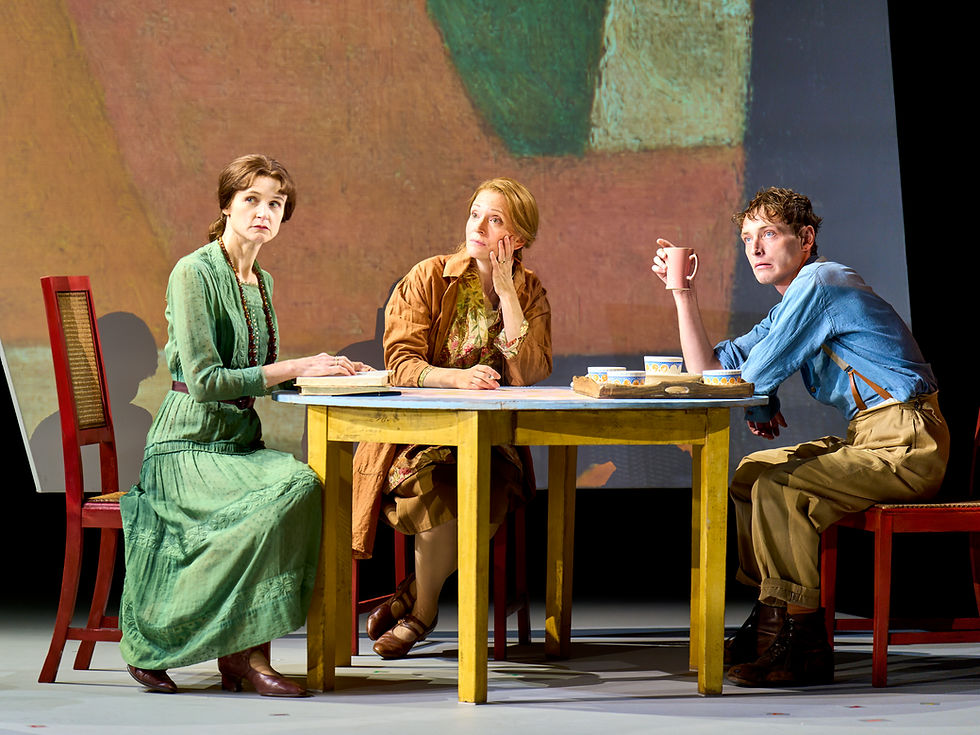
An inspired bit of casting is prima ballerina and Royal Ballet Principal Natalia Osipova as Lydia Lopokova, Keynes’ wife and a celebrated ballet dancer. Osipova delights in the opportunities she gets to showcase her talents both through ballet and acting, demonstrating a fantastic knack for comic timing in a performance that threatens to be scene-stealing. It is also a clever choice to have all of the ballet scenes presented in the play being ones that were danced in London by the real Lopokova. Where the performance is let down somewhat is in how unnaturally her relationship with Keynes is played out. It feels as if there are scenes missing to allow the audience to be invested in their relationship. Similarly, characters of Virginia Woolf (Naomi Frederick) and Vanessa Bell (Claire Price) feel unnecessary to the plot, with each suffering from one-dimensionality.
The earlier part of The Standard of Living plays up to Keynes' initial reputation as a gay man, with some of the more humorous moments coming from his interactions with his male lovers and how he remembers them all. Given the initial significance given to how Keynes is presented as having a gay man, I'm not sure whether to consider it unfortunate or fitting that the strongest relationship we see on stage is that with a man. Of course, this may well have been the intent but given the significance placed on his relationship with his wife, it feels disappointing that this is never given the same authenticity, suggesting that this is an area where The Standard of Living needs more development.

Is The Standard of Living the best thing James Graham has ever written? Certainly not. However, the fact that even a rather middling offering from Graham is as good as it is is a testament to his unrivalled skill as a writer. This is a play with plenty of potential, but it feels as if it still needs some time working out the correct formula before it can come back to present the sum of its parts, which will hopefully be the right answer. Still an enjoyable albeit an unremarkable watch, it is worth seeing if only for the fantastic performances from the cast, all of which take this disappointingly uneven play up to a higher standard.
The Standard of Living plays at Theatre Royal Haymarket until 12th December. Tickets from https://allthatdazzles.londontheatredirect.com/play/the-standard-of-living-tickets
Photos by Manuel Harlan