


Review: The Sea (Theatre Royal Bath)

Review by Justin Lowe
⭐️⭐️⭐️⭐️⭐️
Nothing is more unpredictable than the British seaside. One minute you're enjoying the beach and the view; the next, you're battling a storm, searching for a missing friend, or being accused of taking part in an alien invasion. Edward Bond's The Sea takes us to a small seaside village where a group of rather peculiar characters deal with death, madness and societal life. With Jennifer Saunders leading this Theatre Royal Bath production, the show offers plenty of comedy, but beneath the chaos lies a bigger question about how we live our lives. When life can be so cruel, with death always being around the corner, how will you spend your time?

Edward Bond’s The Sea premiered at London's Royal Court Theatre in 1973. Set in an East Anglian village in 1907, the story begins with a violent storm that claims Colin's (Elliot Goodhill) life, leaving his friend Willy Carson (Sean Delaney) searching for his body. Meanwhile, the formidable Mrs Rafi (Jennifer Saunders) is determined to maintain her social standing, while local draper Hatch (Dominic Rowan), the coastguard on the night of the storm, becomes more convinced that Willy is an alien spy. As grief, suspicion, and petty rivalries run through this seaside society, Bond explores class divisions, conspiracy theories, and the absurdity of human behaviour. Beneath the comedy lies a darker exploration of how people respond to suffering, and whether tragedy can ultimately help us build better lives for ourselves and a better world.
Jennifer Saunders is phenomenal as Louise Rafi, the village's self-appointed First Lady, who knows exactly what she wants and expects everyone else to fall into line. From demanding the exact shade of blue for her drapes to belittling her companion, Jessica Tilehouse (Lucy Briers), Rafi is entitled, controlling, and utterly convinced of her importance to the village. Her behaviour feels wonderfully familiar, with a modern hint of a classic ‘Karen’ thrown in. Saunders makes fantastic use of the talents we know her for, but the subtlety of her mannerisms, facial expressions, and vocal delivery really makes the character work. Every pointed look, change in intonation, and perfectly timed remark adds another layer to this completely unpleasant woman. She doesn't need to shout to command attention, although that doesn't mean she won't try.

Saunders is far from the only cast member making the most of Bond's eccentric characters. Dominic Rowan brings huge amounts of energy to Hatch, using his physicality and increasingly erratic behaviour to show the character's descent into paranoia. His belief that Willy is an alien spy could easily become one-note, but Rowan's performance shows how frightening the world must seem to someone convinced everyone around him is a threat. His comic timing is excellent, and there is something genuinely unsettling about watching fear turn his confidence to madness and an ordinary stranger into an imagined enemy.
Daniel Rainford also makes a strong impression as Hollarcut, a young man the village dismisses as incapable and simple. Rainford gives his character a convincing sense of frustration as he realises the people around him have underestimated him. His performance, alongside Joe Shire and David Tarkenter as Thompson and Carter, highlights the village's class divisions and power imbalance through their language and accents in response to Rafi’s upper-class authority. The cast makes these prejudices of outsiders and class believable without losing sight of their absurdity. Bond’s criticism of human behaviour lands because we can laugh at these characters while still recognising something uncomfortably familiar in them.
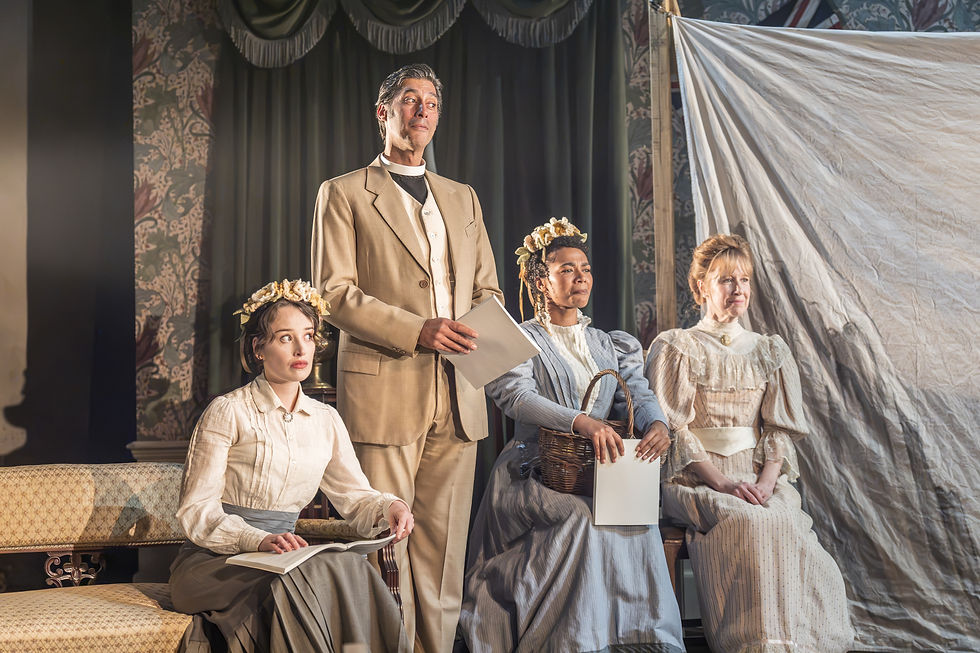
The entire cast comes into its own during the production's satirical moments, particularly in the rehearsal scene for Orpheus and Eurydice and later in the ashes-scattering scene. The latter was my favourite part of the show, and Saunders is at her absolute best. Even during a solemn occasion, Mrs Rafi cannot bear to let anyone else have the spotlight. The rivalry with Jessica, played by Lucy Briers, comes to a head when Jessica begins adding a little harmony to a hymn. Saunders’ Rafi responds with increasingly theatrical singing, shooting her companion daggers before eventually shoving a handkerchief into her mouth. Briers is a brilliant comedic partner for Saunders here, playing Jessica's attempts to contribute with just the right balance of innocence and defiance. The audience's mid-scene applause said it all. More chaos ensues with Hatch's arrival, and the cast make hilarious use of the ashes and the surrounding physical space. Robert Mountford's vicar is also a comic highlight, subtly turning conversations and speeches into opportunities for petty arguments and a plug for the church choir. The performances in these scenes are wonderfully timed, and each character's self-importance makes both scenes even more ridiculous.
These moments work so well because they contrast with the play's more serious discussions of grief, mortality, and the value of life. Lloyd Hutchinson offers a very different performance as Evens, the soul of this piece, the drunken hermit whose conversations with Willy bring tenderness to the story. Hutchinson captures the loneliness of a man who has removed himself from society following the loss of his wife, giving his philosophical reflections on death and loss a real sense of lived experience. Sean Delaney and Holly Godliman bring real warmth to Willy and Rose, capturing the vulnerability and confusion of two young people trying to find a new way forward. Godliman conveys Rose's grief without allowing the character to become defined by it, while Delaney gives Willy an earnestness that makes his journey through his feelings of loss feel extremely genuine.

Saunders shows another side to Mrs Rafi when she speaks honestly with Willy about her place in the village. She sees herself as a lighthouse, someone the others look to for direction. However, she also accepts that, over time, the village will take pleasure in seeing her lose her power as she ages. Saunders allows glimpses of loneliness to emerge from Rafi's domineering exterior. It is very revealing, and Saunders handles this slight vulnerability without losing the character's sharp edges. Her advice to Willy and Rose carries an unexpected sincerity for someone who has spent so long looking down on others, showing that she does have genuine care for others. These performances allow the more unusual characters to remain human, even when their behaviour borders on the absurd.
The creative team deserves just as much praise for the world they create around the cast. Max Pappenheim's sound design keeps the sea present throughout, with the volume of the wind and waves shifting to suit the action while reminding us that the natural world is never far away. Luke Halls' video design works beautifully alongside this, displaying moving water and skies onto the back of the stage throughout. It appears through the windows of indoor scenes and across the sail-like edges of the stage. Together with Richard Howell's lighting, they make the sea feel almost like another character, a constant presence that makes the villagers' petty disputes seem inferior. Paul Wills' set and costume design is also impressive; the period detail helps immerse us in the 1907 seaside village. I particularly appreciated the decision to have the ensemble move the set between scenes in black, funeral-like period clothing, silently rearranging the stage before pausing as the focus shifts to the characters about to begin the next scene. This simple but effective choice reinforces the play's themes of life and death. The transitional movement sequences with Elliot Goodhill’s Colin are another highlight. EJ Boyle's movement direction allows the actor to capture the relentless pull of the waves through his body. The creative contributions feel so deliberate, and the production is stronger for it.

Jonathan Munby's production of The Sea is a fantastic piece of theatre, bringing together truly impressive creative work, razor-sharp comedy, and tenderness as it tackles life's uncomfortable truths about life and death. Jennifer Saunders is a delight to watch, but the wider ensemble is also strong, making this satire and tragedy all the more special. The technical design works brilliantly, creating a world where the sea (and death) is never far away and every creative choice feels connected to the story. Most importantly, the production understands that, beneath the eccentric characters and ridiculousness, there is a serious question about how we choose to live. The heart of The Sea lies in the contrast between this absurdity of everyday life and the inevitability of death. The final scene between Evens and Willy brings these ideas together, answering the question of whether life exists beyond our world with the uncomfortable conclusion that life depends on death. Evans's line, “without tragedy no one can laugh”, highlights the strange balance in Bond's writing. Suffering is unavoidable, but it doesn't have to make life meaningless. The play ends before we see what happens next, but the performances make that uncertainty feel purposeful. Hope doesn't guarantee a happy ending, but it offers the possibility of choosing a different future. Sometimes the first step toward a better future is having the courage to leave the past behind.
The Sea plays at Theatre Royal, Bath until 7th November 2026. Tickets from: https://www.theatreroyal.org.uk/events/the-sea/
Photos by Marc Brenner