


.png)
Review: The Haunting of Hill House (Richmond Theatre and UK Tour)
Review by Ruth Sealey
⭐️⭐️⭐️
Houses and homes should be places of safety, where you sleep the most soundly in your bed. But what if that house stands on a hill and happens to be haunted? The Haunting of Hill House at Richmond Theatre plays to our innate human fears of unexplained sounds in the night, the glimpse of a figure out of the corner of our eye and ghosts who lurk in the corridors of old houses. Would this version of The Haunting of Hill House tap into those fears and leave us sleeping with the light on, or become nothing more than a bump in the night?

Shirley Jackson first published her novel in 1959, following a small group of strangers who gather at Hill House to investigate supernatural activity. At the centre of the story is Eleanor, who has recently lost her mother; Theodora, an unconventional woman searching for her own sense of belonging; Luke, who is set to inherit the house; and Dr Montague, who leads the investigation. The house itself stands alone on a hill and is a place of strange architectural angles and an unsettling atmosphere. The novel inspired two film adaptations in 1963 and 1999, followed by the 2018 Netflix series, which reimagines the story as a family saga. Having only experienced the Netflix version, I was interested to see which elements of Jackson’s story this production followed.
This version of The Haunting of Hill House is adapted for stage by Stef Smith and, when something has been adapted well already, there is a danger of comparisons being drawn. But if you are going to remake, adapt or try something new, it either needs to be totally different, as per the Netflix series, or something better. The Haunting of Hill House follows the original book and tries its best to bring that tension to the stage, with mixed success. Running at just under two hours in length, the play moves very quickly through the story. This is to its detriment, as although the characters get the opportunity to share their backstories through an overload of exposition, there is little time to allow them to fully develop or to allow the audience to understand their motivations, and their histories feel somewhat shoehorned into conversations between strangers brought together in the house. Eleanor is the most rounded character and receives the majority of stage time, yet even her storyline, particularly the relationship with her mother, feels unfinished and leaves unanswered questions. There are moments when the writing feels stronger; the presence of Mrs Dudley forming an interesting link with the house’s past and Dr Montague being determined to present his data as scientifically accurate offer some of the play’s more engaging moments.

Director Martin Constantine must have had fun bringing this production to life, as the set and effects (more on these later) create an expansive space in which he can spin and turn the house on its head. The comings and goings of characters are cleverly handled, with the moving curtain suggesting their journeys through the house and screens allowing us to see them moving through different spaces. These are effective touches, although the pacing is less successful. At times the action slows considerably, and rather than building tension, these moments cause the play to feel very slow. There are also some awkward moments, with the love triangle between Theo, Luke and Eleanor feeling odd to watch and without a purpose for the story or the characters.
Now I come to my biggest issue with this play, which comes down to a combination of writing and directorial choices. It is simply not scary enough. I had expected to be on the edge of my seat, but sadly, this was not the case. The audience was a real mix of ages, yet the production did not seem to frighten anyone in particular. Is this because the writing fails to build sufficient tension, or does the direction and pacing put a damper on this element? I am not sure I have the answer, especially as there is potential, with glimpses of what could have been. Much of the haunting is merely hinted at, which is fine, if those hints are scary or at the very least build tension. But the slightly creaky rocking horse and a repeatedly opening door just do not do it. Without spoiling the ending, the creepiest moments are saved for the very final scenes, and I only wish that this feeling had been introduced and developed much earlier.

Jasper Britton’s Dr Montague is a scene-stealer, bringing a somewhat fatherly presence to the role. I would have loved to see more of him alongside Mrs Montague, played by Jemma Churchill, who does not appear until the start of Act 2 and then is disappointingly underused. Sian Howard is fantastic as Mrs Dudley, with her deadpan delivery and an eerie presence that is maintained perfectly throughout. Sophie Lenglinger as Theo and Robin Morrissey as Luke are less well served by the writing, with underdeveloped storylines that they attempt to address with hastily delivered monologues and neither character is given enough depth to be fully realised. Clancy Ryan’s performance as Eleanor grows in strength as the play progresses, taking her from quiet and awkward to powerful and emotional. Her closing scenes are amongst the strongest of the production, offering a glimpse of the emotional impact that the play never quite achieves consistently.
The design drives the production, and Ti Green’s design of the house itself is stunning, with three internal walls and (very creaky) doors that frame the stage. There is no end of excellent props that move seamlessly in and out, allowing the walls to become multiple rooms of the house. This is supported admirably by the incredible video design by Duncan McLean that literally appears to build the house block by block and gives the depth needed to create the feeling of the vast space of Hill House. He also creates a mind-blowing spectacle of rain and lightning as Eleanor is in the ‘tower’. The lighting by Chris Davey is also high up with some of the best I have seen, working well with McLean’s video design and creating a visual treat for the audience. The sound by Johnny Edwards has some really impactful moments: the constant ticking of a clock, the sound of rain and a repetitive sound that reminded me of a lock sliding into place, creating an oppressive feeling of being trapped inside Hill House.
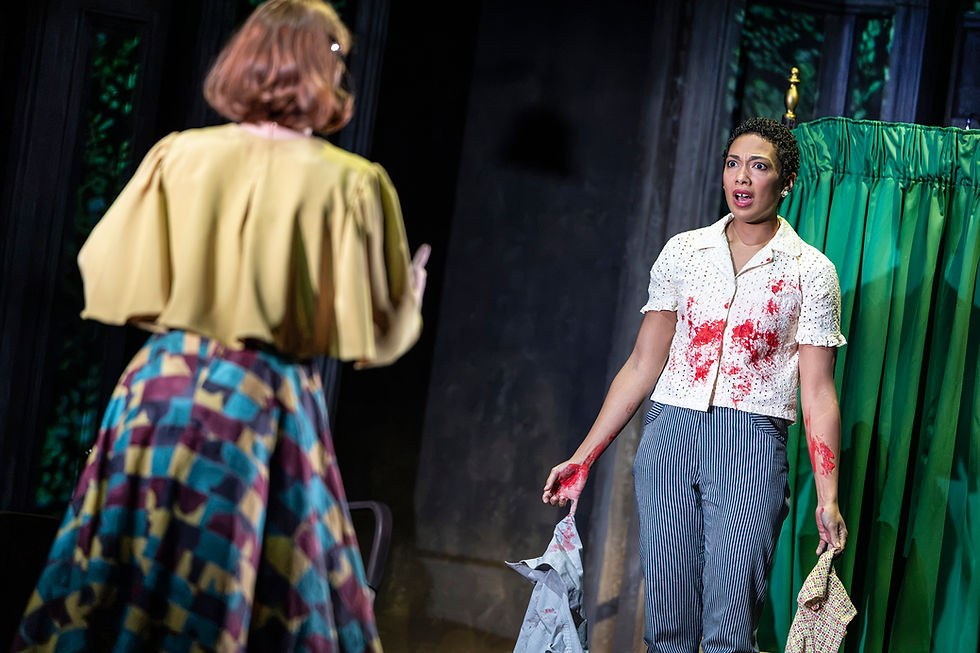
I feel that I have repeated ‘howevers’ with this production, and here comes another. However, even among the astonishing visuals here, there is an over-reliance on them to build the tension and fill the gaps that the writing leaves. The danger is that when the audience is repeatedly exposed to the same incredible design elements, they become less incredible. This is shown especially by the extremely loud sound design (the louder, the scarier, apparently) to create the tension, which, rather than having the desired effect, is brilliant and then a little boring. The set is excellent, but a creaking door is not scary when it has creaked open multiple times or the rocking horse starts rocking again. The production is let down a little when the magic of theatre is lost, and the reliance on technology comes to the forefront. An obvious wire pulling something across the stage and a curtain across a door looking like someone is pulling it on a piece of string just isn’t quite good enough.
The Haunting of Hill House is firmly based on the original book, so if you are a fan of the Netflix series, you will experience something different from what you might expect. This is not a negative though, and it has good design elements and strong performances that remain truthful to the source material, but sadly also some uneven writing. Overall, this production made me feel a tiny bit frightened, with the odd flinch rather than a proper jump. It is visually impressive but ultimately lacks the tension needed to make it truly unsettling. I may have glanced over my shoulder once or twice on the way home, but I suspect I will be sleeping soundly in my own house, even if I do hear the odd bump in the night.
The Haunting of Hill House plays at Richmond Theatre until 10th October and then tours the UK, stopping at the following locations:
Theatr Clwyd 13th – 17th October
Brighton Theatre Royal 20th – 24th October
Manchester Palace 27th October – 31st October
Liverpool Playhouse 3rd November – 7th November
Edinburgh Lyceum 10th November – 14th November
The Arts Theatre Cambridge 17th November – 21st November
Tickets from https://thehauntingofhillhouse.co.uk/
Photos by Pamela Raith.