


Review: The Happy Minds Clinic (Greenwich Theatre)

Review by Molly Gulvin
⭐️⭐️
The lives of the elite are a keen topic for gossip: from their lifestyle to their spending, the public is desperate for even a glimpse into the lives of the rich and famous. The Happy Minds Clinic aims to fulfil this wish by inviting audiences into a health clinic for the rich and famous, run with money as its morals. In a drama turned psychological comedy, The Happy Minds Clinic tries to unveil the toxicity and delusion of the powerful workplace, but despite its more positive moments the production tends to be unsuccessful in driving that message home.
The Happy Minds Clinic comprises a series of scenes, each surrounding the staff and clients of ‘The Happy Minds Clinic’, a mental health facility with top-tier care, for those willing to pay the price. As the story develops, we see how this world functions, and how client retention and financial incentives have far more value to the clinic’s leaders than the true wellbeing of their clients, who include stars such as Jude Lawn (bearing no resemblance to any well-known actor), his wife Rachel and social climber Lacey who will stop at nothing to get what she wants. The characters reveal darker sides as the play continues, and the world evolves to highlight the more hidden side of celebrity and riches. Conceptually, this is a thrilling piece: its subject matter is appealing and the story’s bare bones show that there is something of worth to be found within the production.

On a surface level, Flynn’s writing is perfectly suitable for the work: the story is clear and dialogue helps to characterise the personas. However, the play starts to wilt when its themes are examined more deeply. Going into this production, I was excited by the way that it had been advertised, particularly in the use of misandry to subvert typical misogynistic workplaces, but left somewhat disappointed in this particular aspect. Whilst the clinic itself certainly does place its male clinician in a diminutive position, and the conversations surrounding this are effectively handled, the wider story still holds itself to inherent misogynistic standards (intentional or not). This can particularly be seen in the ‘crazed fan’ stereotype that Lacey seems to step into in regards to her love for Jude. With that being said, Fareed’s history of sexual assault being placed within the misandrist context does effectively subvert audience expectations, although the discussion itself is handled with a lack of expected nuance. Whilst drama will, of course, be dramatic, the extremes that this play’s narrative seems to go to leave the audience struggling to stay immersed within the work, particularly when compared to the fairly typical first few scenes.
Flynn’s direction is, similarly, perfectly fine. Given the limited rehearsal time (which will be mentioned again later), the overall cast and creative alignment is impressive, but requires further polishing. This can be seen sometimes in scenes with a smaller group of performers, making the differences in interpretations of the text more clear. Flynn’s own vision becomes obscured because of this: at times, it is hard to identify the tone of the work, and the stance that the play is taking seems to shift rapidly between scenes.
The cast work hard to tie this performance together, and do so with varying levels of success. However, the largest problem found - perhaps due to the limited rehearsal time - is the lack of dimension that the characters have. Jude, played by Josh Batsford, barely seems to react to the death of his own wife, remaining stoic throughout in a choice that may be intentional, but still fails to resonate with the audience. Some characters appear to be more developed though; Emma Louise Price makes for a great Lacey, with the ability to swap between a downcast failed actor and obsessed fan rapidly. Special praise must be given to both Charlotte Victoria and Paige Hann, too: both actors joined the show only a few rehearsals before opening, and deliver convincing performances as Sammy and Rachel respectively. Hann is a standout performer in this show: every word on stage is full of conviction and Rachel has clearly been given emotional depth.
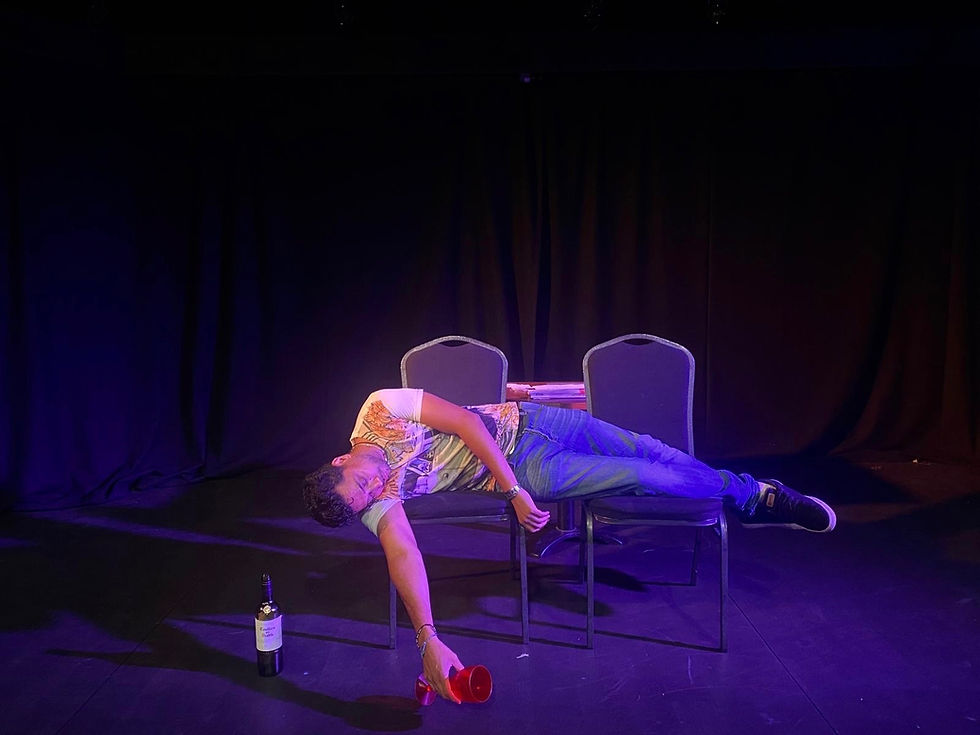
In the small black box space of the Greenwich Theatre, Jathursa Uthayakumar’s creative design is mostly clean and suitable. The set consists of a table and two chairs, which are perfectly functional in their use and suit every scene. Both the lighting and sound design, however, struggle more, whether this be due to design or execution. The lighting was often delayed in changing, meaning that actors would stand for moments in the dark before being lit up or that beats that were aiming to be emphasised were missed entirely. This was particularly noticeable towards the very end of the work, where the lights flash red to signify a murder taking place: this beat was missed by a few seconds, meaning that the eventual lighting change was more confusing than dramatic. The sound design is good on the whole, aside from a few choices that do not seem to match their purpose. For example, in a scene where the brakes of a car are cut, the choice of sound is a vehicle starting, making the action onstage far more confusing than if the sound had not been there at all.
The Happy Minds Clinic is conceptually bold, and there are moments that shine within it, but unfortunately the overall piece requires some more time before further presentation. The piece tries to establish itself as provocative and daring, but often falls flat when trying to do so. The rehearsal process was not without bumps, but this cannot excuse many of the problems that we see within this show. There are elements of a great performance to be found, though: perhaps with some time and care dedicated to all aspects of this work, something that further fulfils the potential of its subject matter can be produced.
The Happy Minds Clinic played at Greenwich Theatre until 18th September.