


Review: The Cherry Orchard (Harold Pinter Theatre)

Review by Daz Gale
⭐️⭐️⭐️
There is always an air of excitement when one of Anton Chekhov’s timeless plays is being revived in the West End, particularly when it is a fresh adaptation promising to bring something new and hopefully complementary to the original text. That is the case with Conor McPherson’s new take on Chekhov’s seminal classic, The Cherry Orchard - the second major staging of this play in recent months following a production at the RSC, and following relatively quickly from the acclaimed 2024 staging at Donmar Warehouse. With so many high-profile productions around, could McPherson’s cherry prove more sweet or sour?
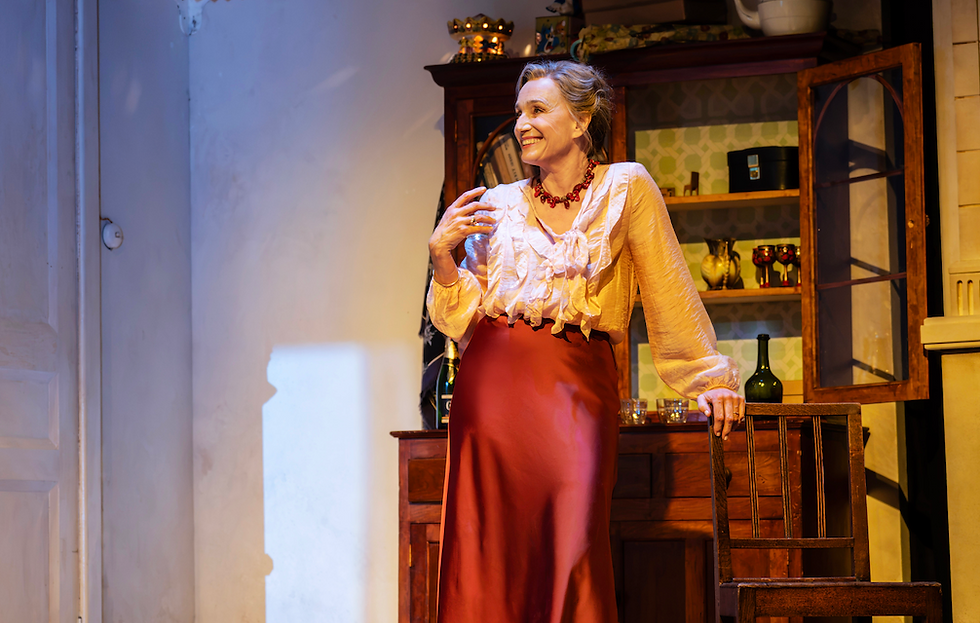
Premiering in 1904 and revived countless times in the many decades since, The Cherry Orchard sees Lyubov Ranevskaya return to her childhood estate after years in Paris - while the rundown family home has undoubtedly seen better days, she is surprised to discover it is under threat along with the beloved cherry orchard outside the home. The story thrusts audiences into a world where old loyalties are tested amid the ambitious nature of individuals. With relationships formed, tested and broken, will there be any future for Lyubov at her beloved home, or is it time for all involved to move on?
The genius of Anton Chekhov’s writing hardly needs to be stated. Though time moves on and certain attitudes change, there is a continual relatability in his writing that speaks to the most essential of human aspects. In The Cherry Orchard, loyalty, longing, the pull of memory and the struggle to let go all form branches under the overarching theme of love. This was Chekhov’s final work so carries with it a touch more poignancy than his others, while its tragicomic style offers light relief and humour amongst the darker themes that emerge.
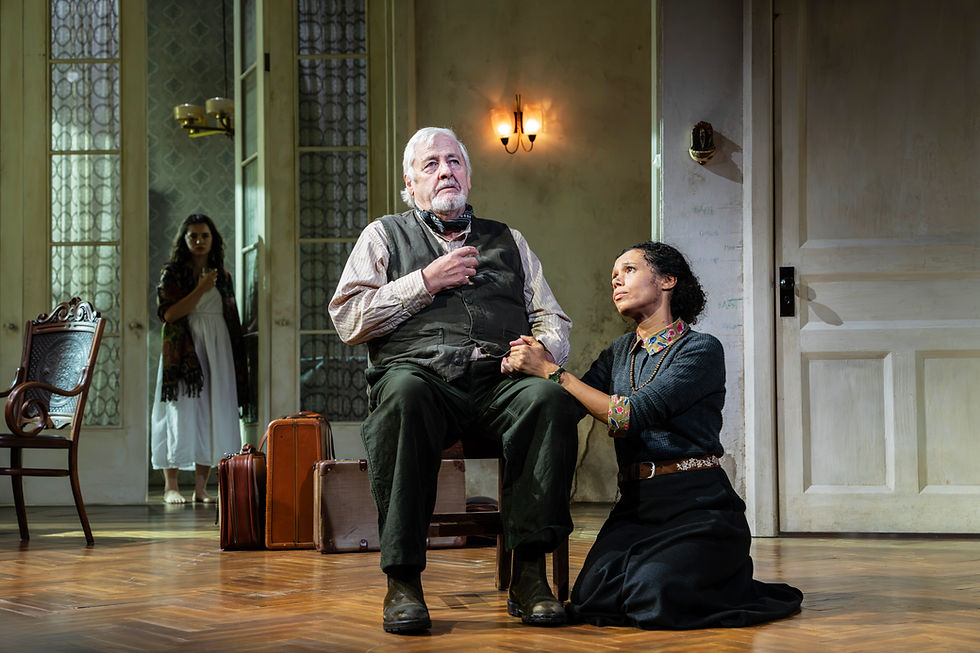
What is interesting is how Conor McPherson adapts this work and puts his own stamp on it. A talented writer in his own right with a proven track record, this is where this production of The Cherry Orchard gets a bit muddy. McPherson struggles to find the right tone of the story, struggling to find the balance between the more comedic moments and the darker ones. This acts as a disservice to the material so that the stakes never feel as high as they should, and the ultimate twists and turns in the story feel smaller than they ought to.
An over-reliance on expletives peppered in the material dilutes the core of the writing, risking feeling more of a gimmick than anything else and detracting from the intelligence of the original story. There are staples in McPherson’s plays here that feel distinctly him, but they work less successfully here than they have done in his other shows with the sense that this is more a McPherson show than a Chekhov one, when the two should marry up together to create a cohesive production. The uneven nature of this adaptation makes for a confusing watch at times, with the many characters feeling more one-dimensional than they have before - if you are unfamiliar with the original story, you may struggle to identify who is in love with him, who is betraying whom, and the very nature of each person's relationship to the other.
And then there’s Chekhov’s gun. You don’t need to have seen any Chekhov play to have heard about this storytelling principle that essentially says if you draw attention to something in a story, it should serve a purpose, using a gun as the best example. So when a character pulls out a gun early on in this production, our expectations are suitably set… only for it to never be seen again. Given that a gun has had no prominence in The Cherry Orchard before, this feels very much an attempt by McPherson to subvert expectations, but I would argue by doing that in a Chekhov play, it goes against his very principles. It is this underlying battle for a clear voice between Chekhov’s original and McPherson’s adaptation that creates the biggest problem with this production and why it struggles to be as thrilling as it should be.
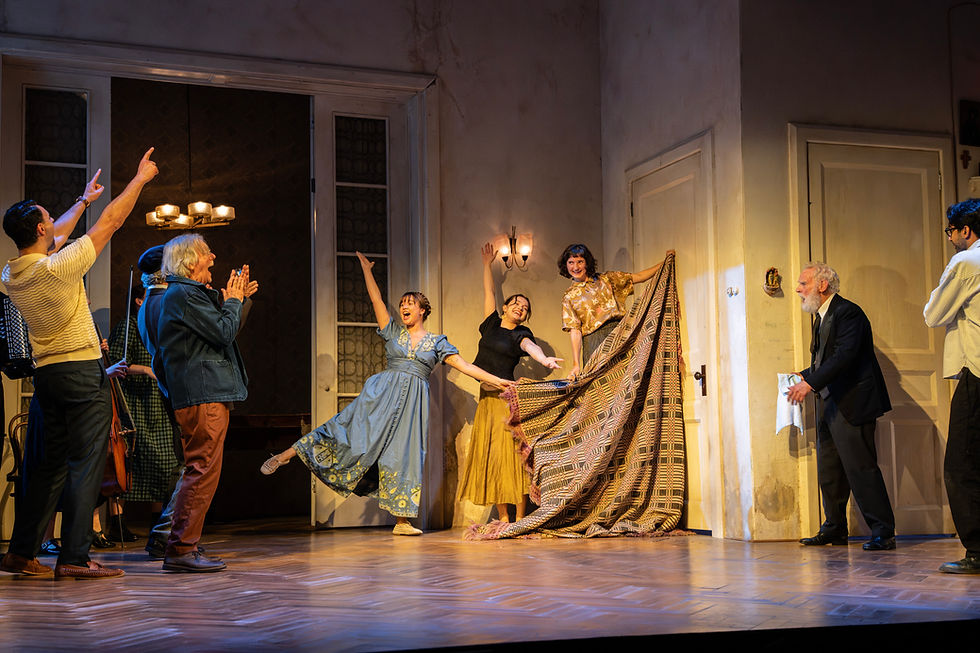
That is not to say that this is a bad production, not by a long shot (and that pun is how Chekhov’s gun can serve a purpose), but its voice and identity get lost far too frequently. Ian Rickson manages to paper over these cracks through his direction, offering fun and flair through his style, leading to a watch that prevents the weaknesses in the adaptation from ever feeling too dull. The comedic moments land through his direction, with several great physical moments to be had.
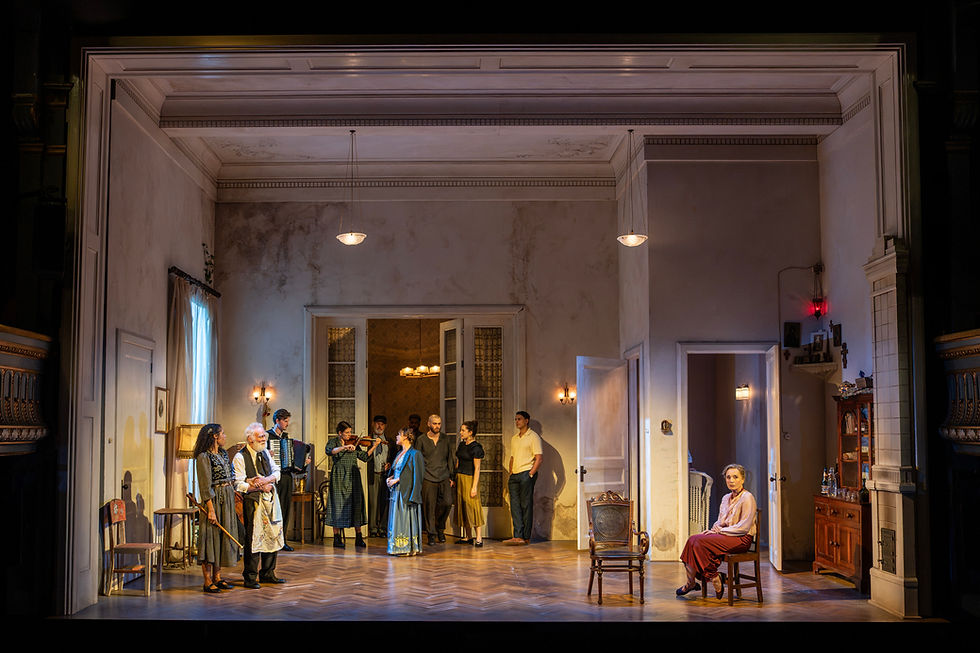
Chloe Lamford’s set design is a thing of beauty, resorting to meticulous detail in replicating the rundown estate. The neglect of the underused property is clear to see, while its original magnificence still shines through creating a fantastic juxtaposition that works much better than the other conflicting styles seen in this production. Bruno Poet’s lighting design is especially effective, with a singular door leading to the outside effortlessly transforming the stage from night to day, creating a gorgeous glow on the set.
The big draw in this production is Kristin Scott Thomas as Ranevskaya. A remarkable actor in her own right, the opportunity to watch her on stage elevates some of the more questionable aspects of the material. Unfortunately, she doesn’t escape these choices with her character struggling under the strain of a wandering tone and never quite asserting her dominance in the show. She still gives a compelling and spellbinding performance at its best, but there are times where she finds herself eclipsed by others on stage and doesn’t quite manage to pull the focus back as you would have hoped. It seemed to me as if there was some sort of disagreement in how to portray her character, with certain moments resembling Jennifer Saunders in Absolutely Fabulous - something that may work for the comedic moments in the story, but minimises the impact of the less funny moments.
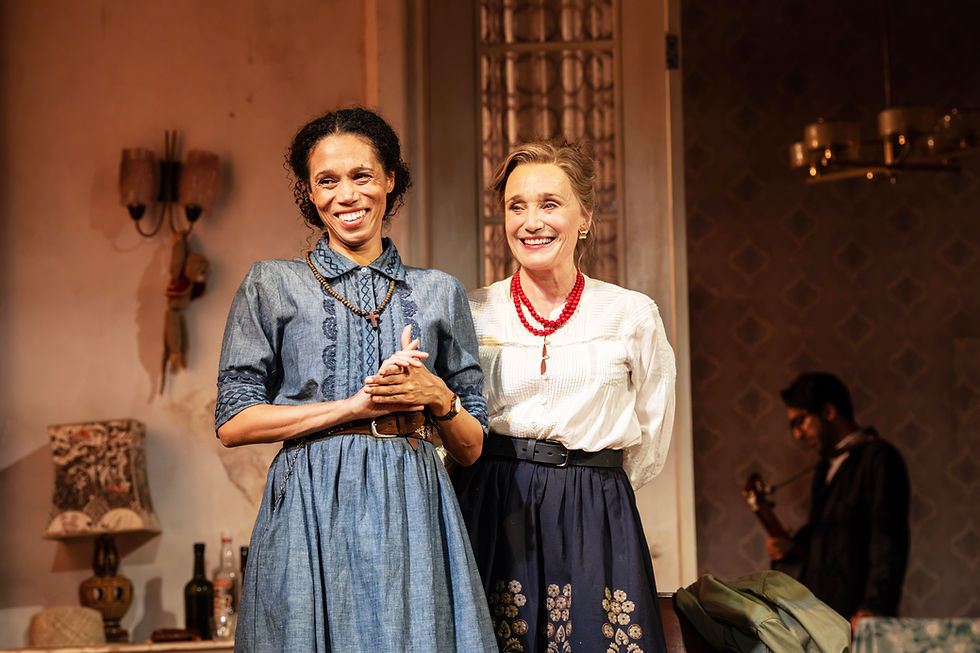
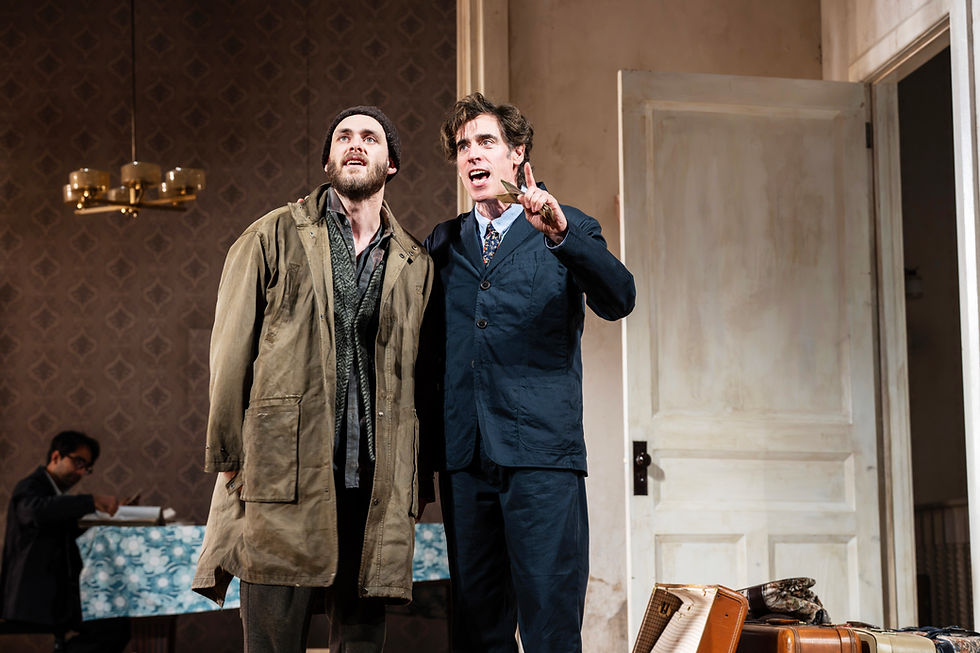
Stephen Mangan delivers a solid turn as Lopakhin, starting things off strong with a clear demonstration of what a sensational comic actor he is. The problem is he just doesn’t have much to do after that, and his prolonged absence becomes increasingly noticeable, making his presence very much missed. When he has something to do, Mangan is an utter joy - it is just a shame he isn’t used more.
The large ensemble cast is all collectively strong though many suffer from the underdeveloped nature of their roles in this production. Shubham Saraf suffers more than most as Yepikhodov in a baffling, caricature-like portrayal, while Jeff Rawle is a comic highlight as Pishchik. However, the standout performance belongs to Karl Johnson for his sweet, funny and sympathetic Firs. Though the declining health of the character is far from funny, Johnson strikes the right balance between sweet innocence and the tragedy of the situation, in the strongest example of McPherson getting it right in a production where that doesn’t happen too often. The result is a scene-stealing performance from Johnson that makes his final appearance all the more impactful and bittersweet.
Theatre is subjective, and I am sure this production of The Cherry Orchard is going to split opinion with the rapturous response present on press night suggesting there will be many more who loved what McPherson did with this production. There will be those who love Conor McPherson’s style, and those who don’t. I fall somewhere in the middle, having loved some of his previous work and been far less enamoured with others. The middle is also where I sit with this production - I can see what McPherson was going for and appreciate the courage in his convictions to realise it, but something has been lost in translation here. The result is a confused and incohesive production that feels at odds with the intent of Chekhov’s original. While the bones of the original story and some stronger moments stop this from being an unmitigated disaster, I am led to go back to Chekhov’s principle of everything in a show having a purpose. I find myself asking what the purpose of multiple elements in this iteration of The Cherry Orchard was in a production full of sharp-shooting ideas that more often than not ended up firing blanks.
The Cherry Orchard plays at the Harold Pinter Theatre until 9th January 2027. Tickets from https://allthatdazzles.londontheatredirect.com/play/the-cherry-orchard-tickets
Photos by Johan Persson