


Review: Second Class Queer (Riverside Studios)
- All That Dazzles

- May 21
- 4 min read
Review by Sam Woodward
⭐️⭐️⭐️
Speed dating is not for the faint-hearted. You sit, smile, make small talk, silently panic about what to say next, and hope that somewhere between the awkward pauses and over-rehearsed introductions, a spark might appear. For Krishna in Second Class Queer, however, the search for connection carries far more than first-date nerves. Written, performed and produced by Kumar Muniandy, this one-man show begins with the familiar discomfort of dating, then slowly lets something far more personal, political and painful rise to the surface.

Before the dating begins, however, Second Class Queer makes clear that this will not simply be a series of comic, romantic mishaps. Projected across the screen are news articles, images and written fragments relating to queer persecution, including state violence, police abuse and conversion therapy around the world, with a particular focus on Muniandy’s birthplace, Malaysia. It is a stark opening, and an effective one, placing Krishna’s personal story within a much wider and more painful context. Krishna’s search for love is set against a wider world where intimacy, honesty and safety have so often been denied to queer people.
When the speed dating in Berlin begins, what initially appears to be a neat comic device quickly becomes something more revealing. Each date lasts only a few minutes, but Muniandy uses those brief encounters to expose the assumptions, prejudices and quiet cruelties that can sit beneath even the most casual conversation. Some men arrive with confidence, others with charm, others with the sort of liberal politeness that begins to crack the moment Krishna pushes back. The result is less a conventional dating story than a series of emotional collisions, as attraction, race, faith, grief and belonging all begin to crowd the table.
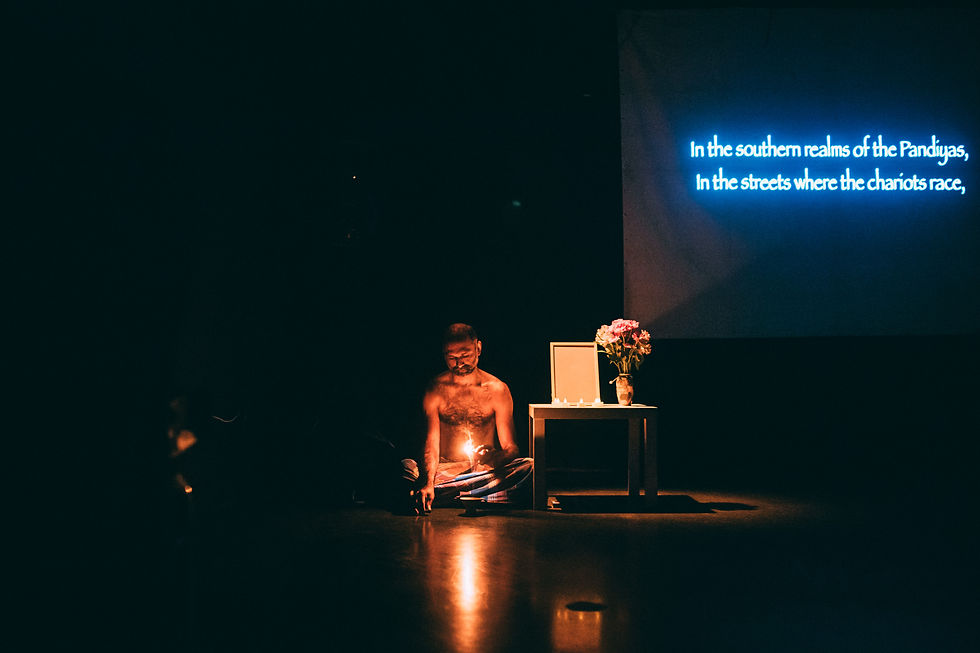
Muniandy’s performance is one of the production’s greatest strengths. One-person shows can be difficult to pull off, particularly in a space this intimate, but he has an easy command of the room and keeps the audience with him throughout. This is most impressive in the speed-dating scenes, where Krishna’s dates are heard through pre-recorded voice-overs. It is the sort of device that could easily become stiff or gimmicky, but Muniandy’s timing is impeccable. He listens before answering, reacts in the tiny pauses between lines, and allows each exchange to feel like a real conversation rather than a technical exercise. Even with no other actor physically beside him, he manages to suggest the rhythm, awkwardness and occasional spark of a room full of people trying, and often failing, to connect.
Beyond Muniandy’s technical skill, he brings real emotional weight to Krishna’s story. His pain feels lived in and genuine, particularly in the moments that circle around his mother’s death and the guilt of what was left unsaid between them. There is also a palpable anger running through the piece: at racism, at homophobia, at the casual cruelties of dating, and at a world that so often asks queer people of colour to explain themselves before they are allowed to simply exist. Crucially, some of that anger is turned inward too, giving Krishna’s journey a more complicated emotional texture. Rather than becoming one-note, the performance keeps shifting: Muniandy finds humour in the awkwardness, tenderness in the silences, and a genuine longing in Krishna’s desire to be seen, wanted and understood.

On a small stage, the production keeps things visually simple but purposeful. There is little in the way of set, with the space largely defined by a chair, the screen and a shrine to Krishna’s mother, where an empty photo frame becomes quietly affecting. Rather than feeling static, Muniandy makes good use of the room, moving between the exposed awkwardness of the speed-dating set-up, the intimacy of the shrine and the wider political landscape created through Haesoo Jung’s sound and video design. Christian Maith’s lighting also does a lot of subtle work, helping to shift the atmosphere between memory, confrontation and confession without overcomplicating the piece. Ilaiyaraaja’s music adds another layer of feeling, grounding the production in a cultural and emotional world that extends beyond the bare stage.
Where Second Class Queer becomes less assured is in how much it tries to carry. At only an hour long, the show moves through racism, homophobia, religion, colonial history, family grief, body image, dating politics, fetishisation and the ongoing violence faced by queer communities around the world. None of these subjects feels unimportant, and Muniandy approaches them with obvious sincerity. The difficulty is that almost every encounter becomes intensely loaded, leaving the play with very little room to breathe. After a while, the speed-dating structure begins to lose its spontaneity, as each new arrival seems to bring another painful subject to Krishna’s chair.

This also slightly strains the realism of the speed-dating premise. Awkward first dates can reveal a lot, and anyone who has ever been trapped in polite conversation with a stranger knows how quickly things can take a turn. Even so, the depth and frequency of the revelations here sometimes feel too neatly arranged, as though each man has arrived with a different issue for Krishna to confront. The result is never dull, but it can be heavy going. There is so much pain, anger and introspection packed into the hour that the more affecting moments are occasionally denied the space they need to fully land.
If Second Class Queer sometimes brings too much baggage to the date, Muniandy himself remains very easy company. Even when the writing piles too much onto Krishna’s little speed-dating chair, there is something compelling about watching him try to flirt, defend himself, mourn, rage and hope, often all within the same breath. The show may need to trust silence as much as speech, and focus as much as feeling, but its heart is never in question. It may not be a perfect match, but it is a thoughtful and affecting encounter.
Second Class Queer plays at Riverside Studios until 30th May. Tickets from https://riversidestudios.co.uk/whats-on/SK-second-class-queer/