


Review: Orphans (Jermyn Street Theatre)
- All That Dazzles

- Jan 8
- 4 min read
Review by Daz Gale
⭐️⭐️⭐️⭐️
While Piccadilly Circus is home to some of the West End's most notable theatres and iconic shows, the small but mighty Jermyn Street Theatre has proven time and time again it can go toe to toe with all the big players with their diverse and consistently strong programming. Their intimate 70-seat theatre demonstrated this when their production of Farm Hall hopped down the road to the far larger Theatre Royal Haymarket. Kicking off what they hope will be a year as impressive as their recent offerings is a revival of Lyle Kessler's Orphans, but could this play stand on its own two feet, or would it still need some careful encouragement to reach its full potential?

Set in 1983, when the play first premiered, Orphans takes place in the home of brothers Phillip and Treat. Phillip hasn’t left the house in years, theorising about the dangers that lurk beyond the front door, not helped by his over-protective and controlling brother, who warns him of the world outside. When Treat brings home a stranger stuffed with cash, he plans to steal what he can from him, though what happens instead changes the trajectory of all three of their lives.
Lyle Kessler’s writing fills Orphans with three intense and exaggerated characters who don’t seem to behave in the same way the majority of human beings do. It can take a while to grow accustomed to the tone here, leaving me wondering if this was some dystopian world where the brothers have to do what they can to survive - in some ways, it bears a striking resemblance to Phillip Ridley’s The Pitchfork Disney, though this play predates that. Eventually, you come to realise the world is still ticking along as normal outside, and what we are witnessing instead are three people with very real problems, whose choices and the hand life has dealt them have left them in the place we find them now.
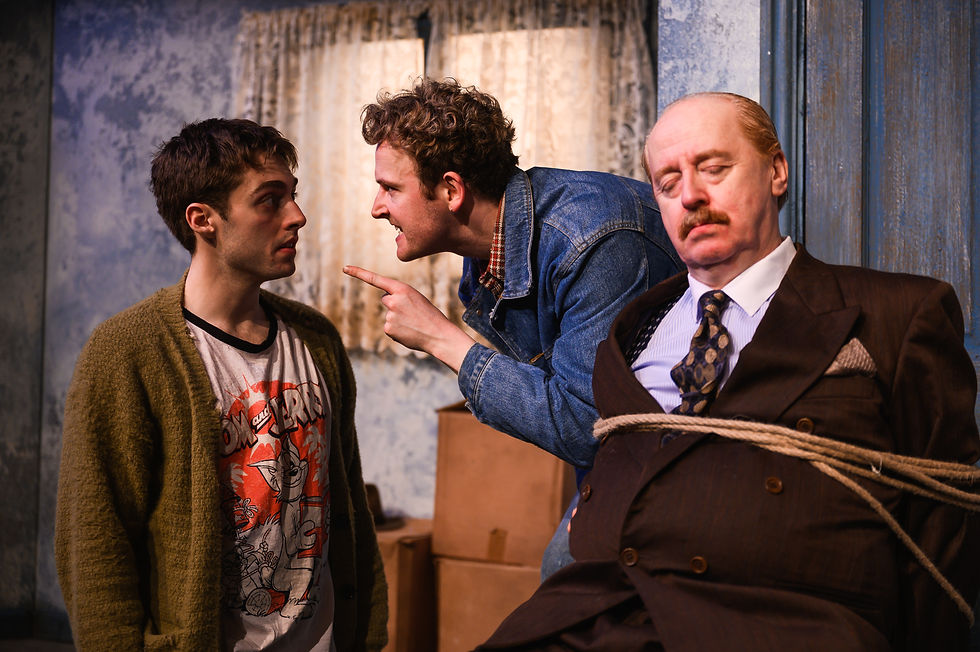
What is fascinating about Kessler’s writing is the way the characters all gradually change throughout the course of Orphans. In some similarly themed plays, these changes can feel quite sudden and extreme, but here they unravel gradually, changing the power dynamics multiple times, so that by the time the play concludes, each of them is in a different position from where we first saw them. In many respects, it is an intimate story to reflect a big world, as we never see what lurks beyond the front door, but we do see the way the characters change each time they return from outside. Orphans is a product of its time, and in some ways, it hasn’t aged well. There is one particularly uncomfortable scene where outdated, racist language is used in a scene that would have been every bit as impactful without one or two words remaining.
Al Miller’s direction utilises the intimacy of the stage at Jermyn Street Theatre to his advantage, immersing the audience into the claustrophobic space Phillip hasn’t left in years. Miller’s choices match the intensity of the story and play up to the unconventional dynamic between the three of them, really amping up the weird factor. Heated moments in each act threaten to get lost among the noise, but Miller somehow manages to reign it all in to make it flow cohesively. My only negative comment regarding the direction is that more thought could have been given to sightlines, as, despite the intimate nature of the venue, several moments where characters are on the floor are not visible to anyone beyond the front row. Sarah Beaton’s set design does a great job in creating Phillip and Treat's home, with a particularly great touch in the crucial window used outside, and how much we see when people walk past, elevated through strong lighting from Simeon Miller.

If there is one reason to see this production of Orphans, it is for the stellar performances from the incredible cast of three. Forbes Masson is electric as the enigmatic Harold in an eccentric and exaggerated performance that has more than a touch of The Wizard from Wicked to it at times (a strange comparison, maybe, but in a play that has weirdness in its DNA, it feels appropriate). Harold has a knack of controlling every scene he is in, pulling the strings even when he is tied up himself, and Masson relishes the opportunity to do this in a striking performance.
Chris Walley showcases his versatility as Treat, offering the hard man we initially see, before cracks begin to show and other aspects of his character come into the light. Walley is effortlessly commanding in the role, bringing great chemistry with both of his co-stars. The cast is completed by Fred Woodley Evans as the naive and coddled Phillip, who experiences the biggest change through the course of the play. The sweet and innocent way Evans plays the role taps into the nature of Phillip’s own naivety, and the subtle way the character grows is played fantastically well. All three characters go on a journey over the course of these two hours, and all three actors more than rise to the occasion, delivering a consistently strong performance.

43 years later, Orphans still has the ability to thrill and shock audiences with its twists and turns. Its insight into one particular home is a simple yet effective tool, reminding us that different worlds can lurk beyond every front door, whether you are trapped inside or merely walking past. Comparisons to The Pitchfork Disney are inevitable, especially given a production was seen in London last year, though Orphans does more than enough to set itself apart from its counterparts. Though it’s far from perfect and a couple of moments could have been tweaked for a greater impact, it is still a captivating play and a great reminder of the brilliant world that lurks behind a relatively hidden door on Jermyn Street.
Orphans plays at Jermyn Street Theatre until 21st January. Tickets from https://www.jermynstreettheatre.co.uk/show/orphans/
Photos by Charlie Flint