


Review: NETTLE SOUP VOL I: DEVON (Hope Theatre)
- Lily - Admin

- Mar 12
- 6 min read
Review by Lily Melhuish
⭐️⭐️⭐️⭐️
Founded in 2022, Nettle Soup’s mission is to explore the duality of folk tradition and queer culture. Their new project, NETTLE SOUP VOL I: DEVON, arrives at The Hope Theatre with a delightfully entertaining evening full of enough witchcraft and wit to do just that. Two short plays, both two-handers, form a complementary couple: they mirror and contrast one another in ways that stimulate the frontal lobe. You’re encouraged to think, to feel, to laugh, and to learn.
Temperance, written by Izzie Harding-Perrott, takes a stab at modernising the past to interrogate the present, and gives it a punchy, and often very funny spin. The set displays a smattering of grass and hay coating the ground, and scattered wooden planks that flare out in formation from a central point, marked with a bench. We’re in Exeter Gaol, 1682, where Temperance Lloyd (Izzie Harding-Perrott) and Susannah Edwards (Nance Turner) are imprisoned during the two weeks leading up to their trial: two of the women historically known as the ‘Bideford Three’, the last to be hanged for witchcraft in England. This is a tragicomedy with teeth, a story about state violence and scapegoating, but at its core sits a compelling, intimate portrayal of what people do to survive in the narrowing corridor before the inevitable.

Temperance arrives like a spark in a dry room: young, brash, and visibly allergic to authority. Her physicality is spot-on, all restless energy and defensive swagger, the posture of a teenager who’s been confined to her bedroom rather than a woman waiting for the noose. That deliberate anachronistic edge peaks immediately with a defiant scream to an offstage guard: “Suck your mum!”. It’s as funny as it is shocking, an unmistakably modern insult in an unmistakably historical setting, and it sets the tone for the following hour.
Opposite her, Turner’s Susannah is prim, pious and proper. Quick to scold Temperance for her language, manners, and appearance, she initially seems rigid, but this strictness soon reads as armour rather than superiority. What’s so satisfying is how the play lets these two women bicker and bite like sworn enemies (think ‘who would be the worst person to get stuck in an elevator with?’) before gradually allowing proximity to do what it does best: soften the corners. Harding-Perrott’s script understands that intimacy isn’t always gentle; sometimes it forms through irritation, shared boredom, and the reluctant comfort of having someone, anyone to talk to.

Howells’ direction keeps the pace tight, punctuating scenes with cold lighting snaps and the blunt sound of a gate slam or gavel bang. Temperance chalks tally marks on the wall as the days tick by, and the blocking makes clever use of The Hope’s modest space: the pair circle, square up, retreat, and return, their positioning shifting as their relationship slowly opens up.
Two scenes stand out for their warmth, cutting through the sinister setting and making the darker context land harder. One is a roleplay as Commons speakers, where both women don posh accents and raised chins, gleefully shouting “Order, order!” as they prance around the room. It’s a burst of silliness that also reads as resistance, a playful refusal to be reduced to ‘case’ or ‘crime’. In a similar vein, a later dance sequence, sparked by music drifting in through the prison bars, offers a brief moment where they forget the trial, and the world’s appetite for punishment. “I could be Mary,” Temperance jokes, referencing the third and unseen member of the Bideford Three. It's playful but lands sombre, a misunderstanding of the significance of Susannah’s relationship with Mary, and it keeps the moment tender without tipping into sentimentality.
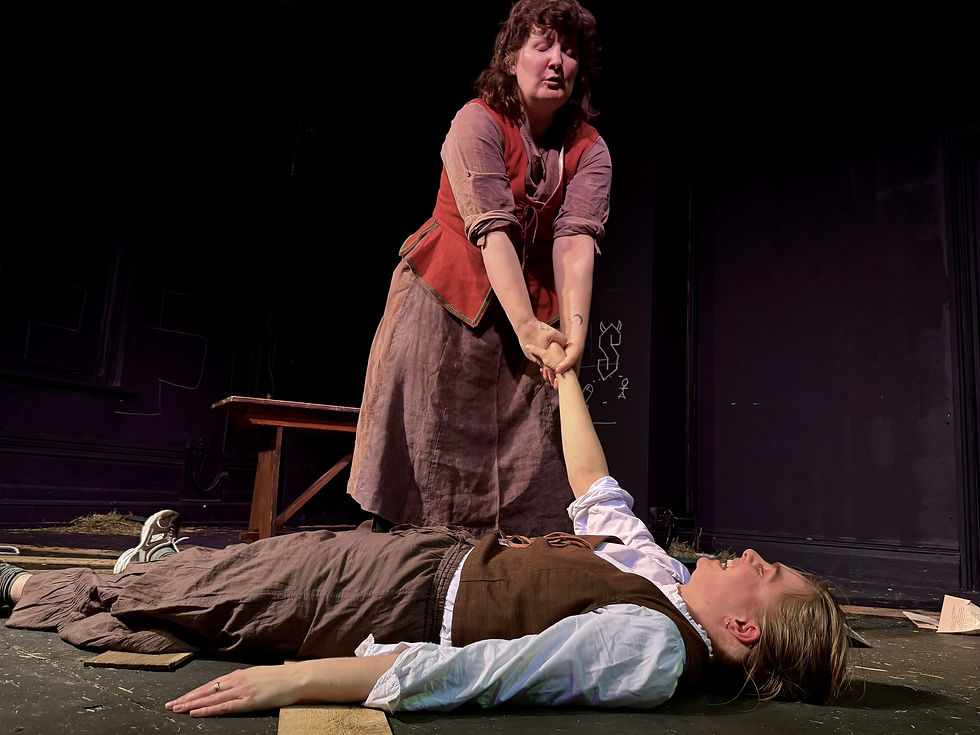
If there’s a drawback, it’s that Temperance occasionally leans too heavily into a recognisable Gen Z performative rant, pulling her out of the moment. The modern language is purposeful, and often effective, but when Temperance’s wokeness isn’t rooted in humour, it can edge into omniscience. When the anachronism extends into costume and props, such as New Balance trainers or headphones, the dissonance can feel forced. Harding-Perrott’s writing already carries this concept with ease; the visual push isn’t always needed.
There’s also a minor inconsistency around Temperance’s literacy: she begins the play scrawling words across the walls in chalk, yet later we’re told she can’t read or write. It doesn’t derail anything crucial, but tightening details like this would make an already strong piece feel cleaner and more assured.
If Temperance is about confinement and inequality, Leylines is about escape and reinvention. For the second half of the double bill we’re in West Alvington, 2025: a public bridleway beside a family home boasting a “For Sale” sign. A soundscape of birds and gentle breeze washes over the audience as we settle in for another hour of deliciously character-driven comedy with a folklore twist. Leigh (Teddy Robinson), aged seventeen and resident of Site Number 13124, lounges on the floor, photographing their surroundings, unaware of the wild presence trudging up the hill, and the other one rumbling from below.

Teri (Louise Gold) arrives like a gust of unfiltered enthusiasm: recently divorced from a man, newly out, armed with dowsing rods (traditional tools used to detect spiritual energy) and a book on English magic. The small talk is hilariously, deeply rural (“What’s your favourite biscuit?”) and it’s a testament to Sinclair’s writing that it never feels like filler. It’s exactly how two strangers tentatively test the water before wading in deeper.
Gold is mesmerising as Teri, a middle-aged woman with childlike wonder, as if leaving her lavender marriage has made her born again. She’s comic without being a caricature: the sort of person who falls down a YouTube rabbit hole and emerges hours later with a new worldview. Gold knows exactly when to go big and when to pull back; her face shifts rapidly between breathless discovery and raw vulnerability. You sense how much her life revolved around her ex-husband - the recurring “that’s what Oliver says,” refrain - and how desperately she wants to place her fate into some external narrative again, whether a man, a myth, or a mystical map.

Robinson offers the perfect counterweight as Leigh: dry, sardonic and grounded. Their performance gives us a teenager who feels older than their years, someone who’s had to become the adult in the room too soon while caring for an elderly grandmother. Together, Gold and Robinson form a dynamic that’s compelling even in the absence of action: the manic sparkle of new discovery bouncing off the wary realism of someone who’s learned not to trust outsiders.
Underneath the comedy, Leylines tackles gentrification and the hollowing-out of rural communities: second homes, tourism, the subtle violence of being treated as “quaint” rather than lived-in. Leigh’s wariness of Teri as a Londoner is pointed, not blanket resentment, but the frustration of watching your home become a product. When Teri realises they’re standing on a ley line, she becomes impassioned, almost possessed by her self-discovery, mapping out a literal timeline with a piece of string. It’s so simple, yet so entertaining. Convinced it’s fate, she insists on buying Leigh’s house. Leigh is understandably alarmed: the offer is generous, but trust is not part of the bargain.

And then, because this is folk theatre, the ground quite literally opens. A low thrum beneath the scene, flickering lights, fizzing electrical energy, and the play plunges into the earth’s belly, where a mythic archangel (Robinson again, now winged and glorious) tests Teri’s right to buy the house while tucking into a can of cold custard. It’s absurd and prophetic, and what could feel like a hard left turn instead becomes the play’s core argument: a house is more than a building. It’s history. It’s sacred ground. And if you want it, money isn’t enough; your soul has to be worthy.
There are hints of something truly fantastical here, in the archangel’s fabric-patch wings, and hanging fairy lights. On a larger stage, you can imagine the show pushing even further into that world with levels, puppetry, or more ambitious technical design. The ingenuity is already there, and the script shows real theatrical potential.

As a double bill, VOL I: DEVON works because the plays speak to each other without needing to match. Both are essentially about two people stuck together, forced into connection. Both explore belief - in God, in magic, in myth, in oneself - and how faith can be a lifeline or a trap. Both ask what happens when you’re labelled: witch, outsider, tourist, straight. If you’re called something enough, you might start to believe it.
And crucially, both plays share a gift for dialogue that feels lived-in rather than polished. There’s a lot of it, but it rarely wastes a beat. Whether the topic is seventeenth-century superstition or modern mysticism, the language stays grounded. The result is an evening that feels intimate and immediate, even when it’s getting delightfully strange.
NETTLE SOUP VOL I : DEVON is a promising first chapter, offering refreshing engagement with queer identity and regional myth. I can’t wait to see what else is simmering in Nettle Soup’s pot.
NETTLE SOUP VOL I : DEVON plays at The Hope Theatre until 14th March. Tickets from https://www.ticketsource.co.uk/thehopetheatre/nettle-soup-vol-i-devon/e-loxvza
Photos by Ciara Southwood