


.png)
Review: Murder Before Evensong (Watermill Theatre)
Review by Hywel Farrow-Wilton
⭐️⭐️⭐️⭐️
I sadly cannot confess to being a fan of the crime genre. The extent of my Agatha Christie knowledge is the episode of Doctor Who she was featured in where she fights a giant space wasp. Additionally, my Cluedo skills are so abysmal that, were it not for the other people playing, Professor Plum would still be on the loose murdering people with candlesticks in whatever libraries he could find. As such, I was going into Murder Before Evensong completely blind, which added to the thrill of the story for me and also meant I could judge the show objectively as a piece of theatre rather than comparing it to its other adaptations. Thankfully, the show is a fantastic mixture of gripping amateur sleuthing, 1980s nostalgia, and outstanding performances that make it the epitome of ‘cosy crime’, with perhaps a few too many crime clichés. This gives Murder Before Evensong a classic feel but avoids adding anything particularly revolutionary to the genre.

The story was originally written by ‘the most famous Vicar in the country’, former member of the band The Communards and holder of the lowest-scoring Paso Doble in Strictly Come Dancing history, The Reverend Richard Coles, who published Murder Before Evensong in 2022 as the first novel in his Canon Clement Mysteries series. It has since been followed up with several sequels, a Channel 5 TV adaptation starring Matthew Lewis and now has been adapted for the stage.
Originally based on a real-life incident in which Richard Coles’ plan of installing a new lavatory in his church was met with fury from his parishioners, Murder Before Evensong sees unassuming village priest Rector Daniel Clement become embroiled in a murder case when he discovers the body of one of his parishioners inside the church one evening. From then on, every villager becomes a suspect. With the help of D.S Neil Vanloo, can the Rector solve the murder mystery and hear a confession from the murderer before they are all sent to an early Judgement Day?
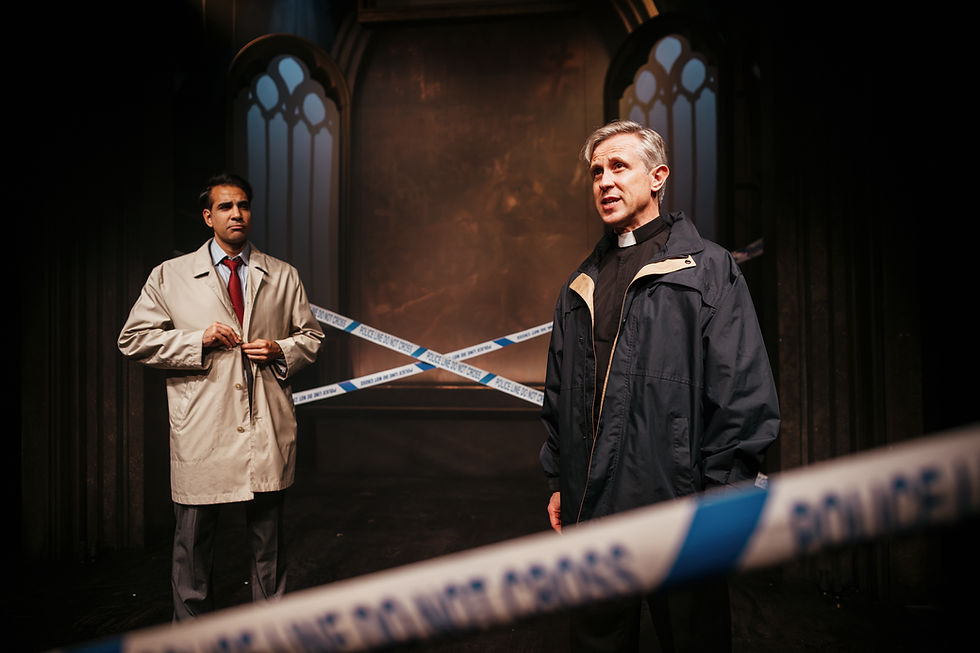
The novel has been adapted by Shaun McKenna, who previously co-wrote the Lord of the Rings musical that enjoyed a revival at the Watermill in 2023, and Paul Hart who serves as Director as well as being the Artistic Director of the Watermill Theatre. Luckily, my plus one for the evening had read the book and also watched the TV show so was well placed to let me know of any changes from the original source material. Both writers have beautifully captured the distinctly countryside charm and wit of the characters, and have greatly succeeded in bringing to life the beauty and eccentricities of a small 1980s country village. As in classic ‘cosy crime’ fashion, the characters and settings seem too picturesque and stereotypical to feel real, but therein lies the crux of why it is popular; this story serves as a fanciful escape into a way of life that doesn’t really exist anymore. Combining this with a whole host of traditional crime plot devices, including red herrings, the least likely suspect and a big reveal, it makes the twists and turns of the plot enjoyable but slightly predictable, as the narrative beats of the story are so well ingrained in the collective consciousness.
Wisely, some strategic cuts have been made so the play is not overstuffed with plot that couldn’t be explained and solved within two hours, such as a secret World War II bunker that I was told features heavily in the book but is absent from the play. As such, some die-hard fans of the novel may consider it untruthful to the source material but, as a newcomer to the story, I did not miss it.

As previously mentioned, Paul Hart takes the reins of this show straight off the back of his successful Summer production of Chitty Chitty Bang Bang. I immensely enjoyed his use of the audience as the congregation during the scenes when Rector Daniel Clement is speaking from his pulpit, and the constant comings and goings of the characters via the auditorium passageway were fun and engaging to watch as an audience member. The show is rather classically directed, and the focus is predominantly on the narrative rather than creating a visual spectacle. However, there are still a few strong moments of theatrical flair thrown in to remind the audience that they are watching a play and not a TV show, and these break up the naturalistic scenes nicely.
Combined with the creative efforts of Set & Costume Designer Ceci Calf and Video Designer Rachel Sampley, the village of Champton springs to life magnificently from page to stage, fully engrossing the audience in the village life. The stage is beautifully decorated with Gothic arches and projected stained-glass windows, which do a fine job of communicating the overarching religious setting and complement the non-church settings too. At times the projector-screen windows do look a bit out of sorts, especially when they move and the video image wobbles, breaking the illusion of the windows, but luckily this wasn’t too impactful.

Leading the congregation as Canon Daniel Clement is Ian Hallard, whose characterisation exists somewhere between Father Ted and Rev Geraldine Granger. He is a bundle of fun to watch, and I really felt his character’s deep connection both to the physical village and church, and to the people who reside within them.
Two absolute standout performances are delivered by Ajani Cabey as Alex de Floures / Harvey Porteous and Alex Wilson as Theo Clement / Nathan Liversedge. Both performers have to play two very contrasting characters and both completely and effortlessly disappear into them with ease and speed. Some of those quick changes are done at breakneck pace, which is very impressive.

Another highlight is Caroline Gruber’s performance as Audrey Clement / Kath Sharman. She alternates between gleaning some big laughs from her portrayal of Audrey, who constantly spars with Stella (played excellently by Julie Teal), and finding great emotional depth as Kath Sharman, the former ladies’ maid-turned-baker. Without giving the plot away, this quickly became one of my favourite parts of the show.
Overall, Murder Before Evensong is a greatly enjoyable evening for those familiar with the novel and those who aren’t. Its nostalgic, classically English aesthetic provides a welcome escape from our fast-changing world, which makes it easy to get swept up in the charm and wit of both the characters and the plot. Whilst this production is not groundbreaking in any particular area, part of the enjoyment of the show is that it doesn’t have to be; the genre is called ‘cosy crime’ after all.
Murder Before Evensong plays at the Watermill Theatre until 14 November. Tickets from https://www.watermill.org.uk/events/evensong#dates-and-times
Photos by Alex Brenner.