


Review: Mother Courage and Her Children (Shakespeare’s Globe)
- All That Dazzles

- May 16
- 5 min read
Review by Matthew Plampton
⭐️⭐️⭐️
Can Brecht truly work in the Globe? That’s the question hanging over Mother Courage and Her Children, now making its first appearance at Shakespeare’s Globe in a new translation by Anna Jordan and directed by Elle While. It’s a contrasting meeting of form and venue: Brecht’s anti-war piece, a play designed to keep its audience thinking rather than simply feeling, placed inside one of the most communal theatrical spaces in the world. On paper, that collision has the potential to be revolutionary, but was that the result?

In practice, it proves more complicated, with a production full of intelligent ideas that never quite overcomes the tension between Brechtian distance and the Globe’s open-hearted theatricality. Brecht’s play follows Mother Courage, a woman dragging her cart through the devastation of war, selling whatever she can in order to survive while the conflict slowly claims her children. In this staging, Michelle Terry takes on the title role, joined by Rachelle Diedericks as Kattrin, Rawaed Asde as Swiss Cheese, Vinnie Heaven as Eilif, and Nadine Higgin as Yvette, among a large, talented cast.
Jordan’s translation and While’s production lean into the story’s brutal contradictions: war as business, survival as compromise, and motherhood as something far messier than selfless devotion. Updates to the script involve the removal of references to the Thirty Years’ War, replaced instead by a modern dystopian reality in which nuclear warfare is presented as a favourable alternative to endless war. References to drones and contemporary warfare sharpen the sense of futility, particularly in relation to the ordinary soldier, whose body becomes almost absurdly vulnerable in a world where those in power possess weapons of overwhelming distance and destruction.

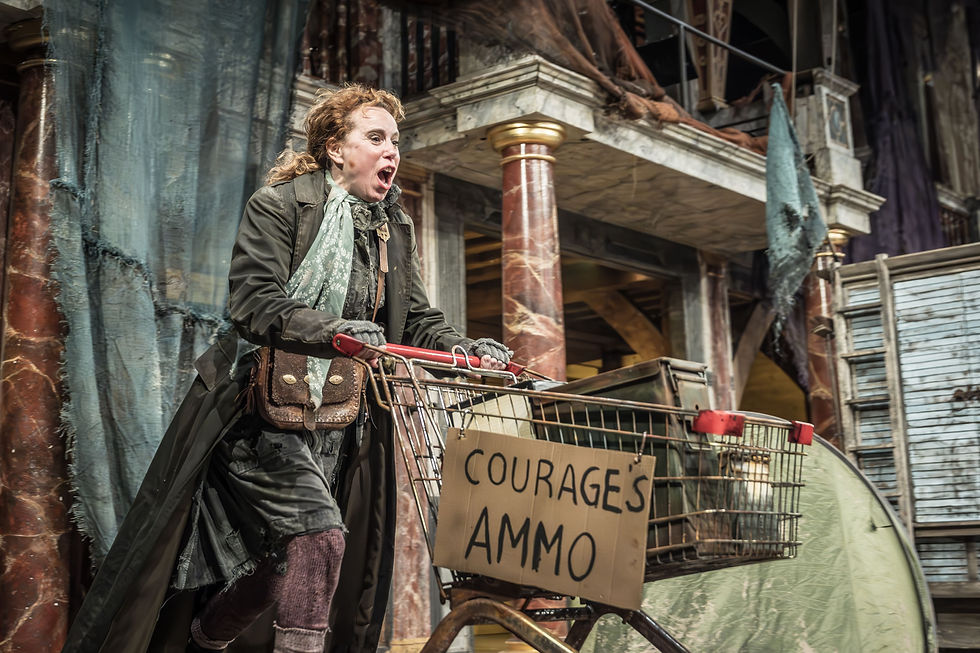
The production is at its strongest when it forces us to sit with the contradictions. This is a piece that asks difficult questions about capitalism, complicity, and the morality of survival, and there’s something uncomfortably potent in watching Mother Courage repeatedly claim that everything she does is for her children while continuing to profit from the machinery that destroys them. Terry’s Courage isn’t presented as a noble victim of circumstance, nor as a straightforward monster. She’s a chancer, a survivor, and a profiteer, attempting to carve out a living from tragedy because the only life she knows is one built around war. I caught a touch of Catherine Tate’s Nan in her cantankerous comic bite and a little of Fagin in the way she hustles through misery, turning desperation into commerce with a wink, a shrug, and a sales pitch.
Terry gives a captivating central performance. She’s comical, commanding, and, when needed, heartbreaking. Her Courage is funny but exhausting, loving but exploitative, and it’s in these contradictions that the performance finds its strength. Her relationship with Kattrin has a genuine current of care running through it, but that love is poisoned by control. Terry allows us to understand Mother Courage without ever asking us to excuse her. She may insist that she’s keeping her children alive, but the production makes clear that she’s also feeding her own need to keep moving, keep trading, and keep surviving, no matter the cost.
That cost is embodied most clearly by Diedericks’ Kattrin, whose silence gives her a moral force that others in the play often lack. The climax of the piece, in which Kattrin sacrifices herself to save a camp of refugees, should land as the devastating moral counterweight to Mother Courage’s endless compromises. Here, however, it felt strangely muted for me. The moment has the structure of tragedy but not quite the emotional force it needs. I observed Kattrin’s brutal end and Mother Courage’s grief, but the production kept me at such a distance that the heartbreak never fully took hold. Brechtian alienation is one thing, but there’s a difference between being forced to think and being prevented from feeling.
This becomes one of the production’s central problems for me. Brecht’s usual style of theatre isn’t a natural fit for the Globe’s communal energy. The direct address, episodic structure, visible theatrical machinery, and pointed songs all make intellectual sense, yet they frequently jar with a space that thrives on shared immediacy and human connection. While’s direction engages boldly with the Globe rather than ignoring it, using the openness of the yard and the direct relationship with the audience as an opportunity to test new approaches. At times, that pays off. The most striking example came from the cast’s reactions to actual planes passing overhead, their glances transforming a familiar Globe interruption into the unnerving possibility of bomber planes. In that moment, the venue suddenly became an asset, collapsing the distance between theatrical war and the world above us.

Too often, though, the Globe setting detracts from the force of the message. The openness of the space works against the claustrophobia and brutality that the play seems to demand. Mother Courage’s world should feel inescapable, a landscape of grinding hunger, fear, and exploitation. Instead, the production sometimes feels too spacious, too airy, too removed from the horrors it depicts. The Globe can be a thrillingly alive venue, but here that aliveness occasionally diffuses the bleakness rather than intensifying it.
takis’ design centres the production around Mother Courage’s cart, the one constant in her life as everything else is stripped away. It’s the means of her survival, her livelihood, her burden, and ultimately the physical manifestation of the bargain she keeps making with war. The visual world around it gives the play a non-time-specific, modern dystopian feel. Armies are reduced to colours, landscapes to grids, camps, and refugee zones.

The music, composed by James Maloney, is used in true Brechtian fashion, creating a jarring juxtaposition against the wartime setting. The visible band gives the piece an intentionally unsettled energy. The upbeat, New Orleans jazz-inflected sound repeatedly refuses to let the audience settle into the atrocities, pulling us out of emotion just as we might begin to sink into it. That’s clearly the point, and when it works, it sharpens the production’s attack on easy sentiment. The use of cast singing is effective in places, particularly in the way it can heighten emotion before abruptly undercutting it, though the lyrics are too often swallowed by the Globe’s open space. Nadine Higgin does provide one of the more poignant musical moments in the second act before the final atrocities unfold.
There’s much to admire in this Mother Courage and Her Children: a commanding lead performance from Michelle Terry, a sharp contemporary lens, and a production team willing to wrestle with how Brecht might function in the Globe. But admiration isn’t quite the same as impact. For all its ambition, the production remains caught between the brutality of its subject and the openness of its surroundings, never quite finding the defiance or devastation it needs. Like Mother Courage herself, it keeps moving forward with determination, but leaves too much of the emotional cargo behind.
Mother Courage and Her Children plays at Shakespeare’s Globe until 27th June. Tickets from https://allthatdazzles.londontheatredirect.com/play/mother-courage-and-her-children-tickets
Photos by Marc Brenner