


Review: Magic (Chichester Festival Theatre)

Review by Hywel Farrow-Wilton
⭐️⭐️⭐️⭐️⭐️
Magic, the new play from actor/playwright David Haig, is an unexpectedly fascinating debate over truth and fiction as told through the real-life friendship between ‘Sherlock Holmes’ author Arthur Conan Doyle and famed illusionist Harry Houdini. The play centres around their relationship and shared fascination with spiritualism, especially Houdini’s obsession with debunking fraudulent mediums, contrasted against Doyle’s devoted belief in communication with the afterlife. The effect is a gripping, surprisingly emotional discussion of whether we can trust what we can see with our eyes or whether all that we see is just an illusion.

This is David Haig’s most recent play to have premiered at the Chichester Festival Theatre, the last being Pressure back in 2014. Magic is the second new play of the 2026 Festival season, following on from their hit RSC joint production, BFG. A strong start to their Festival that seems to be focusing on dissecting the meaning of theatricality and the essence of what divides fact from falsehood.
At first glance, you could be forgiven for thinking that a play about Arthur Conan Doyle and Harry Houdini would have nothing to say about our modern world, but it is this ability to reach through the years that is David Haig’s greatest strength as a playwright. There is a beautiful dichotomy between the two central characters who are seemingly at odds with how we, as the audience, might know them. Conan Doyle is, of course, famed for writing the Sherlock Holmes books, the man who is the archetype for detectives all over the world, a man who will seek the facts and the truth to solve the greatest crimes of the day.

Conversely, Houdini is a man who has built his life on lies and deceit. A man whose great fame and celebrity exist because of his ability to bamboozle an audience into thinking he can walk through walls or escape from impossible boxes. However, when Conan Doyle attempts to convince Houdini of the merits of Spiritualism, we see the desperate sadness of a man who prizes empirical facts above all, willingly fools himself into belief in the hope of communicating with his deceased family, whilst the popular magician and confessed charlatan becomes obsessed with exposing the lies and deceit that he himself used to make his name.
In our own post-truth world, it’s hard not to sympathise with either side of the argument. Wanting to believe in something that brings you great comfort, whether it’s true or not, is very desirable in our turbulent world. On the other hand, trying to discover what is a genuine fact or fiction is getting increasingly harder for all of us with modern charlatans appearing around every corner attempting to profit off confusion and extreme emotions. But is it wrong to believe in something that brings you peace amongst despair, even if it is factually untrue? Do you want to peek behind the curtain, or relish in the belief that the mystical could be real? Unsurprisingly, this play leaves these questions open for interpretation, but they are questions that are just as relevant for modern audiences as they were for Conan Doyle and Houdini themselves.

Directed by Lucy Bailey, she indulges in the hyper-theatrical aesthetic of early Twentieth-Century cabaret shows and the scene transitions are filled with magic tricks, music and kick lines. The effect is that the scenes are presented as the audience getting to peek behind the curtain, behind the façade of showbiz and seeing what the truth of theatre is. The magic tricks (created in collaboration with Illusion Designer John Bullied) are seemingly deliberately underwhelming and half-baked to show the fakery involved in deceiving the audience. Houdini’s own trick of walking through a solid brick wall at the climax of the show is extremely underwhelming, as whenever the actors knock on the wall to show how real the bricks are, they obviously avoid the centre of the wall, showing us exactly where the lie of the trick is but leaving it up to us to decide if we want to see it or believe in the magic of the moment. Overall, Bailey masterfully creates a world where you can decide to be a truth-seeker/exposer like Houdini or a believer like Conan Doyle; the choice is simply up to the audience.
David Haig and Hadley Fraser are both simply exceptional as Arthur Conan Doyle and Harry Houdini, respectively. David Haig communicates great sadness in Doyle’s desperate attempts to speak to his son through his characterisation as a very lovable grandfather figure. The gravitas he gives to this performance is utterly gripping and very emotionally provocative. Hadley Fraser, as Houdini, initially plays him as a rather slimy American showman who is desperate to believe in spiritualism to communicate with his beloved mother, but can’t bring himself to knowingly pull the wool over his eyes. He bounds about the stage with great youthful energy and is every bit the opposite of Haig’s slow physicality. Fraser’s characterisation only gathers depth and intrigue as the play progresses, as Houdini's obsession with debunking mediums grows, deepening the void between him and Conan Doyle, but still conversely retaining the core of their relationship that binds them together and at the same time, tears them apart: their love for their family.

Jenna Augen as Bess Houdini and Claire Price as Jean Conan Doyle are commendable in their roles, which are not simply just foils to their husbands. Jenna Augen finds great humour in Bess’ stereotypical American style but manages to find much more depth in the ditzy American showgirl archetype. At the centre of Claire Price’s performance is Jean’s class and embrace of traditionalism as the wealthy British housewife stereotype, but, like Jenna, she finds greater depth and intrigue that subvert the character. Collectively, they are a powerhouse foursome that drives the beating heart of the play.
A highlight that should not go unmentioned is the combined efforts of Jade Williams as the fraudulent medium Mina Crandon, the Lighting Designer Joanna Parker and Sound Designer Beth Duke to create a masterfully creepy atmosphere during the Séance scenes. The heightened tension within these scenes is in a very typical horror film style. Don’t worry! It isn’t quite the Woman in Black levels of jump scares, but it is enough to give your heart a good workout.
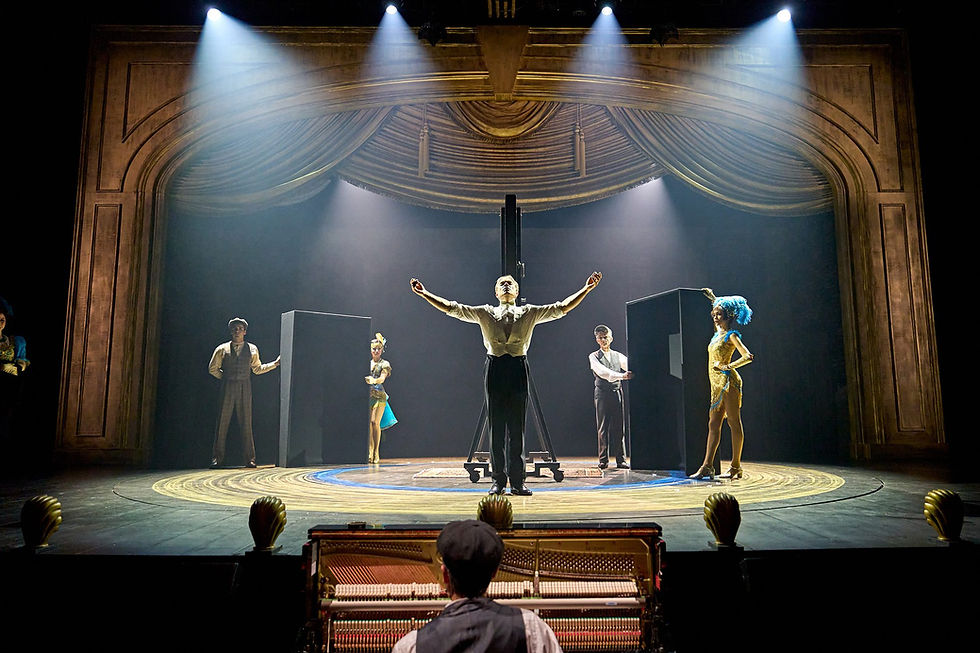
Overall, Magic is a masterful analysis of the truth and lies we tell ourselves and how we distinguish between them, or if, in our heart of hearts, we really want to. It speaks to human nature on a very personal level without being too sentimental, obvious or overbearing, and its inclusion of famous characters acting out things they did makes for some fascinating after-show Wikipedia scrolling. With stellar acting, a superb script and thrilling design, you really won’t want to miss this absolute treat of a production.
Magic plays at The Chichester Festival Theatre until 16th May 2026. Tickets from https://www.cft.org.uk/events/magic
Photos by Manuel Harlan