


Review: Love’s Labour’s Lost (Shakespeare’s Globe)

Review by Molly Gulvin
⭐️⭐️⭐️⭐️
The heat in London certainly made Shakespeare’s Globe feel like northern Spain as the audience settled to watch Love’s Labour’s Lost, made all the more fitting by the flamenco inspiration that the production draws from. The task of blending these two elements is certainly complex, and it was not a guarantee that this production would be able to deliver. However, very early on in the performance, it was made very clear that this production aimed for brilliance, and in many ways did so.

Love’s Labour’s Lost is by no means an unpopular Shakespeare work, but it certainly never reached the upper tiers of fame that many of his other works did. A very basic plot summary can be done in just two sentences: four men swear off women to focus on their studies. Enter four women. However, the work itself does hold more nuance: within the comedy, more serious discussions on power and desire can be found. The ending also works to subvert audience expectations: following the death of the Princess’s father, the expected happy ending is paused for twelve months. Instead, the play closes on our male protagonists promising to return to the ladies in a year. The ending serves as an example of how this play differs from some of Shakespeare’s other comedies, which is maybe what makes it such a perfect target for this adaptation. While narratively, this may not have been one of Shakespeare’s most thrilling works (in fact, there are very few major events within the two-hour performance), it certainly has its place in his comedic works, and can make for a highly entertaining production when taken care of.
While I do not claim to be a flamenco expert, it is necessary to provide a brief history to highlight the genius of this fusion. Developed from Spanish tradition, the flamenco style combines song, dance and performance to create artistry. Flamenco music is highly rhythmic, uses specific instrumental techniques, and has a strong community aspect, with audiences encouraged to clap and cheer to involve themselves in the performance. Whilst not all of these features lend themselves to classical theatre, there are certainly enough parallels that the decision to fuse the genres creates a work that blends seamlessly, while also celebrating both traditions. Shakespeare’s rhythmic writing is perfectly complemented by the flamenco performances scattered throughout the production, and the use of dance to extend the emotional range of the work is nothing short of an inspired decision. The original Love’s Labour’s Lost uses Latin for its quips and wordplay, which have been replaced with Spanish in this production. This not only helps to ground the fusion elements of this production, but certainly makes it more accessible for a modern audience: the more verbose and classical elements of the humour might have been lost, but in its wake, a new comedic take on the work arises.
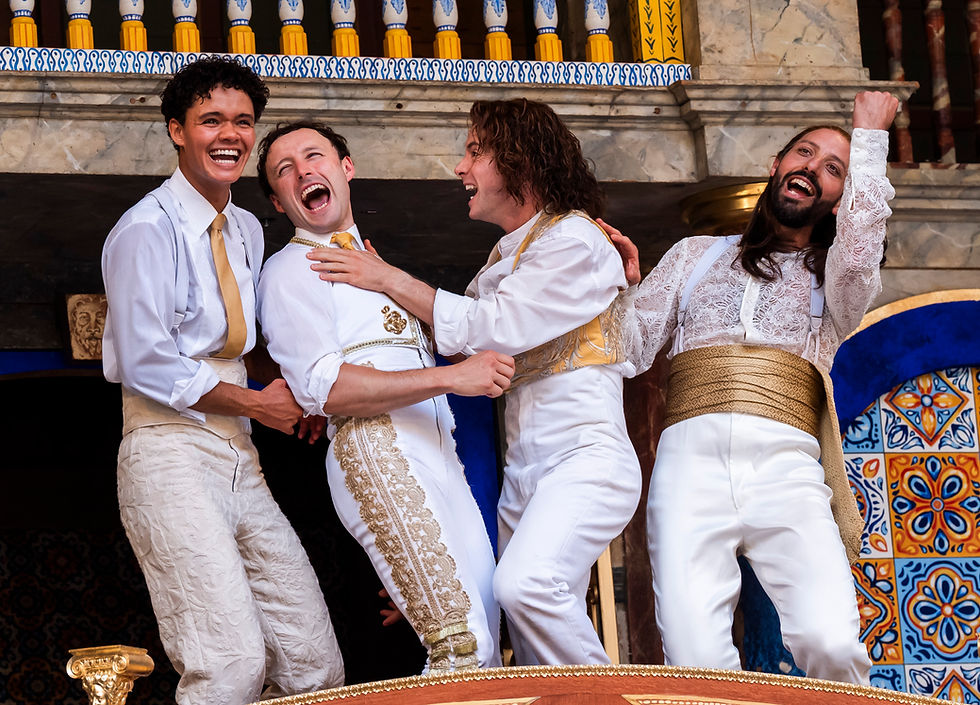
Indiana Lown-Collins certainly doesn’t take on a small task in directing this production, and she shines while doing so. The beats are well-controlled, and each decision has a visible reason, as well as nuance and care for the piece at hand. Even the most chaotic moments of the work feel as though they still have a strong narrative grip, and the narrative and comedic beats are timed to complement one another wonderfully. Her control of the creative elements is clear, ensuring that the vision of the production is visible in everything that occurs on stage. Even the boldest of decisions, such as the setting of the male protagonists’ lamentations of love to popular music that has Spanish connections (for example, “Despacito” and “Livin’ La Vida Loca”), serve to enhance the production in some way. It cannot be said that every decision completely aligns with the original vision of the text, and certainly not with a traditional Shakespearean style, but this works to refresh the work and provide a new, highly enjoyable, evening. Aside from comedy, Lown-Collins also keeps a firm grasp on the deeper themes within the work: when the comedic dust settles, Shakespeare’s wider commentary on male and female power dynamics is clear, and the use of flamenco (where men and women perform as equals, instead of other traditional dance styles where men lead the performance) helps to further highlight this theme.
This production is delivered by a wonderful cast of actors and flamenco performers, all of whom are vital to producing Lown-Collins’s artistic vision on the stage. Norah Lopez Holden, playing the Princess of Spain (traditionally the Princess of France), is an emotive performer who truly shines in her dancing, particularly during a moment in the first act that had the entire audience in awe. The King (Ned Costello) and his court (Philip Arditti, Jax Guerrero and Philip Labey) bring about raucous laughter at their every appearance, particularly Philip Arditti as Berowne, who acts the lovestruck fool wonderfully. Katy Stephens also provides two diverse performances as Maria and Holofernes, with the latter being restyled as a slightly overenthusiastic English teacher in a slightly baffling but nonetheless entertaining choice. The flamenco performers in this production are utterly outstanding: bailaor Pablo Egea and bailaora Anita La Maltesa are breathtaking, and cantaor Carlos Lobo Cordón works with the musical ensemble (comprised of co-composers Adrián Solá and Michael McMahon alongside Ayoze De Alejandro Lopez and David Delarre) to truly bring flamenco music to the stage of the Globe.

As previously mentioned, Lown-Collins’s vision is seamless across the creative elements, but this is not at the cost of any intricacy or care in any element. Katie Lias’s designs are overwhelmingly strong across the board, with care for a classical style joining with traditional Spanish elements to create set and costume designs that are remarkable. The set design includes a barrel in the centre of the standing yard, and on-stage designs that are reminiscent of Andalusian architecture, all of which feels fitting for the theme. The costume designs, however, are where Lias shines: in a wash of colour and pattern, each costume is hugely detailed and combines the Shakespearean tradition of rank and authority with vibrancy and vividness that truly brings the production to life. Carmen Igarza’s choreography and movement direction must also be noted: each moment of the production feels dictated in a sense, but there is still a freedom left to the performers that leaves the overall performance feeling entirely natural.
When fusing art forms, countless traps are incredibly easy to fall into: favouring one over the other, overindulgence in both, or even the fear of integrating the two, resulting in a piece that swaps between them and creates jarring moments. I am pleased to say that this production of Love’s Labour’s Lost falls into none of these. In fusing Shakespeare’s work with flamenco elements, Indiana Lown-Collins brings life to the piece, resulting in a production that is sharp and passionate while (mostly) staying true to Shakespeare’s intended narrative. It is a daring and inspired performance from all involved, and brings genuine joy to those who are watching - or it certainly did to me. This production is a triumph in each aspect and proves that reinvigorating Shakespeare’s works is entirely possible, and should even be encouraged if it leads to more performances like this one.

Love’s Labour’s Lost plays at Shakespeare’s Globe until 13th September. Tickets are available from https://allthatdazzles.londontheatredirect.com/play/loves-labours-lost-tickets
Photos by Tristram Kenton