


.png)
Review: Jerker (Waterloo East Theatre)
Review by Sammi Xing
⭐️⭐️⭐️⭐️
There are plenty of ways to avoid talking about your feelings, but Jerker makes a surprisingly convincing case for sex as one of the easiest. Love, grief, sympathy, insecurity, hope, fantasy, and hurt can all be temporarily pushed aside when there is something else to focus on. Robert Chesley’s play may be explicitly about desire, but underneath all that desire is a much more tender question: what happens when two people begin to want to know each other for real?

The premise is deceptively simple. JR and Bert are two strangers who meet through a series of late-night phone calls, initially finding each other through anonymous fantasy. What begins as something purely sexual gradually becomes much harder to define. Chesley’s writing is remarkably assured in allowing that relationship to develop without making the shift from lust to love feel forced. In fact, it is tempting to wonder whether JR has loved Bert from the beginning, simply using sex as a convenient way of making sure neither of them has to admit it. This is also a play very much of its time, written by Robert Chesley in 1986, during the height of the AIDS crisis, and later caught up in an FCC censorship controversy.
As JR becomes increasingly interested in Bert beyond the fantasy, that emotional connection becomes harder to hide. Yet his insecurity prevents him from allowing Bert to know the real him. JR wants to be the strong, young, perfect lover that Bert imagines, rather than the older, injured former mercenary with little money and a very different reality. It is an uncomfortable insecurity, but also a painfully recognisable one. When we really like someone, how much of ourselves are we willing to let them see?
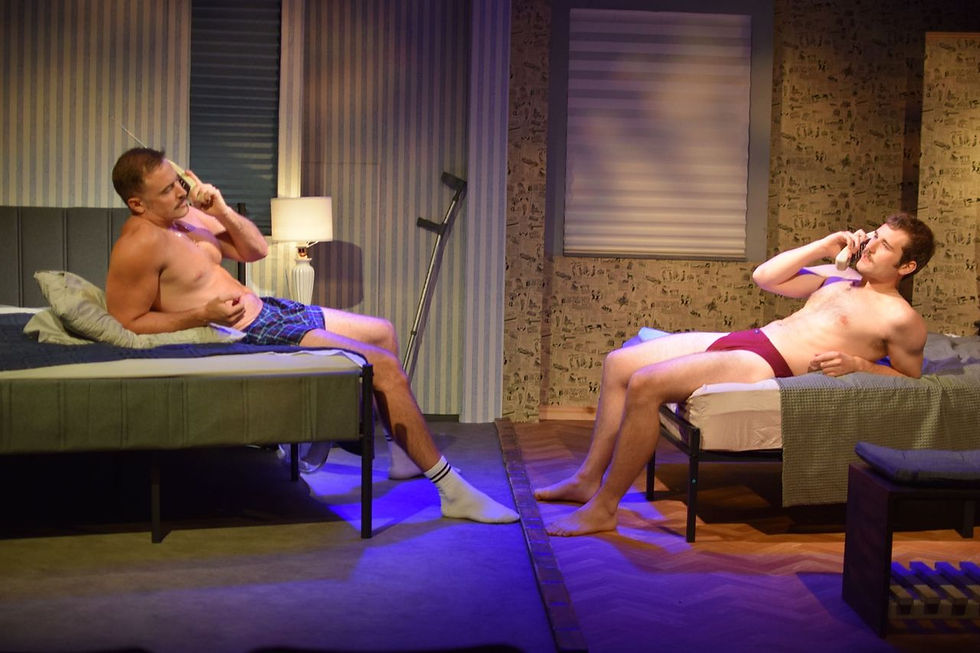
Paul Dennison gives JR plenty of room for this contradiction to emerge. His performance moves naturally between the playful confidence of their sexual encounters and the vulnerability underneath them, making JR’s growing attachment increasingly difficult to disguise. James Lee’s Bert provides a compelling counterpart, and the chemistry between the two performers is particularly impressive considering how much of their relationship has to exist through voice and imagination rather than physical interaction.
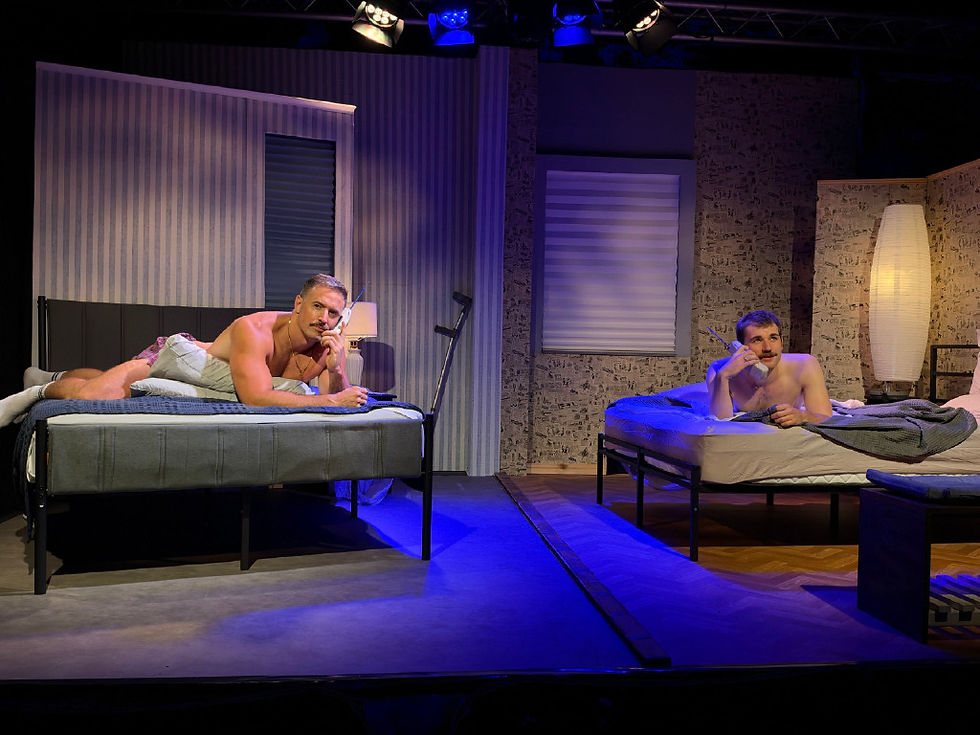
Henry Adams’ direction is equally assured, although it is perhaps the kind of direction that is easiest to overlook precisely because it feels so natural. Nothing calls attention to itself as a grand directorial statement; instead, the staging quietly allows the relationship to develop at its own pace. The two bedrooms remain separate throughout, yet the performers feel increasingly connected, and the shifts of attention between them never make the distance between JR and Bert feel artificial. It is a mature piece of direction that trusts the writing, the performers, and the audience enough not to over-explain what is happening.

The play also carries much heavier material beneath its seductive surface. HIV/AIDS, the effects of war, and the helplessness of being moved around by government systems all form part of the world these men inhabit. What I appreciated most is that Jerker never seems determined to tell its audience what position it should take on any of these subjects. These are simply things that have happened to these people, just as difficult and complicated things happen to all of us. The result is a story that feels less like an argument and more like a reminder of how brief and fragile human connection can be.
That idea is reflected beautifully in the design. The stage is divided into two very distinct bedrooms, connected but clearly belonging to different worlds. Despite being physically close together, the two spaces make it completely believable that JR and Bert are somewhere else entirely, unable to see each other. Jonathan Simpson’s lighting design makes particularly effective use of this separation, shifting focus between the two rooms with some beautifully timed changes. The frequent blackouts did become slightly tiring on the eyes, however, with the repeated darkness and relighting occasionally drawing attention away from the scene.

Sound, designed by Henry Adams and Scott Michaels, is perhaps where the production most cleverly plays with the distance at the heart of the story. The amplified telephone voices feel incredibly close, almost as though they are sitting directly in your ear, while the people speaking to each other remain physically far apart. The effect captures the strange intimacy of talking to someone you cannot see. There is also an unexpectedly fitting soundtrack provided by the trains passing above Waterloo East Theatre, their low rumble often resembling an enormous drone score.
The sound design becomes particularly striking towards the end, when it suddenly feels enormous, cutting through the background music that usually accompanies the scene changes. It is almost as if JR’s own mind has turned the sound of that failed connection into something impossible to ignore. And that is what makes the moment so effective: the distance between the two men has suddenly become very, very loud.
The production’s most provocative moments are certainly not shy about announcing themselves. The opening, with JR masturbating on stage, is an immediate shock to the system, although the audience reaction suggested that discomfort quickly gave way to curiosity and laughter. Yet as the play progresses, the sexual material becomes much more than provocation. It becomes the language these two men use when they are not quite brave enough to say what they actually feel. The sex may bring them together, but it also gives them somewhere to hide. And perhaps that is what makes the ending so quietly devastating. Jerker understands that sometimes the hardest part of loving someone is not admitting that you love them, but doing it before the opportunity disappears.
Jerker plays at Waterloo East Theatre until 18th October. Tickets from https://www.waterlooeast.co.uk/jerker
Photos by Scott Michaels.