


.png)
Review: Jeeves Takes Charge (Charing Cross Theatre)
Review by Sam Woodward
⭐️⭐️
Few fictional servants have enjoyed an afterlife quite like Jeeves. P.G. Wodehouse's impeccably competent creation has lent his name to everything from search engines to dry cleaners, but remains best known for rescuing the hapless Bertie Wooster from an endless succession of social catastrophes. Jeeves Takes Charge, which opened at Charing Cross Theatre last night, takes the story of Bertie and Jeeves's first meeting and combines it with several other Wodehouse tales to create a one-man play. Through an evening of physical comedy, strong characterisations and old-world humour, the result is less a conventional retelling than a one-man anthology of Wodehouse stories and characters.
The original story was published in the Saturday Evening Post in the United States in 1916, and in The Strand Magazine in the United Kingdom in 1923. The original one-man play, devised by James Duke, Edward Duke and Hugh Wooldridge, premiered in London in 1980 before touring the world for seven years. This revival brings Hugh Wooldridge back to the helm as co-creator and director more than four decades later. That history matters because this revival makes little attempt to reinvent or substantially reconsider the material for a contemporary audience. Instead, it largely preserves the rhythms, sensibilities and comic assumptions of the original adaptation.
The writing consequently feels markedly antiquated, relying heavily on nostalgia to generate much of its appeal. Its characters, social conventions and preoccupations can feel almost as remote from contemporary Britain as those of a mythical realm. In a place where employment barely exists, wealth seems inexhaustible, marriages are proposed and cancelled almost instantaneously and the greatest existential danger facing a young man is an aunt telephoning him, the distance the audience feels from the story unfolding before them is difficult to ignore. At moments that distance makes the evening wonderfully escapist; at others, it raises a more difficult question about what this revival is offering beyond the preservation of a familiar comic world.

Wooldridge's direction is lively and frequently ingenious, yet there remains a strong sense of a production preserving its original theatrical vocabulary rather than substantially reimagining it. Furthermore, by combining a number of Jeeves stories, the structure often becomes repetitive. Each story establishes a trivial problem, lets Bertie make a mess of it and eventually reveals Jeeves's solution. What is delightful once can start to feel structurally predictable when repeated for two hours. There is nevertheless considerable care in Wooldridge's handling of a work with which he has been associated since its creation.
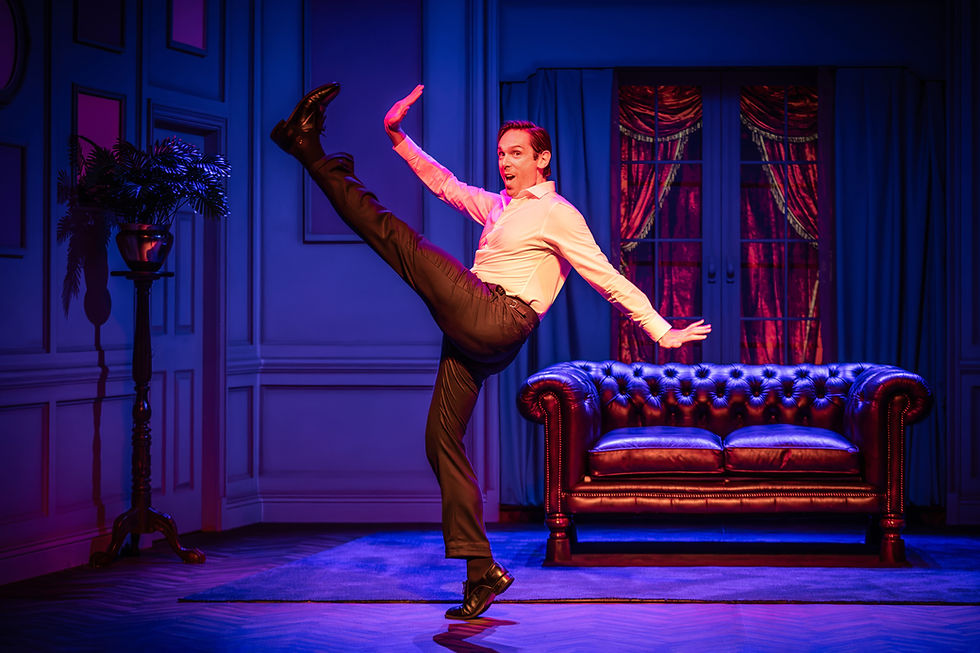
The saving grace of the production is the inspired Sam Harrison, who creates twenty-two distinct characters over the course of the evening. His stamina, memory, vocal control and ability to distinguish one character from another are all extraordinary and give the play the energy it desperately needs. From Bertie Wooster and Jeeves to children, formidable women and drunken old friends, Harrison is magnetic, effortlessly funny and boldly dynamic. Even when moving across age and gender, he avoids allowing the characterisations to collapse into crude impersonation. Harrison brings a freshness to an otherwise old-fashioned show, and the ease with which he transitions between characters is impressive.

Harrison can only do so much, however. More difficult are the production's depictions of women. Wodehouse's female characters are frequently formidable figures whom Bertie regards with outright terror: fiancées determined to reform him, aunts issuing commands and women whose intelligence and resolve easily overpower the men around them. There is an element of comic inversion here, not least because Bertie and his friends are hardly presented as paragons of masculine competence. Yet the extent to which the comedy repeatedly depends upon Bertie's terror of female authority can inevitably grate a century after the stories were written. There is no need to impose a contemporary political reading on something deliberately frivolous, but this revival does little to mediate the distance between those attitudes and the audience encountering them today.
The production makes clever use of its relatively compact playing space. Wood-panelled architecture and framed projected imagery are used to shift rapidly among locations, with paintings, portraits and other visual material helping establish different rooms and settings. Caite Hevner's scenic design proves particularly effective in facilitating those rapid shifts of location. Paul Groothuis's sound design and Tim Mitchell's lighting similarly help establish changes of location and add texture to the action. The design's speed mirrors Harrison's own transformations, allowing the production to move between drawing rooms, school halls, car interiors and green spaces without breaking his momentum.

Jeeves Takes Charge ultimately becomes an unusual contradiction: an astonishing central performance trapped inside a relatively unsuccessful revival. These elements do not necessarily rise and fall together, and while getting a ticket to witness the remarkable work of Sam Harrison may be worthwhile, the play surrounding him does not live up to his artistic vigour. Devotees of Wodehouse may still find considerable pleasure in its nostalgia, linguistic gymnastics and Harrison's exceptional performance. Those looking for a revival that gives its century-old material a compelling reason to exist in 2026 may be left wondering why Jeeves has been summoned back into service.
Jeeves Takes Charge plays at Charing Cross Theatre until 6 September. Tickets from https://allthatdazzles.londontheatredirect.com/play/jeeves-takes-charge-tickets.