


Review: Jane Eyre - A Musical (Southwark Playhouse Elephant)

Review by Daz Gale
⭐️⭐️⭐️⭐️
Musicals based on existing IP are a common thing in theatre, with more and more being green-lit and opening than ever before. Whether it is an artist’s songbook or the increasing popularity or the movie musical, it is the familiarity and intrigue that usually entices audiences to see the latest adaptation of a story they know and (presumably) love. It works for the classics too, with a new musical adaptation of Charlotte Bronte's timeless novel Jane Eyre receiving its highly anticipated UK premiere at Southwark Playhouse Elephan, but would this new take on the story leave audiences feeling rosy, or decidedly thorny?

Jane Eyre was first published in 1847 and has been the subject of many adaptations across stage and screen in the decades and centuries since. This musical version was first seen in 1995, making its Broadway debut in 2000, and taking more than 30 years to cross the pond to give UK audiences a taste. The story follows the titular Jane Eyre who becomes a governess at the mysterious Thornfield Hall following a difficult childhood herself. When she meets its master, Edward Rochester, an intense relationship is developed but as their sparks attempt to turn into a flame, their happy ending risks coming to a premature end due to dark secrets, forcing Jane to choose between love and her own principles.
Charlotte Bronte’s original story has been adapted and reimagined by Paul Gordon and John Caird, retaining the original tone and much of the original dialogue while being unafraid to add in new elements, slightly contemporising it (while keeping it Victorian, of course). Whether you are a Jane Eyre purist and can recite the story word for word or have never read the book or seen any version of the story before, there is something beautiful in how universal and accessible Gordon and Caird have made the story, ensuring it appeals to a wide audience and retains the heart and essence of Bronte’s original story. There must also be great difficulty in condensing a novel such as Jane Eyre into a two-hour musical without the sense of losing anything, and this has been achieved pretty effectively, resulting in a fleshed-out story that never feels rushed but similarly never feels too slow or drawn out either.

Equally impressive is the direction, again by John Caird, co-directed with Megan McGinnis. Southwark Playhouse Elephant has been a particularly exciting new venue, though the execution of some of the productions there have been inconsistent, usually down to directors not using the space wisely and ignoring that the stage is surrounded by three sides. It was refreshing to see Caird and McGinnis consider this thoroughly with their directorial choices, making a great use of their setting and finding innovative ways to bring the story to life in this not always easy space without resulting in a restricted view for half of the audience (something that has been a problem more times than I would care to admit). In fact, the direction is so grand, it feels as if it has been imagined for even bigger venues, though that in turn creates a slight problem. At times, it feels as if Jane Eyre is bursting to explode with life, but the embers that appear never quite ignite, making the production feel smaller than it ought to. Clearly, it has its sights on bigger venues and where a previous production here, The Curious Case of Benjamin Button, transferred to the West End at the Ambassador’s Theatre, I could see that theatre being a great fit for this, giving Jane Eyre the breathing space and grandeur that it is so desperately seeking here. That said, I must repeat how fantastic Caird and McGinnis have been with making full use of the space.
The creativity seen in the direction is more than matched through all other elements. Georgina Lamb’s slick choreography is simply sublime, resulting in some breathtakingly beautiful sequences and an intricate use of movement that truly added to the story. The choice to have the ensemble all become Jane Eyre at one time or another is an interesting choice and certainly one that may split audiences but I found it quite impactful. Bringing her story universally through the ensemble, each has moments to guide the narration, and the brief times where they unite to narrate I found to be an inspiring choice.
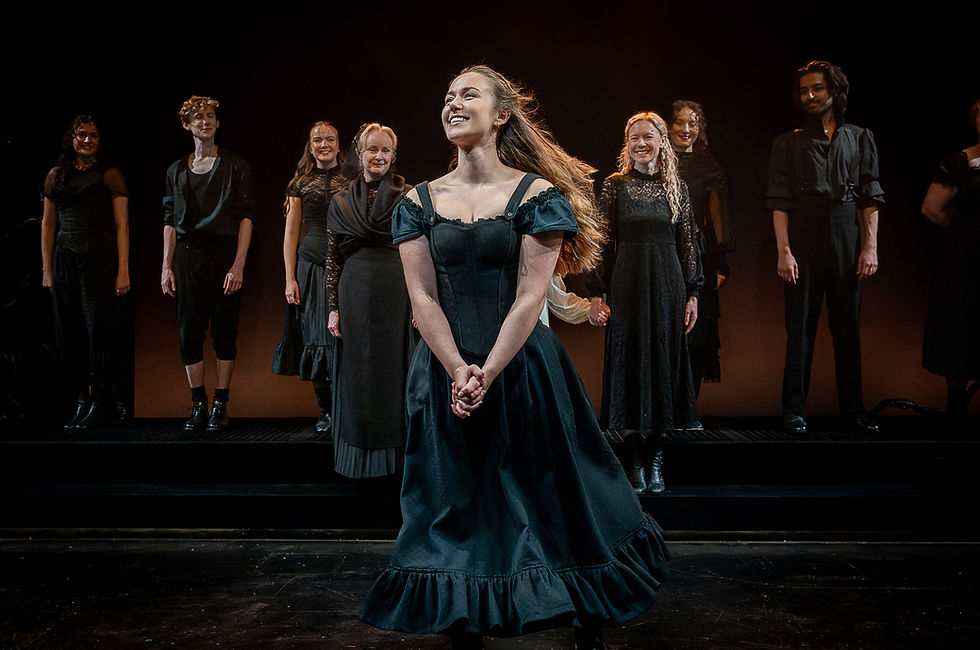
Equally, Jane Eyre boasts a thrilling and mesmerising design, with Morgan Large’s set gorgeously resembling Thornfield Hall with detail given to the gothic nature of the story. The thorns protruding from the stage are a fantastic touch as is the use of writing permanently displayed above. Large’s costume design also wows, blending the Victorian and gothic looks to create a great aesthetic. James Whiteside’s lighting brings the stage to life further, with a striking design that again feels bigger than the space it is in, but works to incredible effect. Bathing the stage in a red glow early on to relay the sinister goings on lets the audience know this is going to be a show that is stunning to watch from a visual perspective, despite the initial sparseness of the space. Andrew Johnson’s sound design never falters, making sure each word and sound is heard as intended - something that should never be taken for granted, given some shows that have struggled with that this year.
One of the strongest elements in this production of Jane Eyre is the outstanding cast. First, I must mention Emily-Rose Samuel, playing the roles of Young Jane and Adele at this performance, shared with Poppy Jason at others. Rarely have I seen a young actor with such charisma and talent on display on stage, showcasing a versatility with two differing roles but wowing at every opportunity. Given some of the actors sharing the stage with her, Samuel more than held her own, resulting in what was perhaps surprisingly one of the standout performances of the night for me. Elsewhere, the cast act as an ensemble while all having moments to shine, from Jonathan Andrew Hume’s solid turns as Brocklehurst and Mason to Melad Hamidi’s captivating Lord Ingram later on. Isabelle Methven similarly delights as Helen Burns, with Gemma Page a force to be reckoned with in her dual roles of Reed and Fairfax.
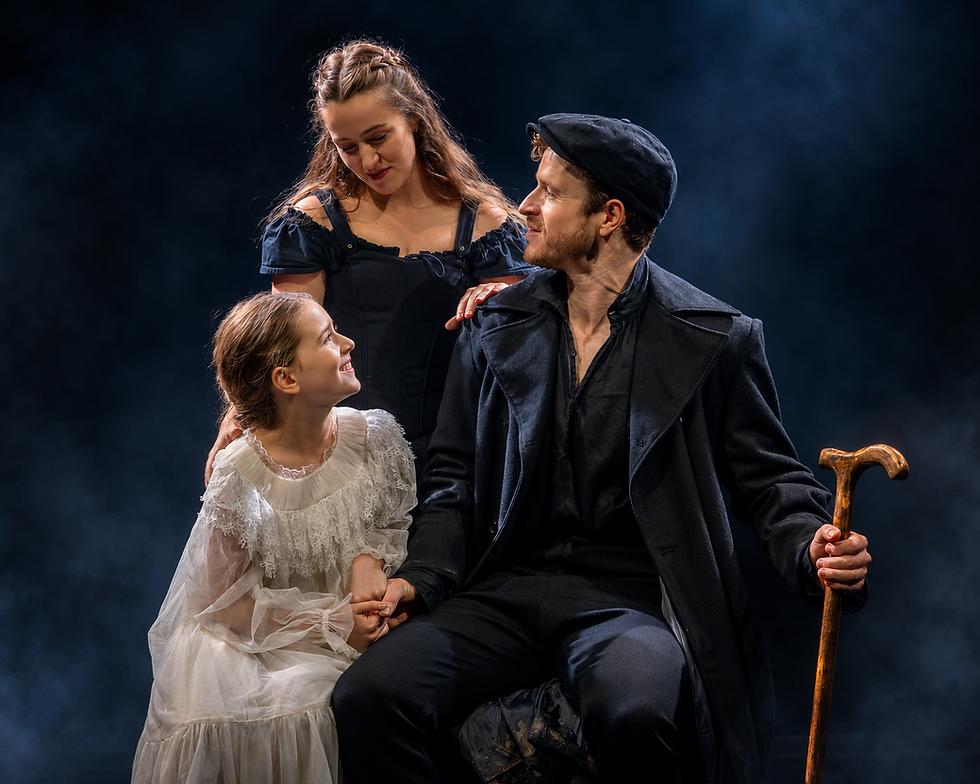
Ashley Gilmour takes on the role of Rochester, bringing a sense of gravitas that carries his performance beyond the relative intimacy of Southwark Playhouse Elephant. There is a charm to his character at times, while bringing a sense of danger and commanding presence, ending with a sweet portrayal in what is ultimately a well-rounded characterisation. Whenever Gilmour is on stage, the show becomes infinitely more compelling, with his acting and presence second only to his heavenly vocals. Always beautiful to listen to, he even sometimes has the ability to surprise such as his turn in the unexpected number ‘Dear Sister’ - perhaps slightly tonally off compared to the rest of the show, but providing a much-needed bit of light relief amongst all the darkness.
Last but certainly not least is Charlie Burn who takes on the leading role of Jane Eyre. Anyone who caught her in Mean Girls in the West End will be acutely aware of what a strong performer she is and how effortlessly she is able to lead a show. However, even the biggest of Charlie Burn fans will not be prepared for just how remarkably brilliant she is in this role. Through a flawless characterisation, Burn delivers the kind of performance that is impossible to take your eyes off of, bringing a sense of warmth, humanity and authenticity to the role. It is her portrayal that allows for a pure connection with the audience, so that when Jane is suffering, the audience feels her pain and struggle, willing her to succeed. The power of that connection can never be overstated, and Burn finds the best way to tell this story in a way that is both compelling and convincing. To say she is a standout in the show would be stating the obvious, but I was not prepared for just how blisteringly brilliant she was going to be. While the show is good in itself, Charlie Burn is even better. If she is not already on your radar for the next big star in musical theatre, she is certainly one to watch.

A musical is only as good as the music within it, and luckily Jane Eyre boasts a stunning score. Feeling reminiscent of Les Miserables in places, it feels like an instant classic with numbers such as ‘Sirens’ and my personal favourite ‘Sweet Liberty’ gorgeous to listen to. Another highlight came from Act One opener ‘Sympathies Exist’, showcasing Charlie Burn at her very best through a rousing vocal. With music and lyrics by Paul Gordon and additional lyrics by John Caird, they have created a series of songs that feel simultaneously classic and familiar while refreshingly new and contemporary, truly finding the sweet spot to strike the perfect balance. I will admit that some of the rhymes did feel slightly jarring and obvious but those were few and far between, with the majority of the songs a pleasure to listen to, leaving me longing for a full cast recording (though three of the songs are available to stream, at least).
It’s fair to say that 2026 has been a wildly uneven time for new musicals. We have seen the good, the bad and the ugly, mentioning no names, of course. Though Jane Eyre can’t exactly be considered a new musical, it is new to the UK with this production offering new elements not seen in the ones that have come before it. Other new musicals may have faltered through questionable and poor choices, but thankfully this does not have that problem. It may not be perfect, but its flaws are few and there is a real sense that this musical and particularly this production is destined for bigger and better things. A transfer to a bigger house is not beyond the realms of possibility for this exciting and fiercely fantastic musical. An absolute pleasure to attend, this is one musical that guarantees you leave the theatre with a smile on your face, a song in your heart and feeling completely satisfied. Reader, I loved it!

Jane Eyre plays at Southwark Playhouse Elephant until 24th October. Tickets from https://southwarkplayhouse.co.uk/productions/jane-eyre/
Photos by Victoria Davies