


Review: Imitations (Riverside Studios)

Review by Holly-Lily
⭐️⭐️⭐️⭐️
Speaking about your feelings is not an easy task for any human being. We distract, avoid and use humour to cover them up, despite all knowing that the statement, ‘a problem shared is a problem halved’, couldn’t be more true. Imitations conveys this message perfectly, through a thought-provoking and compassionate plot that reminds the audience of the importance of speaking up, as well as supporting and encouraging those around you to do the same.

Following a previously sold-out run at the Hen and Chicken’s Theatre in May, Imitations follows Bea (Anna Ticehurst), who is evidently lost and admittedly very lonely, on her journey navigating a breakup. She has a tendency to tell jokes in place of facing her fears and laugh when perhaps crying would be more helpful. Her childhood friend Frank (Gregor Roach) makes a surprising appearance and recognises instantly that Bea’s humour is a mask, and throughout the play he helps her slowly take it off. Simultaneously, Bea learns more about Frank’s own mental health and finally gives in to having those difficult but important conversations, which she regrets not having had with him earlier.
Ticehurst (who impressively wrote and starred in this production) has written a very believable friendship between Bea and Frank. We see them bounce off each other with their banter and butt heads and bicker when they disagree, but make peace very quickly to comfort each other when they’re in need in a very relatable and realistic duo. The Gen Z banter is written very naturally, which is not easy to do without it sometimes coming across as cringy, but Ticehurst has created a script that feels like we, as the audience, are just flies on the wall during their evening together. The most engaging and effective moments, however, are those where Bea and Frank are having deep conversations and connecting over their struggles. These were particularly compelling and moving, but just as we were investing in those stories, a joke was made and the emotional moment was overlooked. Whilst it can be acknowledged that this was perhaps intentional, to demonstrate how awkward it is to have those kinds of conversations, as a viewer, I would actually have enjoyed sitting in those exposing and challenging exchanges for even longer.

Lilly Butcher, the director, creates a lovely dynamic between the pair, playing with proximity to reflect the type of conversations they're having and the emotional progress that is being made. The characters speak across the stage to each other when arguing; they pace around and play about when catching up casually, and towards the end, they rest their heads on each other when connecting emotionally. Some moments felt a little messy on such a small stage, for example, when they started playing Twister. This was something that could have been quite funny but instead felt a little random as it came and went so quickly. The moments when the pair are both sitting, facing out towards the audience and speaking about what they are going through are particularly clever. It comes across like they’re in therapy, which ultimately is what they are giving each other in these moments, but it is very powerful as it is like we are getting to see their inner monologues; all the things they want to say out loud but don’t quite have the courage to do when looking at the whites of each other’s eyes.
The fantastic set, created by Fin Atkin felt like a completely believable space that looked lived in and loved. The walls were decorated with posters and old parking tickets, attached with careless pieces of brown tape. The floor was covered in clothes and empty wrappers, impeccably reflecting how one’s physical space is often evidence of their mental state. Bea’s lack of clothes at the beginning and mismatched socks, initially appears to reflect her care-free and spirited attitude but throughout the play it becomes obvious this is more an embodiment of her lack of self-care and self-sabotaging attitude.
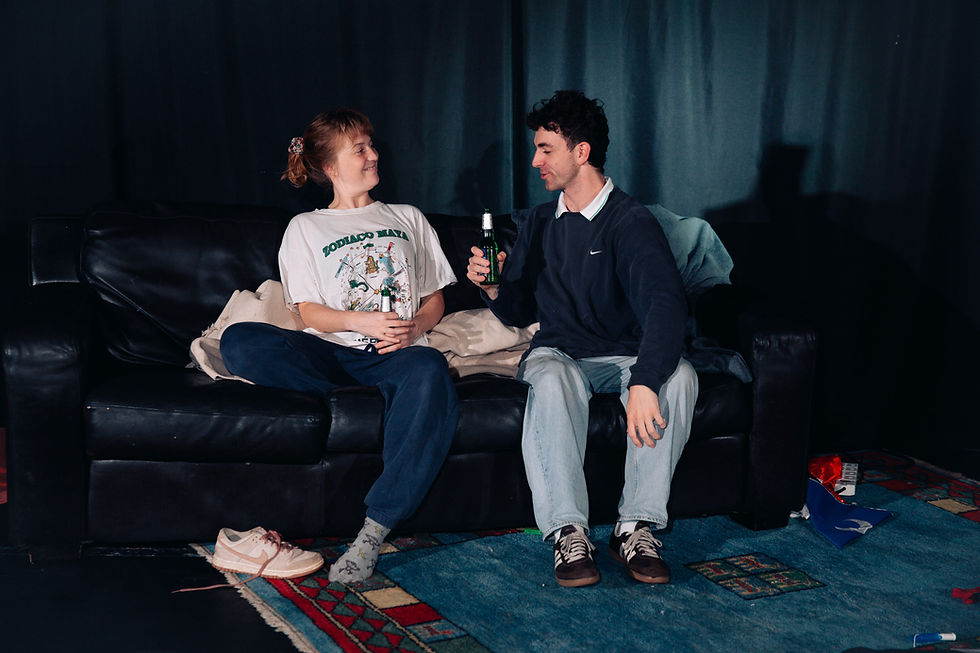
Character-driven stories need strong actors who can not only create characters, but believable ones. Imitations relied heavily on its actors' rapport, and Ticehurst and Roach had a chemistry that was palpable. Both actors handled the emotion well, and even in the lighter moments, we could see beneath the surface their worries bubbling away. Fitting within just 50 minutes, Imitations gently encourages you to reflect on how you deal with grief, subtly highlighting to you the importance of speaking up and reaching out for support. For her debut play, Anna Tilehurst has created something truly special and undoubtedly has a successful career ahead of her.
Imitations plays at Riverside Studios until 3rd October. Tickets from https://riversidestudios.co.uk/whats-on/uwf-imitations/