


Review: HMS Pinafore (London Coliseum)

Review by Isabel Benson
⭐️⭐️⭐️⭐️
After four shorely much-anticipated years, the Gilbert & Sullivan classic HMS Pinafore sails triumphantly back into the West End, dropping anchor beneath the deck of the London Coliseum for ENO’s shanty-tastic production. The colossal venue proves the perfect vessel for Britain’s most beloved comic opera or operetta. Under the buoyant direction of Cal McCrystal, the voyage begins as the Captain (John Savourin) proudly announces the betrothal of his cherished daughter Josephine (Henna Mun) to the pompous Sir Joseph Porter (Neal Davis) … only to discover that she’s already drifted towards another. Her heart belongs to Ralph Rackstraw (Thomas Atkins), the lovelorn sailor several ranks below, who pines just as deeply for her in return.
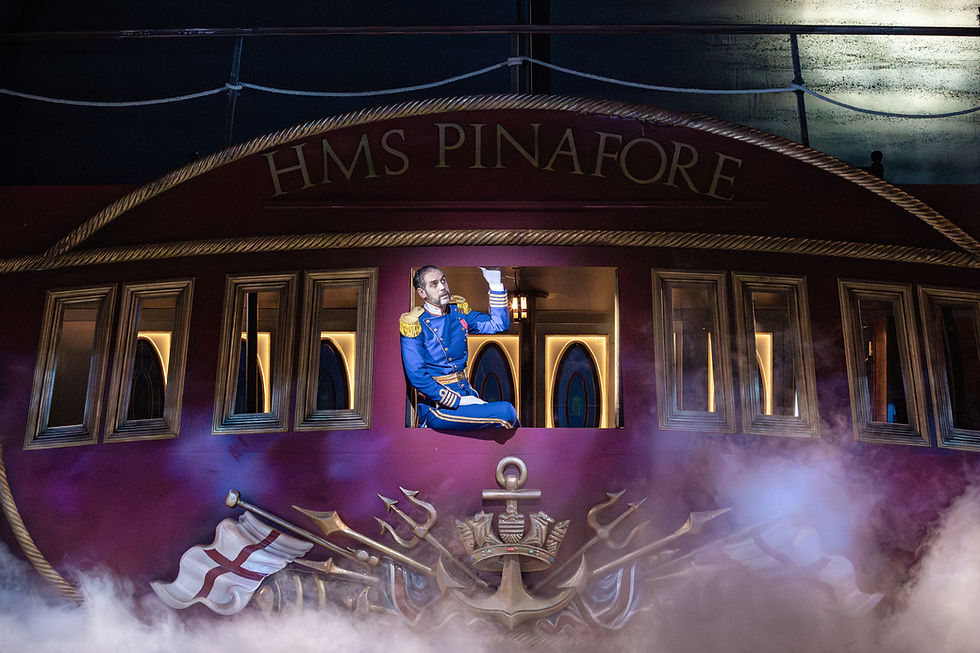
The production leans into what I’ve mapped as three levels of ingenuity that feel refreshing for an operatic revival. McCrystal’s focus on reimagining a traditionally rooted classic pays off, resulting in something that feels both confident and contemporary. The first standout example of this clever approach is the inspired inclusion of household name and TV favourite Mel Giedroyc. Now, instead of testing the density and moistness of sponges, she’s risen beautifully herself - a well-leavened comic treat having the time of her life on these operatic shores.
The colloquial nature of her character elevates the traditional innuendo humour of Pinafore with charm. Her relationship with the Captain, performed with the equal quick wit of Savourin, is akin to a Basil Fawlty and Manuel duo (non-respectively(!!)). Moments like when Savourin scolds chatty Giedroyc, saying, ‘non-speaking role’, are very funny, contributing to the overall entertainment of the production. Giedroyc is often scurrying around, teasing, probing and breaking the fourth wall by actually calling him ‘John’. Although these moments add nothing to the narrative or the drama, I found them refreshingly humorous, bringing novelty and charisma on board.

The second and third examples of inventiveness both stem from the show’s visual layout. The whole spectacle is vibrant and beautiful, with fabulously lavish costumes, impressively designed by Takis, who also envisioned a beautiful high-end set, featuring a revolving ship, a below-deck opening and hilarious inclusion of dummies on harnesses, flying birds and a humorous furry cat which often appears randomly on the top of the ship. In fact, the costumes and set are so impressive that at times they overshadow or distract from the action onstage. For instance, the opening number “I’m Called Little Buttercup” felt slightly muffled, though the moment was lifted by the vivid pop of the sailors’ blue vests and the sheer scale of the ship’s interior. The grandeur of the set can therefore cut both ways: it is a visual bonus that elevates the onstage action, but it also risks working against the cast, who must project unamplified vocals across such a vast auditorium and from challenging points of height across the vast set.
Beyond the impressive set and costume design, the final flourish of inventiveness comes through in the production’s choreography. Lizzi Gee weaves a high-energy multitude of dance into the musical action at a pretty high standard for an operatic performance. The numbers involving dance are slick, and all principal cast and chorus members should absolutely be commended for their ability to produce such a strong sound with the perfect technique of both opera singer and dancer simultaneously. I particularly enjoyed the tap trio at the beginning of Act 2 before the Captain’s gorgeous rendition of ‘Fair moon to thee I sing’. There were points where I did notice the singers ahead of the orchestra whilst trying to execute this high-level choreography, but these points were sparse and did nothing to detract from the overall quality. I also enjoyed Spencer Darlaston-Jones’ role as a quasi-stuntman, flipping across the stage in leaps and bounds (literally), always grabbing our attention with the magnificence of his tricks.

Alternatively, the standout member of the cast had to be Thomas Atkins as Ralph. His soaring tenor melodies caught the hearts of all audience members with the lyricism and attractiveness of his sound. Similarly, Henna Mun did a gorgeous job as the aristocratic Josephine. Her arias were technically pristine, and you can tell she is a well-oiled, polished machine, obviously flourishing on her journey as ENO Harewood Artist. Special shoutout goes to Alaric Green, who played the Carpenter. Also a Harewood Artist, his voice had an extraordinary quality that, although he only featured for a very sparse amount of time, he stood out significantly as a vocal contender.
Bethan Langford also did well to impress humorously with her ‘sisters, cousins and his aunts’ refrain. She had a great haughty expression throughout and wondrous mezzo notes. The orchestra always impresses. Conducted wondrously by Maestro Matthew Kofi Waldren, they provided soaring melodies and a perfect warmth of sound throughout, which always supported the singers with great energy, reliability and sensitivity.

Overall, I was impressed by ENO’s production of HMS Pinafore. It had a refreshing spirit for the opera and, although it sometimes lacked a bit of punch and humanity, made up for it in innovation of production, music and humour. Families, in particular, will find themselves caught up in the fun. With wit, whimsy, and high-seas antics on display, this is one operatic voyage that promises to keep everyone on deck smiling!
HMS Pinafore plays at London Coliseum until 7th February.
Photos by Craig Fuller