


.png)
Review: Henry V (Royal Shakespeare Theatre)

Review by Raphael Kohn
⭐️⭐️⭐️⭐️
It may only be his second RSC performance, but actor Alfred Enoch already seems to be becoming the jewel of the company. After a tremendous performance in Pericles two years ago, Enoch has returned to the RSC to tread the boards once again; this time, on the main stage, in Henry V. Last time, he was directed by Tamara Harvey (the RSC’s Co-Artistic Director) in a folk tale-inspired production full of epic storytelling. This time… well, he’s directed by Harvey once more in another historical tale, but with a captivating and arresting twist.

Those whose history knowledge (like mine) is far from expert-level are in luck, given how convoluted the storytelling could be. Following the titular King during the Hundred Years’ War with France, Henry V jumps from battle to battle in its episodic, violence-filled narrative centred on the Battle of Agincourt, leading to a peace treaty with France. It’s thankfully not focused on the fine details of history on stage, though; what comes across far more is Harvey’s subtly radical re-examination of this classic play’s themes.
Scholars can debate far better than I on Shakespeare’s intentions when writing the play, whether he was glorifying Henry V’s nationalist aims or whether he was critical of Henry V’s conduct. It’s fairly clear, though, that Harvey falls squarely into the latter camp. But rather than bluntly showing him up as a warmongering brute, Harvey takes a subtler and far more fascinating approach.

There is a compelling and utterly believable arc throughout, as the King begins his reign as a slightly immature and naïve monarch. As the story progresses, his confidence grows, and his morals, initially clearly set out through demands to preserve civilian life at all costs, begin to decay. And so, with his progression through the story, he descends into tyranny, gleefully killing prisoners of war and growing more entitled. Harvey steers clear of overly obvious anachronisms, yet it feels as if it is a reflection on modern-day politics and their leaders, or even a warning to not forget our history.
Thanks to Enoch’s captivating central performance, it is a mesmerising show to watch. Masterfully delivering Shakespeare’s verse, he navigates the narrative with aplomb, transforming during the course of the show from an enthusiastic yet inexperienced leader to a battle-hardened warrior king with shaken morals. His enemy, the ‘Dauphin’ (the heir of France) comes in the form of Michael Elcock as a brooding and passionate antagonist.
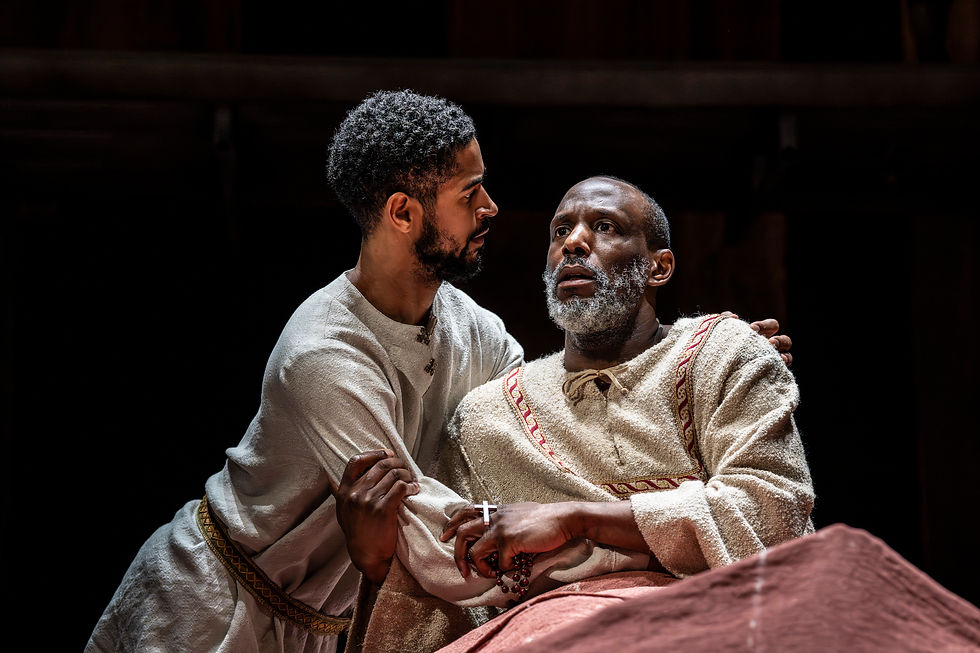
Fittingly for Shakespeare’s epic tale, the rest of the cast multi-role their way through the play to portray the vast amount of parts with a company of 18 on stage. All of them work in excellent harmony as a collective without a weak link in sight, navigating everything from heart-pounding drama to laugh-out-loud comedy (primarily thanks to Paul Hunter’s slapstick performance as Pistol).
Harvey has another trick up her sleeve, though, as the cast expands remarkably on stage with the addition of the ‘supernumeraries’, a team of 30 young people (rotating in two teams of 15) from across the West Midlands recruited as part of the RSC’s new programme to support access to work in the arts. On stage, they form a bulk of bodies who create endless lines and hordes of soldiers, strewn across the battlefield in a striking tableau of violence. It’s almost as if they’re part of the set, blending into the walls and floor to conjure remarkable visuals. It is one thing to witness Enoch perform the famous ‘once more unto the breach’ speech; it is quite another to see it delivered amongst a myriad of soldiers across the ground.

Much of the set starts off bare, framed by a large scaffold and not much else. But set designer Lucy Osborne loads it with a clever trick, rotating it out into the deep thrust during Kate Waters’ punchy, violent fight scenes. In harmony with Jamie Salisbury’s pounding music and Ryan Day’s dynamic lighting, it makes for a thrilling experience throughout each of the many fight scenes.
It may look and sound traditional in Osborne’s medieval garb, accompanied by Salisbury’s lute-twinged music. But thanks to Harvey’s intelligent interpretation, it truly feels like nothing of the sort. It’s less of a rallying cry against warmongering and more of a thought-provoking meditation on the morality of conflict. And in these times of brutal dictators and their playground bully tactics, perhaps that’s exactly what we need.
Henry V plays at the Royal Shakespeare Theatre until 25th April. Tickets from https://www.rsc.org.uk/henry-v/
Photos by Johan Persson