


.png)
Review: Franz & Marie (Charing Cross Theatre)
Review by Ruth Sealey
⭐️⭐️
An unfinished German play, written in 1837 and exploring dark themes, Büchner’s Woyzeck leaves directors to make their own choices, from how the story is presented to how its unfinished ending is imagined. Franz & Marie at Charing Cross Theatre takes this freedom one step further, adding music and creating a whole new version of Büchner’s classic play. But does the classic need a new focus and a musical score, or should this be left well alone?
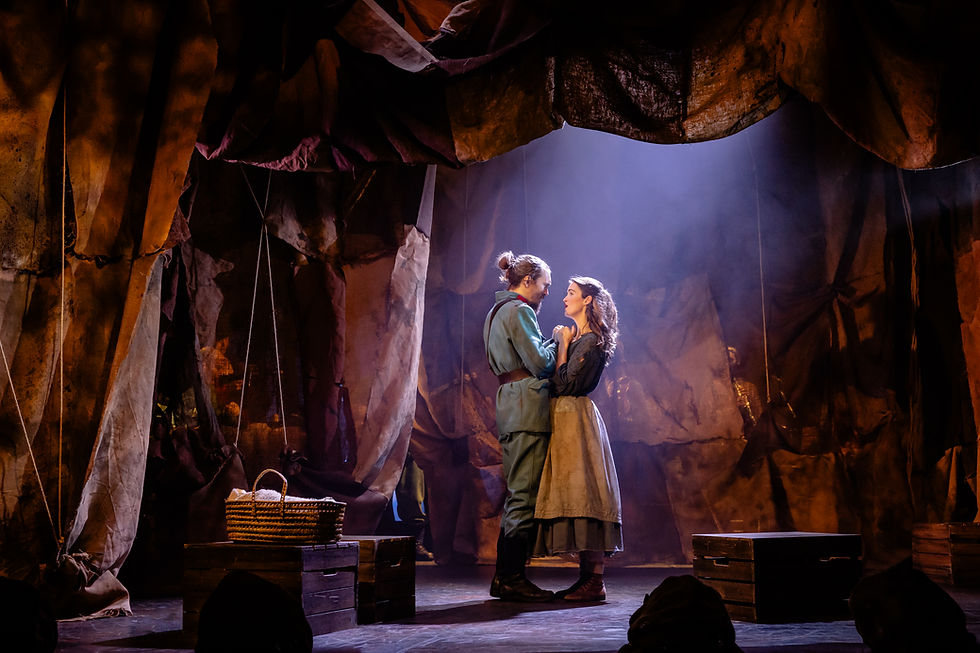
This production of Franz & Marie has been adapted by Teresa Howard from a musical adaptation of Büchner’s play by Chris Broderick and Rob Shepherd, which premiered in South Korea in 2014. Broderick and Shepherd are members of the folk band, ‘The Singing Loins’, and they weave this background in with folk tunes and actor-musicians. At the heart of the musical are Franz and Marie, a couple with a child born out of wedlock and a difficult path ahead. Franz, a soldier already suffering horrifying flashbacks to the war, agrees to take part in an experiment led by Doctor Simian, where he eats only peas for three months and is subjected to increasingly cruel treatment at the doctor's hands. Marie watches as her lover’s mental and physical health deteriorates, desperately trying to support him, but comes to the attention of predatory Drum Major Varg, with devastating consequences.
The premise of this play is an interesting one but, sadly, the adaptation does not quite reach its potential. Much of the dialogue feels underdeveloped, which leaves the characters lacking the depth needed to give the audience a stronger connection with them. At times, the dialogue feels stilted, with lines hanging in the air and seeming at odds with what is happening around the characters. At one point, Franz is exhausted and physically and mentally broken by the experiments and what has happened to Marie, yet he is told by another soldier to “go and get some shut-eye”, a line which feels more akin to a parent talking to a child than two soldiers in this situation. There are moments when swear words seem to take the place of dialogue that would develop characters further. While the blunt language and coarse humour have a place in a story exploring class, power and exploitation, here they do not always feel purposeful, sometimes adding little to our understanding of the characters. Franz in particular is given very little character development, starting and ending in a very similar place. He is constantly on edge, but it is hard to determine if this was what he was like before the ‘experiment’, leaving his journey feeling thin. I was much more invested in Marie, however, and the writing gives her a more sympathetic story arc, making the experiences and consequences she faces easier to engage with.

The song lyrics do not fare much better, becoming unsettlingly predictable in rhyming couplets. “This machete killed a yeti”, while inexplicably singing about knives, and “I took off my clothes, and he broke my nose” were particularly low moments lyrically. This is not about the style or storyline that Büchner created, but about trying to bring this into a musical form. There are far too many songs in the production, and they often add very little to the overall storyline. The musicians are extremely talented, and there are moments, such as ‘Inconsolable Boy’, which are beautifully performed by the entire ensemble. However, songs such as ‘Surfeit of Joy’ land badly, and I was left asking myself whether this story should ever have been a musical at all.
Michael Oakley’s direction makes good use of movement on stage, and the relationship between Franz and Marie provides an emotional thread to the story. Their physicality with each other and moments such as their duet ‘Lay Me Down Love’ are tender and well executed. Characters such as Zella and Schmitt also feel well developed, giving the audience more to engage with. However, the production seems to skim the surface of what should be a deeper exploration of themes like class, misogyny, and power and exploitation. Some moments, including an electrocution, fights and experiments on Franz, are dizzyingly face-paced, leaving the audience little time to absorb or digest what is happening on stage. One particularly well directed moment, however, is Varg’s attack on Marie, which was staged with real thought and care. I was struck with how well this scene is handled, and it is a shame that this same level of thoughtfulness is not carried through more consistently across the production.
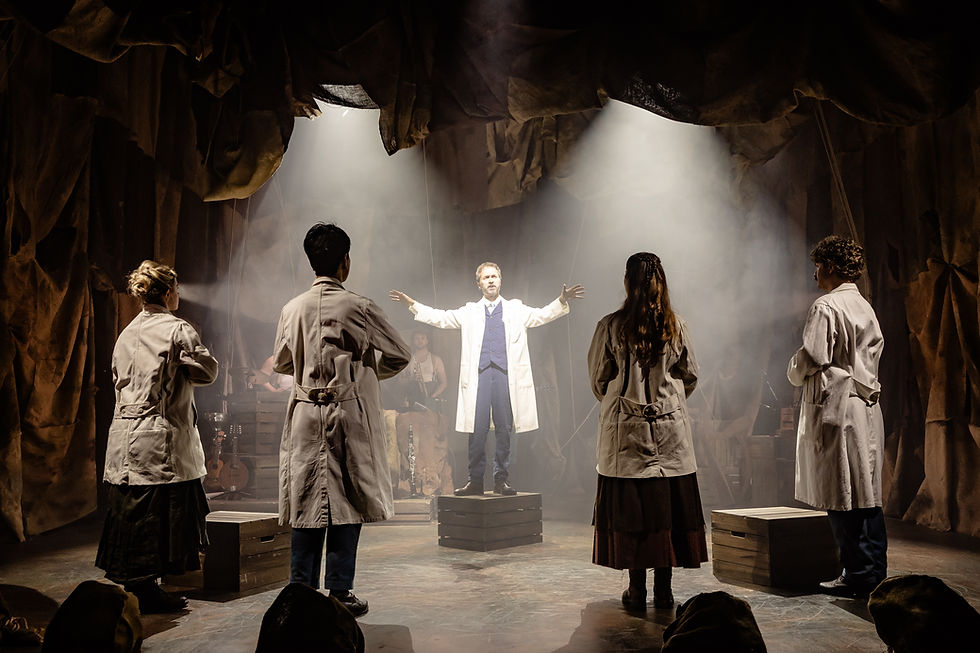
Shows such as Coven and The Curious Case of Benjamin Button are productions where the actor-musician cast feel perfectly at home within the story and move seamlessly between band and characters. The choices here leave some of the musicians looking like they were unsure if they were part of a band or part of the ensemble, especially during intimate moments, particularly at the climax of the show, when even the vast space of this staging feels crowded with musicians. Yet, in a rather obscure choice, the musicians are hidden behind drapes at other points, reinforcing this uncertainty around what their role actually is.
The cast can sometimes slip into caricature, losing some of the impact that was intended. Richard Emerson Gould as Doctor Simian and Mark Meadows as the moustache-twirling Captain Peccary should be amongst the most terrifying of characters but are so exaggerated that it is hard to see past this. Matthew Heywood as Drum Major Varg is one of the most consistent in terms of character and is genuinely intimidating. His attack on Marie shows what the characters could convey when given the tools to do so. Brenock O’Connor as Franz does exceptionally well to portray the spiral that he finds himself in, giving an emotional performance as his life unravels. The highlight of this production is absolutely Jade Oswald as Marie, and she seizes every opportunity to show her emotional journey. She is gentle as a mother, raging as the victim of a brutal assault and loving as Franz’s partner. Her singing is stunning, and her performance of ‘Lullaby’ is truly beautiful. The stage comes alive, and the play makes more sense when Oswald is at the centre.
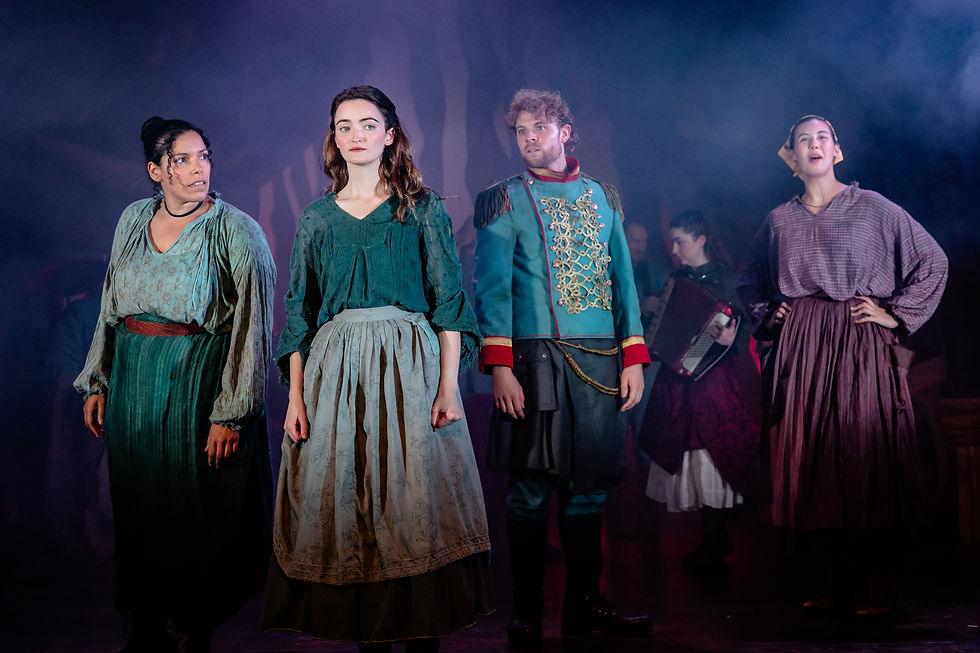
The opening scenes reveal a beautiful set, designed by Bretta Gerecke, with military-type canvas drapes surrounding the stage. These drapes add depth, as they are cleverly raised and lowered on ropes, and trees are created at the back of the stage, giving the impression of a forest. The military costumes are a bright blue and a perfect contrast to the muted, yet detailed costumes of the villagers. The lighting by Christopher Nairne and sound by Andrew Johnson are particularly effective during the flashback scenes, with a heartbeat pulsing and the sound of a piercing ringing combining with the flashing lights to create an intense and disorienting feel.
This musical production of Franz & Marie left me confused as I left the theatre: what was it trying to be, and what was it trying to say? I have been careful not to critique the intended abstract nature of the play – in fact, that it absolutely not my issue here. Moments such as Franz’s flashbacks and the message of rich versus poor and those in control versus the weak are themes that are important. There are also some strong performances and design choices that lift this production. My issue is with the execution of this piece and the performance choices that make for a jumbled and uneven musical. The awkwardness I felt in the audience, with several moments when we were unsure whether to clap or not, was mirrored at points by an awkwardness on stage. Franz & Marie, as an idea and with the source material behind it, clearly has a story to tell. But in musical form? I think not.
Franz & Marie plays at Charing Cross Theatre until 14th November. Tickets from https://charingcrosstheatre.tixtrack.com/shop/tickets/series/FranzandMarie
Photos by Danny Kaan.