


.png)
Review: Dracula (Reading Rep Theatre)
Review by Ruth Sealey
⭐️⭐️⭐️
The nights are drawing in, Halloween is all but a month away, and it feels fitting that Reading Rep Theatre should embrace the darkness and turn to a horror classic with Dracula. Several fairly recent interpretations of the tale have appeared, including Cynthia Erivo taking on every character at the Noël Coward Theatre earlier this year. With such a well-known story having been revisited so many times before, I was intrigued to see how this production would be presented and whether it could breathe new life into a familiar tale. Would this production lack bite or would it discover a new lease of life?
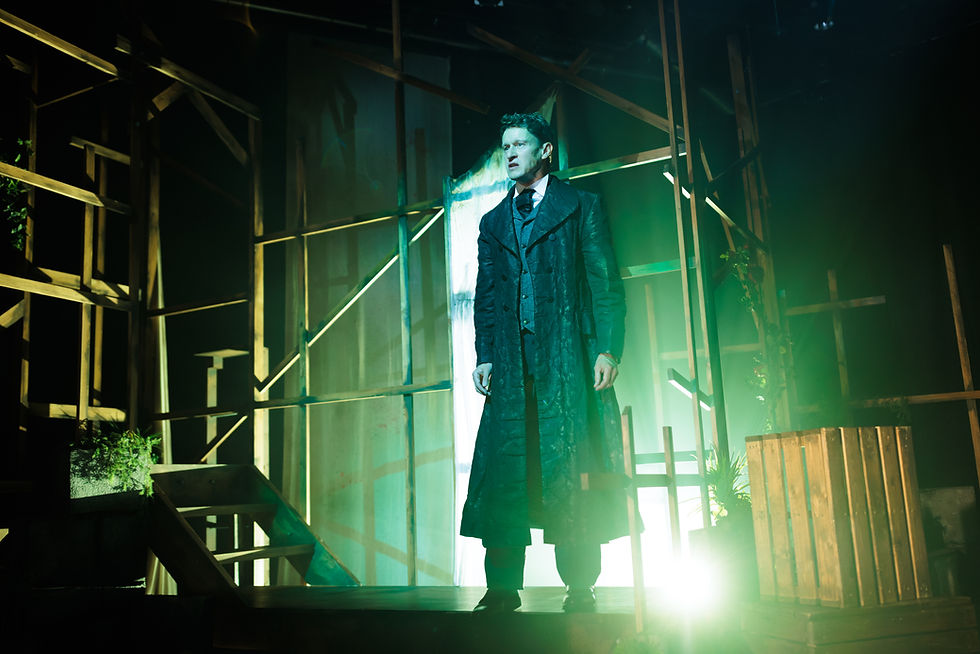
Blackeyed Theatre’s production of Dracula toured the UK in 2025 and now returns for a new run in Reading. Bram Stoker’s novel, however, travels significantly further, beginning in Transylvania before crossing the sea to England. Written in the late nineteenth century, at a time when traditional beliefs were increasingly challenged by technological and societal advances, Stoker’s gothic tale taps into our fears of what might be hiding in the darkness. The story brings together solicitor Jonathan Harker and his fiancée Mina, the ill-fated Lucy Westenra, psychiatrist Dr John Seward, an American adventurer Quincey Morris and the determined Professor van Helsing as they unite to confront Count Dracula and prevent the spread of his bloodline.
Dracula is a scary story. He lurks in the shadows, wears a long black coat, has fangs and drinks the blood of beautiful women, and as someone who generally avoids horror, I had expected to be hiding behind my reviewing notebook. However, while this version, adapted and written by Nick Lane, is commendable in its efforts to bring something new to a centuries old story, what results is a somewhat overly long and, unfortunately, not particularly frightening version of events. The cast act as narrators, telling the dates of events on stage and providing exposition, which becomes extremely repetitive and regularly interrupts what should be moments of tension. There are strengths in the writing, particularly in characters such as Lucy, whose mental decline as Dracula’s influence takes hold is well written and heartfelt, while Van Helsing is a real driving force within the story. These stronger character moments demonstrate what the writing can achieve, but these are too often interrupted by exposition, making the overall experience feel inconsistent.
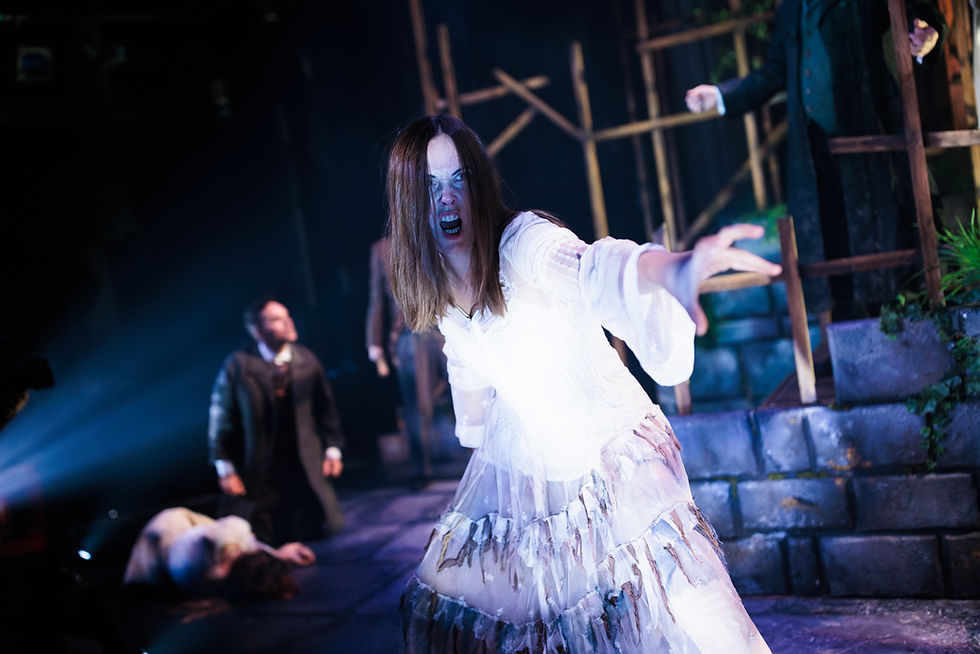
Hal Chambers’ direction very cleverly uses props and movement to create a surprisingly wide array of locations. Working brilliantly with Movement Director Enric Ortuño, Chambers creates locations such as a boat, along with all the movement and action that comes with it, as the crew travel from mainland Europe to England. The physicality is particularly impressive, with some of the most impactful moments when the ‘Sirens’ crawl and writhe along the ground, and when Lucy and Mina physically respond to their connection with Dracula through a clawed hand or sudden jerk of their neck. These moments show the potential for this production to become much more terrifying. The decision to have three actors play Dracula is intended to show how he becomes younger with the more blood he drinks. However, the changes between actors impact the character development, as none has enough time to build the fear, brooding or intensity needed for a character who should strike fear into the audience. Given the excellent physical direction within this production, and having seen reverse ageing done brilliantly with physicality and slight prop changes in a show such as The Curious Case of Benjamin Button, I am left wondering whether there was another way to show Dracula’s transformation. More opportunity to develop a single Dracula might have created a much stronger sense of menace, something that is ultimately lacking here.
David Chafer, Richard Keightley and Harry Rundle are all given the opportunity to play Count Dracula, each bringing something different to the role. It is a shame, however, that none gets to inhabit the character entirely, leaving Dracula himself underdeveloped. Keightley is also fantastic as Dr John Seward, with his intellect hiding his feelings for Lucy in an understated and emotional portrayal. Rundle plays the rather bumbling Arthur Holmwood and develops the character from naïve to brave as the story progresses. Chafer is outstanding as Abraham van Helsing, with a believable Dutch accent and a real intensity as he tries to understand what is happening and determine how he can help. Nicholas Prasad also puts in an impressive performance as Jonathan Harker, brilliantly capturing his terror as the play progresses.

Maya-Nika Bewley as Mina Harker/Dr Hennessey and Pippa Caddick as Lucy Westenra/Renfield create a fantastic dynamic together. As Mina and Lucy, they are entirely believable as close friends, with a warm, natural connection between them which makes the outcomes for them all the harder to watch. The physical effort they put into their various characters is particularly impressive, with both actors making clear distinctions between the different roles they play. Their physical changes and subtle movements become increasingly unsettling, showing real versatility as they move between characters and states of mind.
The set by Victoria Spearing is especially striking, with the wooden structure creating multiple levels, entrances and exits and dark corners. The use of boxes and planks enables the cast to construct and dismantle parts of the set with ease, and additional materials create impressive pieces such as the boat. Oliver Welsh’s lighting goes some way to helping build atmosphere and is at its best when creating the dark spaces and shadows and showing the contrast between locations, and I especially like how a rotating spotlight cleverly captures the movement of the horse and carriage. In an interesting addition, Tristan Parkes has composed some well-placed sung pieces which complement the beautiful soundscape that is created.

Overall, this production of Dracula has impressive artistic elements, with a beautifully designed set combining with other design elements to make the audience feel as though they have travelled across a continent. The physicality and movement are also impressive, and the cast work incredibly hard to show that the journeys their characters make are reflected in the wider story. However, the slightly disjointed feel created by some of the writing choices, combined with the decision to have three actors play Dracula, makes the production feel more complicated than it needs to be and ultimately hampers its potential. There are some strong ideas, and moments that show how effective this production could be, but they do not come together consistently enough. Does this production suck? Definitely not. But for a story that should leave its audience looking over their shoulder as they leave, it just is not scary enough.
Dracula plays at Reading Rep until 10th October and then tours the UK.
New Wolsey, Ipswich 13th-17th October
Gaiety Theatre, Dublin 3rd-7th November
Everyman Theatre, Cheltenham 10th- 14th November
Photos by Harry Elletson