


Review: Carlos Acosta's Carmen (Richmond Theatre)

Review by Sam Woodward
⭐️⭐️⭐️
Reimagining Carmen is no small undertaking. Georges Bizet’s opera premiered in Paris in 1875, adapted from Prosper Mérimée’s novella. Since then, it has taken on a life far beyond the opera house. Its music is instantly recognisable, its heroine endlessly reimagined, and its tragic arc so familiar that any new adaptation arrives carrying a certain weight of expectation. Carlos Acosta’s answer, in this full-length dance version for his Havana-based company, is to push the piece away from operatic tradition and into a different physical language, blending classical ballet, contemporary dance, flamenco and traditional Cuban folk influences.
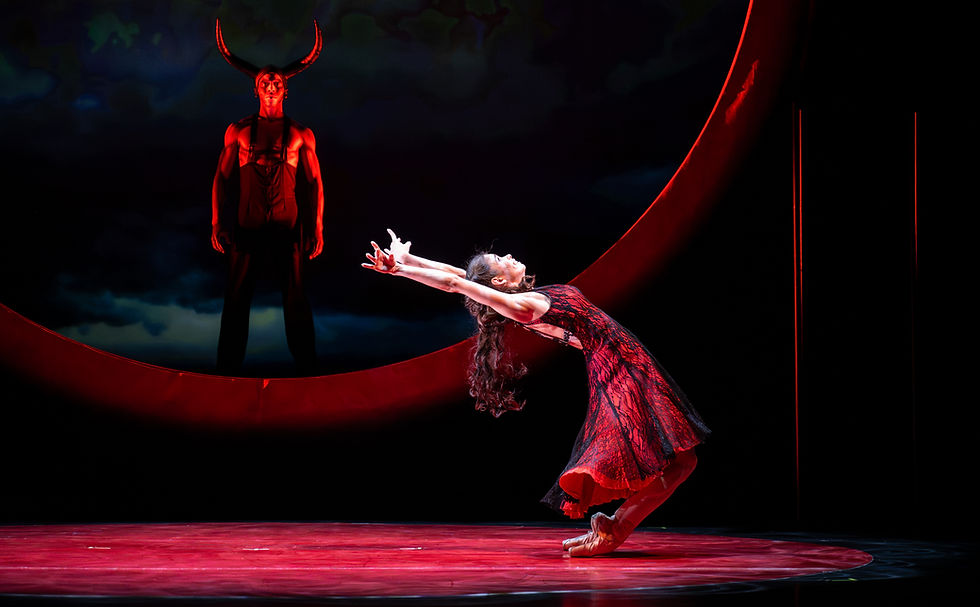
Acosta first created Carmen as a one-act ballet in 2015, later expanding it into an expanded version that premiered at Sadler’s Wells in 2024, before bringing this new full-length iteration to Richmond Theatre as part of a five-stop UK tour. That broader scale is felt not just in the storytelling, but in the production’s whole atmosphere, which leans into heat, danger and spectacle from the outset. In reshaping Bizet’s opera, Acosta frames the story less as a straightforward retelling than as something more ritualistic and ominous, shadowed from the beginning by the sense that its tragedy is already in motion.
Acosta’s storytelling is one of the production’s real strengths. Rather than becoming overcomplicated or overly abstract, Carmen is rendered with clarity, beauty and directness, its drama carried cleanly through movement and stage image. The mix of contemporary and classical dance is especially effective here, giving the production a physical language that feels both expressive and easy to read. There are also moments of real choreographic invention, with some inspired movement ideas that feel fresh rather than merely decorative.

The evening finds a new level of force after the interval, and nowhere more so than in the tavern scene, one of the production’s strongest passages. Packed with energy and rich in movement detail, it is here that the Cuban flair of the piece comes most fully into its own, giving the choreography greater personality and the drama a stronger pulse. The sharp, impressive clicking and powerful amalgamation of dance styles add another layer of rhythmic intensity, making the whole sequence feel even more alive. The first act has plenty to admire, but Act Two is where the production feels most fully realised.
The cast brings real commitment to the production throughout, throwing themselves fully into its physical and emotional demands. Adria Díaz makes a strong Carmen, combining beauty and grace with playfulness and charm, while Alejandro Silva stands out in particular for his powerful dance style and compelling stage presence. The dancing is consistently engaging and often impressive, even if there are moments, especially in Act One, where the ensemble looks a little less precise than it might. Yet what the company may occasionally lack in precision, it makes up for in attack and effort, and in the sense of joy that emanates across the stage.

Much of the production’s force lies in its design, which repeatedly finds powerful images within a deceptively simple framework. The metal bars at the heart of the set are used with impressive imagination, becoming seating, prison, wall and barrier in ways that constantly reshape the stage and reinforce the sense of entrapment running through the piece. The rope work between fighters and lovers in the prison scene is particularly clever, making the threat of capture feel tactile and cruel, while the bedroom sequence, danced across the bed, is both beautiful and charged with danger. Then there is the Bull, entering through the great red circle that dominates the stage, an image so bold and mythic it seems to pull the whole production into darker territory. With costumes that are just as striking, the result is a visual world that feels sensual, threatening and likely to linger in the mind.
For all its visual power and choreographic imagination, Carmen does not quite sustain the same level of impact throughout. The first act, while clear and often striking, lacks some of the rhythmic force and precision that make the second half so effective, and the production as a whole feels just short of the polish needed to fully ignite. Even so, Acosta’s reimagining remains engaging, atmospheric and full of conviction, with enough energy, invention and theatrical flair to make it a rewarding evening, especially once Act Two begins to catch fire.
Carlos Acosta’s Carmen plays at Richmond Theatre until 11 April, before embarking on a short UK Tour. Tickets available here
Photos by Katja Ogrin