


Review: Broken Glass (Young Vic)
- All That Dazzles

- Mar 4
- 5 min read
Review by Daz Gale
⭐️⭐️⭐️
While programming at the Young Vic always excites with its versatility, something is reassuring and familiar about their continued relationship with the works of Arthur Miller. In the past, they have staged productions of The Crucible and A View From The Bridge, with their most recent offering being 2019’s outstanding Death Of A Salesman, a production that went on to conquer the West End and Broadway, and remains one of the greatest I have ever had the pleasure of seeing at the Young Vic. So it was with much anticipation that I returned to the venue to settle into Broken Glass, a play I wasn’t as familiar with as some of Miller’s others. With such a formidable legacy behind it, would this latest revival prove strong enough to uphold that standard or risk shattering the Young Vic’s impressive track record?

Broken Glass is one of Arthur Miller’s later works, premiering in 1994 and winning several Olivier Awards the following year. Set in Brooklyn in 1938, it centres on the married couple Sylvia and Phillip Gelllburg. After becoming fixated on reports of violent attacks against Jewish communities in Germany, Sylvia suddenly loses the ability to walk. Her husband insists the paralysis is all in her head, but his dismissal deepens the fractures in their already strained marriage that become harder to ignore as Sylvia forms a strong bond with Dr Hyman.
It is an extremely intimate play, and the first time in his career that Miller spoke of his own Jewish heritage. Despite being written more than 30 years ago, and set 88 years ago, there is something undeniably modern and relevant about Broken Glass, with inevitable comparisons to the rise in antisemitism we so often see on the news lately. This speaks not just to the genius of Arthur Miller’s writingbut also to the timeless nature of the piece, which remains affecting decades later. The intimacy of the piece only heightens this, diving into the nature of the couple and exploring the varying themes between them as individuals and together.
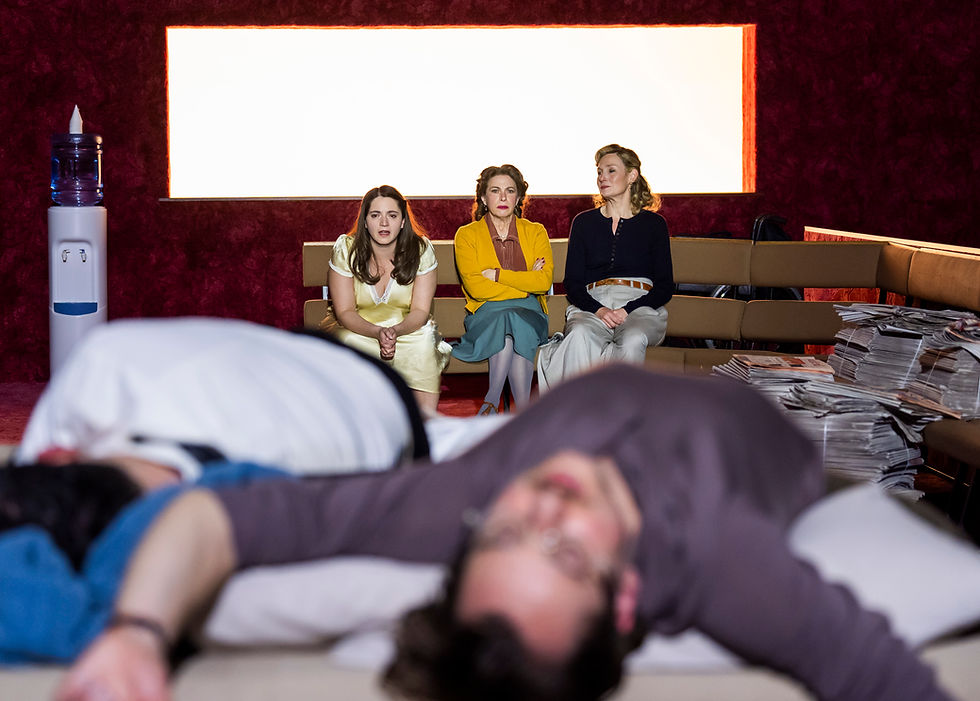
Jordan Fein’s direction takes the intimacy of the writing and explores it through some bold choices - some of which prove incredibly effective, while others don’t land in quite the same way. Static characters remaining visible when they are not in the scene, observing, is a great parallel to Sylvia’s obsession, kicking off with her prolonged silence before the nature of her character is unravelled. Very much like his inspired production of Fiddler On The Roof, Fein has some creative and thrilling ways to reimagine a classic, though arguably it isn’t done quite as flawlessly this time around.
One of the aspects that makes the Young Vic such an exciting and unpredictable place to visit is the many ways it can reconfigure itself, with Broken Glass continuing this trend with a new configuration I haven’t seen there before. Six rows of stalls wrap around three sides of the stage, breaking down the walls between performer and audience, and feeling slightly reminiscent of the venue’s neighbour, the Old Vic’s newest year-long configuration. It is an admirable move, but one that comes with its own problems, creating tricky sightlines from essentially every seat. The front row is left empty to become part of the stage, with cast members sitting there - though if that happens to be on the same side as you, you may not even realise they are there. Even when they are standing, there are large chunks of the play where their positioning still creates a restricted view - some might say this is an eventuality of staging anything “in-the-round” (or near enough), but I couldn’t help feeling like not enough thought had been given to sightlines, lessening the impact moments in the play should have had.

Pearl Chanda delivers a compelling performance as Sylvia Gellburg, managing to retain an intensity and interest even in the quieter and more silent moments she had throughout the play. This makes the louder moments all the more effective, with Chanda at her best as the play roars towards its climax. Eli Gelb is far more animated as Phillip Gellburg, but delightfully so, in a strong and varied performance that races through conflicting emotions and is the perfect vehicle for Gelb’s immeasurable talents. It is the contrasting and believable dynamic the pair have as a married couple that makes Broken Glass such an electric watch at its best.
Elsewhere in the cast, Alex Waldmann is a highlight as Dr Harry Hyman, bringing an undercurrent of danger to the story and acting as a catalyst for the unfolding events as the perfect antithesis to Sylvia’s husband. The other roles in the play are much smaller, but Nancy Carroll, Juliet Cowan and Nigel Whitmey each get moments to shine as Margaret Hyman, Harriet and Stanton Case, respectively.

Some of the choices in this production of Broken Glass are certainly distinct and even unconventional. I mentioned the interesting stage configuration, designed by Rosanna Vize, with some great set details, including stacks of newspapers and a rather on-the-nose glass window (admittedly not broken). Adam Silverman’s lighting proves equally unpredictable, suddenly opting for incredibly bright lights at times that almost make you forget you are sitting in a theatre, resembling more a hospital waiting room - an interesting choice, and one that lends itself well to developments in the story. Tom Gibbons’ sound design is atmospheric at times, even underscoring certain moments, most notably whenever the character of Stanton appears, drastically shifting the tone.
Though this is the first time I had ever seen a production of Broken Glass, I can’t say with all honesty that it ranks up there with some of the other Arthur Miller classics I have adored over the years, with the superb production of All My Sons about to wrap up its acclaimed run in the West End a fine example of when it can be done right. That is not to say there is anything wrong with this production whatsoever. It is absolutely fine, perhaps fittingly given the director’s surname. There is nothing wrong with fine, but it does stop just shy of becoming as thrilling and compelling as it promises to be. There are moments of brilliance to be found throughout, but these are swiftly followed by more uneven moments. Running at two hours without an interval, the play does suffer from slight pacing issues at times, but ultimately proves to be a solid if not groundbreaking watch. Though this production may not quite shatter expectations, it is strong enough to keep it from cracking.
Broken Glass plays at the Young Vic until 18th April. Tickets from https://www.youngvic.org/whats-on/broken-glass
Photos by Tristram Kenton