


Review: Brixton Calling (Southwark Playhouse Borough)
- Sam - Admin

- Jul 26, 2025
- 4 min read
Review by Sam Waite
⭐️⭐️⭐️⭐️
In the world of popular music, there was plenty to remember about 1983. The likes of Madonna, Europe, Sonic Youth and Wham! would drop their debut LPs; Marley, Bowie, Prince and Michael Jackson released smash hit records; in Brixton, a young man with £1 and a dream would purchase 211 Stockwell Road. What would soon become the Brixton Academy is still operating today, with production duo Kick It Anywhere bringing the stories behind the iconic venue to Southwark Playhouse Borough in their new bio-play, Brixton Calling.

Drawing from Parkes’ own memoir, Live at the Brixton Academy, the show charts his adolescent gigging misadventures, the clever manoeuvring that led to his paying just £1 for the venue, and the countless highs and lows that would come from operating the space. A duo of actors, chiefly credited as Simon Parkes and his long-time friend and business collaborator Johnny Lawes, Brixton Calling blends live music with frenetic storytelling and a palpable, endless passion for music and nightlife culture, focusing on stories of not just success, but of perseverance despite odds stacked against Parkes and his team.
Director Bronagh Lagan brings the same chaotic but controlled quality to Brixton Calling as to West End smash Cruise, keeping those same smooth transitions between traditional actor-to-audience monologuing and brief musical performances. Lagan notes in the show’s programme that she pushed for a second actor to be added to flesh out the world of 1980s Brixton, to ensure that the area was central to the story rather than just a backdrop – I’m thrilled to say that, as with Soho in Cruise, she has successfully brought the energy of the setting successfully into the work.

One half of Kick It Anywhere, Alex Urwin takes on scriptwriting duties for Brixton Calling, bringing a genuine enthusiasm to the dialogue and a real sense of momentum to the stories told. Urwin and production partner John Dinneen’s delight in bringing such human but hard to believe stories to life is clear in every moment, and their absolute respect for Parkes and his many friends and colleagues could not come across more vividly. Admittedly towards the end of this 100-or-so-minute performance the energy threatens to dip, the building still standing and the gigs still selling leaving little doubt of a happy ending, but Urwin’s script finds a satisfying place to leave Simon, and to leave the audience.
Another alum of Cruise’s soaring success, Nik Corrall’s set is immediately arresting, bringing to life the tight-packed nature of a standing room gig while hinting at the sheer stature that proved part of the appeal for Parkes upon his entering the space. Neon cabling hangs loosely over framework, while an array of guitars ready to be played hang on the back wall. Most lifelike is the floor, littered with stickers and flyers for the countless artists who found their way through the Academy’s doors, looking not unlike the bathroom walls of many venues to this very day. This gig-space atmosphere is completed by Max Pappenheim, who manages to balance the extended monologues with the constant presence of music, and the bold, almost too-intense (deliberately so) lighting from Derek Anderson.
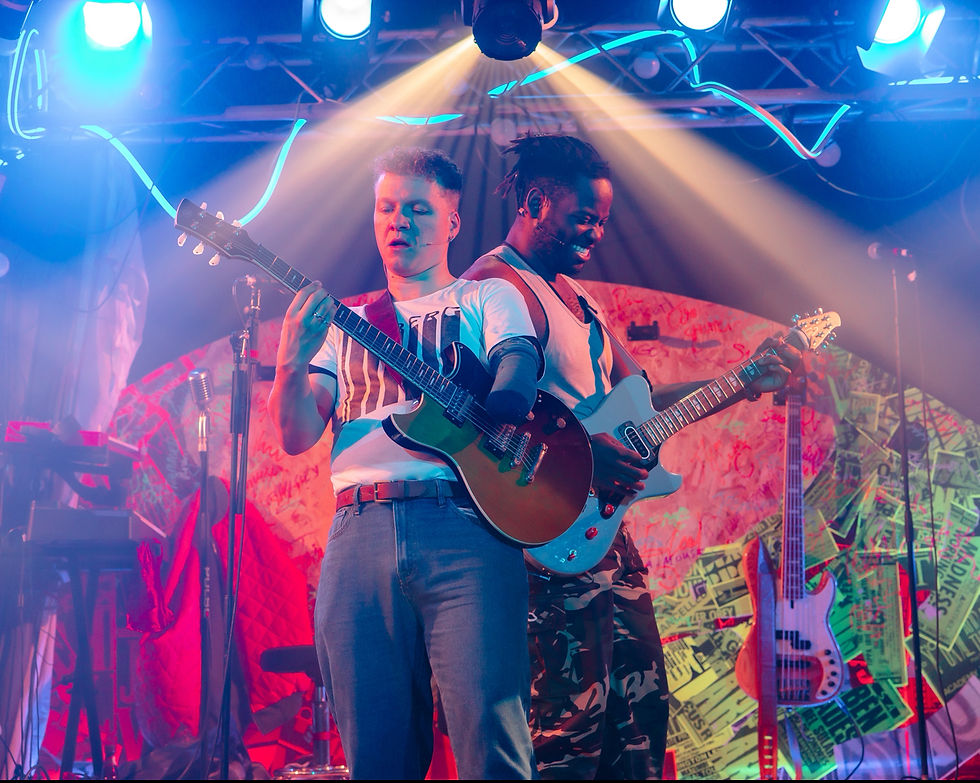
Though principally Simon Parkes’ story, and therefore Max Runham’s to tell, both he and Tendai Humphrey Sitima are endlessly impressive to watch. Both actors rotate through roles, hold conversations between both each other and themselves, and take the place of many of the musical acts mentioned. Both musicians in real life, both demonstrate solid guitar work and strong vocals, with some of Sitima’s singing particularly impressive. That sheer joy at telling this story, and that continued passion for a place where music could be king, bleeds deeply into both of these performers, and the effect is remarkable.
Unaware of Parkes or his legacy prior to Brixton Calling’s announcement, I found out only as the first scene played out that he was born with one arm. This is an afterthought to the character of Simon (and, I’d imagine, the man himself) and thankfully this extends to the script. So much that is endlessly more significant to his journey, that it was refreshingly easy to forget that Runham too has one arm – Simon tells us that he never thought of himself as disabled, and so the trappings of stories of overcoming take a backseat to the fact that he simply never took into account the idea of failure. Representing disability and difference is deeply important, but allowing them to be defined by strength of character rather than circumstance is ever more so.

Thoughtful, frantic, and an utter delight, Brixton Calling is a lesson in rock and roll history which shines a light on a man who bridged gaps between races, ethnicities, genres, even boroughs. An essential and invigorating piece of London history, I can’t advise enough that those set to go in blind do no preparatory research. Everything you need to know is right there, and the strength of the work on all sides will ensure you feel like you and Simon Parkes are old friends by the time the lights come down.
Brixton Calling plays at Southwark Playhouse Borough until August 16th
For tickets and information visit https://southwarkplayhouse.co.uk/productions/brixton-calling/
Photos by Danny Kaan