


Review: Black Comedy (Orange Tree Theatre)

Review by Ruth Sealey
⭐️⭐️⭐️⭐️
Blending slapstick comedy with chaotic mistaken identity, where light becomes dark and dark becomes light, Black Comedy arrives at the Orange Tree Theatre. A small theatre that has produced some outstanding work in recent times faces a real challenge staging comedy like this in the round, when the audience can see every move. The question is whether this production of Peter Shaffer’s classic farce can still leave a modern audience in hysterics, or simply leave us all in the dark.
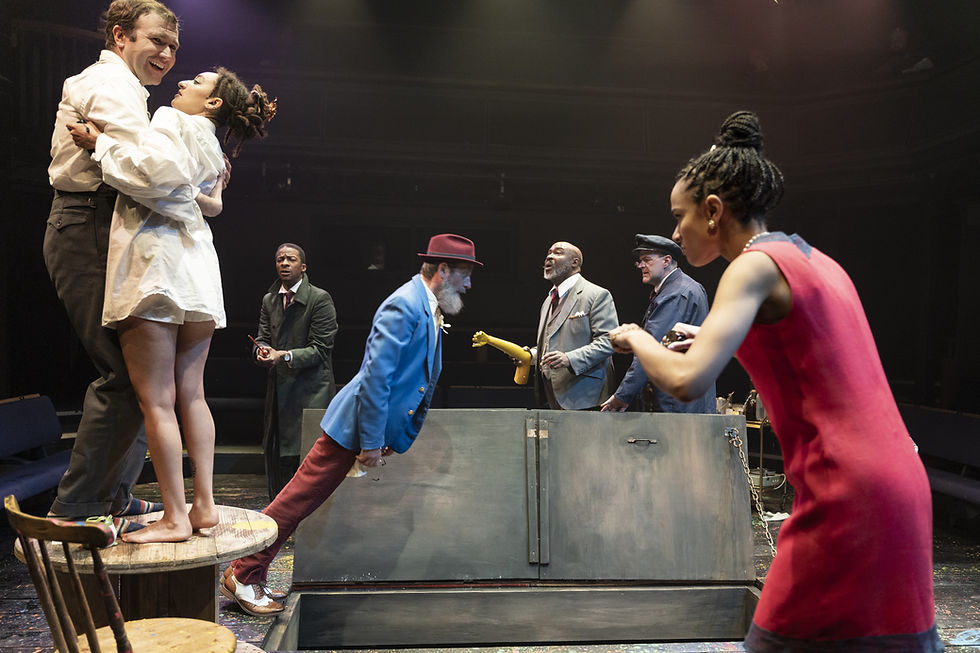
Peter Shaffer’s one-act comedy was first performed in 1965 and is built around a reverse lighting scheme. Until you see it in action on stage, it is quite hard to describe, but then, believe it or not, it all makes perfect sense: when the audience sees light, the cast is in darkness, and when the stage goes dark, the cast acts as if in light. This creates a hilarious series of events in which the audience constantly feels that they know more than the characters on stage.
Shaffer’s writing is inherently funny, and the audience’s ability to see what the characters cannot allows for some brilliantly clever moments, as lines are delivered blindly to the wrong person, and sometimes even directly to the audience. Alongside the obvious comedy, however, darker themes run beneath the laughter. Shaffer was writing at a time when homosexuality was still criminalised, and it is these relationships within the play that are hinted at but never quite allowed to be openly addressed.

On the evening in question, aspiring young sculptor Brindsley Miller prepares his flat for the arrival of a wealthy art dealer: a meeting that could change his life forever. Realising he has very little of value to impress his guest, Brindsley decides to borrow the contents of his neighbour’s flat, including a valuable sculpture, in the hope of appearing far more sophisticated than he really is. What begins as a simple deception quickly descends into chaos with the arrival of lovers, friends, and neighbours, which is all made even more complicated by a power cut that plunges the flat into darkness. Identities are mistaken, secrets are revealed, and things are said that cannot be unsaid, as the situation spirals into a brilliantly raucous farce.
Before the performance begins, the audience is given strict instructions to switch off anything that emits even the slightest bit of light. What this creates is something I have never experienced in a theatre before, and the play opens in darkness, which is so complete that you genuinely cannot see your hand in front of your face. At first, it feels slightly oppressive, until you realise that you are effectively listening in on a couple interacting in their home, able to see each other perfectly clearly.

The real artistry in Caroline Steinbeis’s direction lies in the fact that, despite the audience initially being unable to see a thing, the performances are so precise and fully realised that every movement and interaction plays perfectly to the conditions on stage. The comedy and pacing are relentless, yet Steinbeis manages to control the chaos within such a small space with remarkable detail and nuance. Combined with the work of Physical Comedy Consultant John Nicholson, it is astonishing how something so carefully choreographed can appear so utterly chaotic, and that contradiction sits at the very heart of the play.
Joe Bannister, as Brindsley Miller, is constantly at the centre of the action. He has impeccable comic timing and an exhausting amount of physical comedy to contend with throughout. Bannister handles both the larger slapstick moments and the more subtle comic elements with real ease, never allowing the performance to feel overplayed. Even something as simple as watching him negotiate moving chairs, tables, and furniture in the darkness becomes an impressive feat in itself.

Leah Haile, playing Brindsley’s fiancée Carol Melkett, balances exceptionally well alongside Bannister, moving from an initial innocence to an impressively vengeful edge by the play’s conclusion, which she captures convincingly. Patricia Allison’s Clea is notably unkind, and this adds a sharp, more uncomfortable edge to the comedy, as she almost seems to revel in the confusion she causes in Brindsley and Carol’s relationship.
A standout performance comes from Julia Hills as neighbour Miss Furnival, who hilariously discovers a newfound love of gin in the darkness, adding a brilliant running touch of chaos. Simon Manyonda’s Harold Gorringe is equally strong as the deceived neighbour, gradually revealing a more vulnerable side as he struggles to process the growing realisation of Brindsley’s deception and his own complicated feelings. Jason Barnett brings an imposing presence as Carol’s father, Colonel Melkett, with his carefully judged interactions with the audience landing perfectly. Meanwhile, an unexpected visitor, in the form of a London Electricity Board official, Schuppanzigh, played by Chris Chilton, injects an additional layer of confusion and comedy, particularly in the final sections of the play, where the chaos reaches its peak.

The lighting, or lack of it at times, in this production, along with everything in between, including the delicate candlelight moments designed by Elliot Griggs, epitomises the precision of the show. It works seamlessly with the sound design of Simon Slater, and together the two elements form an excellent example of how vital technical design is to theatre. Simon Daw has his work cut out with the set, costumes, and the sheer number of props, all of which need to be moved and used to generate the comedy moments. The use of the theatre’s balcony as a bedroom area is particularly inspired, especially within such a compact space.
There are elements of this play that do not always sit easily, such as the way Carol is treated by Brindsley, and the brief but suggestive hints at Harold Gorringe’s feelings for him. However, ultimately the play is driven by comedy and contradiction, and by questions of how truly seen we are, and as Clea tells Brindsley, “You don’t really want to be seen.” The result is a fantastic evening of entertainment, with an excellent cast and genuine moments of laugh-out-loud comedy. The Orange Tree Theatre has once again created a production that lights up the stage with a farce that sparkles from start to finish.
Black Comedy plays at Orange Tree Theatre until 11th July. Tickets from https://orangetreetheatre.co.uk/whats-on/black-comedy/
Photos by Sam Taylor