


Review: BBC Proms: Evelyn Glennie and the Fantasia Orchestra (Royal Albert Hall)
- All That Dazzles

- 8 minutes ago
- 5 min read
Review by Molly Gulvin
⭐️⭐️⭐️⭐️⭐️
In the London classical music sphere, there is arguably no greater event than the BBC Proms. Boasting a range of talent performing a huge variety of styles and genres, there truly is something for everyone across the season. For example, this particular performance stars percussionist Dame Evelyn Glennie, alongside the Fantasia Orchestra and the BBC Singers. The Royal Albert Hall provides a backdrop to an entire musical journey through the 75-minute set, spanning genres, instrumentation and performance techniques. In this performance, Glennie sets out to prove that she truly has earned her place amongst the greats of modern classical music - something that she achieves entirely.

This is the Fantasia Orchestra's fourth Proms appearance, with their previous appearance being the Relaxed Prom earlier this season. A relatively new ensemble to the scene, the orchestra boasts a ten-year history of diverse repertoires, including a range of genres, composers and collaborations. This concert’s collaborator, Evelyn Glennie, has been labelled an innovator in percussion and the wider musical world. From being the first percussionist to perform a concerto at the Proms in 1992 to becoming the first person to sustain a full-time career in percussion performance, there can be no doubt that her work in increasing the spotlight on solo percussion has revolutionised the genre. Her composition and performance career has spanned a huge variety of genres, such as jazz, contemporary, folk and classical. This collaboration, therefore, had huge potential for success from its conception, and the performance created realises that potential wonderfully.
The programme for this concert represents the diversity that both the Fantasia Orchestra and Glennie are famous for. Beginning the night with John Coltrane and Duke Ellington before embarking on a journey of composers from Ralph Vaughan Williams to Radiohead, the repertoire creates what conductor Tom Fetherstonhaugh names a "sound world tour”, exploring sonority and texture alongside genre and period. This is not a stereotypical Proms programme: whilst eclectic, there is a strange smoothness in the selection of pieces performed, and the programme in its entirety is engaging and, in many cases, thrilling. Unlike the stereotypical opinion of Proms programmes, this programme includes seven living composers and two living arrangers, highlighting the contemporary classical scene that is truly thriving.

This Prom features the debut of The Wood Pigeon, a BBC commission by Héloïse Werner, a piece that is somewhat confusing at the outset, although it settles to become a wonderful musical moment. The work explores the idea of workshopping a piece from the composer’s perspective, from the chaos of last-minute changes to parts to the ever-familiar promise of an early end to rehearsal if the ensemble works through the break! The piece culminates in a ‘performance’ of a section of the supposedly final work in a moment that truly exemplifies the work’s potential. Werner’s setting of Ali Lewis’s poem Absence is a stunning moment in the concert, using rich harmonies that seem to swell around you to create a soundscape that is truly immersive and engaging. However, the additional input of pre-recorded speech and the supposed rehearsal setting detracts slightly from the imagery of the stillness and peace of a pigeon that Werner appears to be intending to project.
A true highlight of the programme for me is the excerpt of Vincent Ho’s Sandman’s Castle, performed solo by Glennie on the Tam Tam (which is a type of gong). Generally, gongs are used for a single purpose - to play loudly - but this work proves that the instrument can do far more. The use of a variety of beaters and their placements on the instrument creates an utterly unique sonority, with a more diverse range of sounds that a Tam Tam is rarely known for. The bold use of silence and Glennie’s ability to sit comfortably in those beats create an entirely singular moment, in which you truly could hear a pin drop. The unpitched swells in this piece feel like the closest that many of the audience will come to understanding Glennie’s perception of music: being profoundly deaf from a young age, her approach to music is certainly unique, and this feels as though it is at least an introduction to the way that musical swells can be just as emotive as a soaring melody.
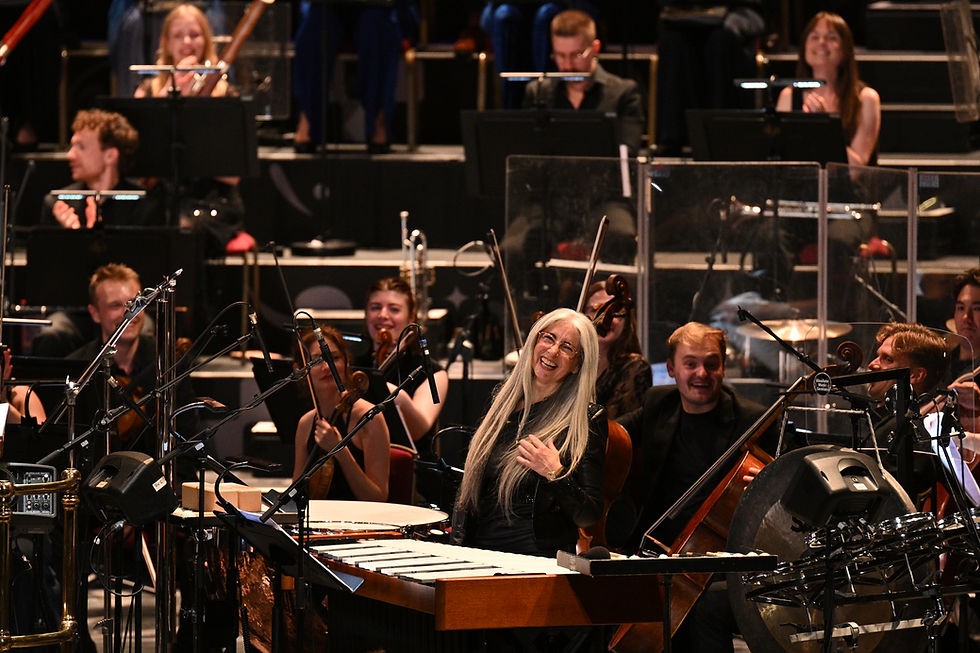
The Fantasia Orchestra certainly prove their worth in this concert, with a polished programme that feels effortlessly performed from top to bottom - although the music they are playing is anything but! Their leader, Millie Ashton, shines in this performance, particularly in her solo within Vaughan Williams’s Serenade to Music, where her performance above the shimmering strings is absolutely breathtaking. Fetherstonhaugh is, as previously mentioned, responsible for conducting the concert and does so with a clear passion and joy from start to finish. His love for the craft is poured into every note, absorbed by the musicians and sent straight back out to the audience, creating an overall performance that is sharp, slick and musically engaging. Furthermore, the BBC Singers are wonderful in this performance, particularly in their performance of Caroline Shaw’s Partita for Eight Voices - Sarabande. This Pulitzer Prize-winning work is brought to life by the performers, truly doing every note justice to create a spectacular moment in the programme. In this performance, Dame Evelyn Glennie can be described as nothing short of outstanding: every note is placed with purpose, and from her very first notes on the vibraphone, it is made entirely clear that Glennie is a master of her craft. This is proven time and time again across the performance, and she performs even the hardest repertoire with apparent ease. In this performance, Glennie exemplifies exactly why her place in musical history is already so well-defined.
On a technical and design level, there are very few changes during the performance. Instead, the sheer excellence of the Royal Albert Hall must be noted. I truly believe that nowhere can host music performances like the Royal Albert Hall, with its acoustics that somehow seem to make the music surround you in even the quietest moments of the performance. The Hall’s limits are truly tested in this performance, from full-ensemble jazz numbers that burst into the space to moments of almost entire silence that seem to reverberate around the room and reach every guest. Whilst maybe not technical in the modern sense, the ability to create such a wonderful performance simply wouldn’t be possible without the wondrous space that is the Royal Albert Hall.

At the start of this review, I noted that Glennie was aiming to prove that she deserved her space among the modern greats of classical music. By the end of the concert, I was fully prepared to place her amongst the greatest of all time. This performance with the Fantasia Orchestra is a masterclass in musicality and technical ability from every performer on the stage, and the overall product is an outstanding performance that highlights the diversity that the modern Proms can achieve. Whilst there may still be room to progress, this concert proves that the classical music sphere continues to revolutionise, and that it’s never too late to start exploring the classical world.
The BBC Proms continues its season until 12th September. Tickets are available from https://www.royalalberthall.com/tickets/proms/bbc-proms-2026.