


Review: Bank of Dave - The Musical (Curve Leicester)
- All That Dazzles

- May 25
- 7 min read
Review by Daz Gale
⭐️⭐️
There’s nothing I love more than a new musical, which is why it was a no-brainer for me to travel to one of my favourite theatres, Curve Leicester, to catch one of the first outings of Bank of Dave (following a world premiere run at The Lowry earlier this month). With a proven team behind it and a very British premise that had all the makings of the next big inspiring musical, I was banking on this being a huge success, but would it successfully be able to make my interest grow, or would I find it difficult to invest?

Bank of Dave is based on the true story of Dave Fishwick, and the 2023 Netflix film of the same name. Burnley born and bred, Dave is a self-made millionaire who has spent years helping people and small businesses in his community when they were turned away from the hard-nosed bankers. Finding himself frustrated by the system, he comes up with the idea to set up his own bank, putting the profits back into the community. However, with no new banking licence being granted in 150 years, and a lot of capital needing to be raised in order to set it up, Dave takes to London to fight the banking bigwigs for a fairer deal.
This is the kind of story musicals were made for - the tale of the underdog who managed to achieve something almost miraculous in the unlikeliest of circumstances. There is a reason why Dave Fishwick’s story has resonated with so many, being the subject of a book and Channel 4 series more than a decade before the film. Dave has become a symbol for dreaming big, so it feels fitting that this musical similarly has big dreams and aspirations for its own version of telling the story. That is admirable in itself, so why did it end up falling so flat for me?
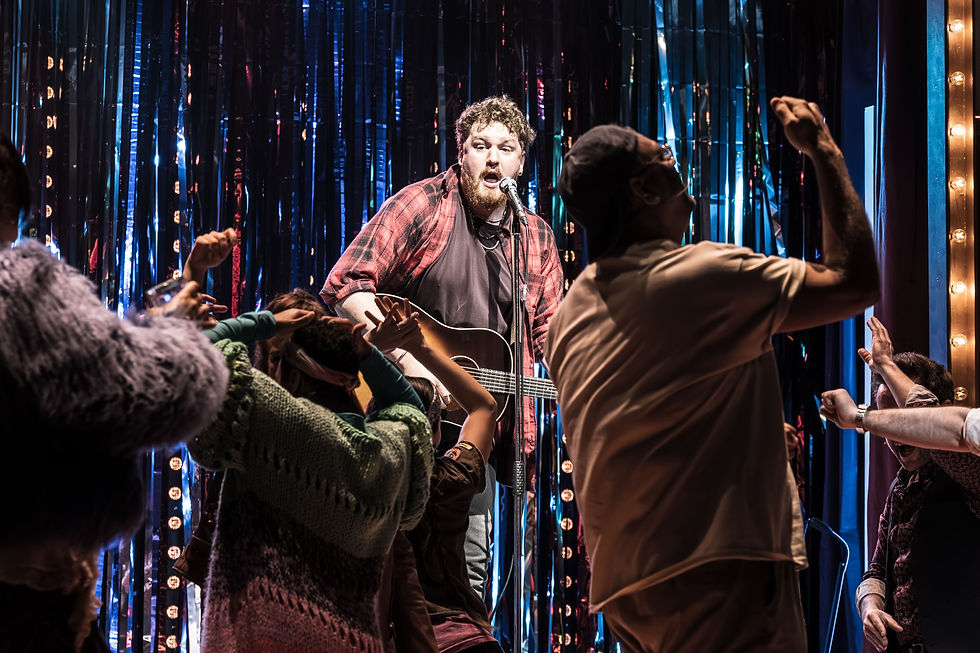
The biggest issue found in Bank of Dave is an identity crisis, as the musical doesn’t seem to know exactly what it wants to be. The tone shifts drastically throughout, never quite settling on one, with niche jokes that feel more suited to a fringe show rather than a big, glitzy musical, and dialogue that veers from family-friendly to crude; it makes for a dizzying watch. Crucially, the musical seems to have borrowed heavily from other musicals to create an almost “Frankenstein’s monster” of a show. There is more than a touch of Kinky Boots to both the story and the production itself, while lines of dialogue and certain songs feel as if they have been lifted from other shows. I counted similarities to Dear Evan Hansen, Billy Elliot and more than a passing resemblance to ‘Dear Bill’ from Operation Mincemeat in a show that felt as if it was more in the brainstorming stage, rather than being fully realised. It often felt like I was watching a draft on stage, which was a shame, as this had all the makings of the next best thing.
Any regular readers of this website will know how much I have always adored Rob Madge both as a writer and a performer. Their soon-to-be-returning My Son’s A Queer (But What Can You Do?) remains one of the most joyous and important shows I have ever reviewed, while they never fail to make me laugh, be that in the context of a show, one of their frequently funny social media posts, or even the face-to-face conversations I’ve been privileged to have with them. Having Madge write the book for Bank of Dave was one of the reasons I was most excited to see this, so it was a shame the writing isn’t up to their usual standard. While Madge’s book has some chuckles within it, it feels at odds with other creative choices. I had the sense that there were conflicting ideas behind the scenes on how best to tell this story (whether that is right or wrong), leading to a messy and inconsistent execution that failed to make the pieces of the puzzle fit together.

Bank of Dave is overstuffed with references, almost over-compensating for its structure not being fully realised yet, with an over-reliance on nods to Coronation Street and EastEnders. Other lines of dialogue fell flat, even making me cringe at times. While I love a good pun, referring to cast members as “banking dancers” didn’t bring the house down laughing as expected, while lines such as “Can I take you up the OXO Tower?” similarly misfired. Fourth-wall breaking references to knowing it was a musical, with a character asking “Is it my cue?”, saying “Here’s a dance break. Let’s tap” and talking about reprises removed any necessary escapism from the show while, bafflingly, somebody impersonating Cher is a fairly regular character, adding nothing to the story beyond contributing to the confusion in tone that is prominent throughout. Early on, a character says, “There’s a laugh in every line if you listen” - sadly, this proved to be untrue.
The biggest frustration in the story of Bank of Dave is in how little Dave himself features. This should be a show centred around him, but his character feels secondary to the whole thing, receiving what felt like less stage time than some other characters. Though it can be argued that his idea brought about a sense of community, so it makes sense to focus on the impact of other characters, the balance here is too extreme, resulting in Dave fading into the background. It repeatedly felt like the idea for a musical was already there, and the story of Dave was hastily placed on top of it in a way that clearly didn’t fit. Similarly, the characters are all too one-dimensional and underwritten, with Dave’s wife, Nicky (Hayley Tamaddon), having almost nothing to do, apart from a showstopping 11 o’clock number (more on that shortly).

Speaking of the songs, Pippa Cleary and Rob Madge’s numbers are a mixed bag. There are some decent musical numbers in there, and some that should never have survived the workshopping stage. Of the latter, ‘Put Your Trust In Us’ performed by “Sir Charles and Pigs” (no, really) is a particularly low point, quickly followed by a frustratingly poor and occasionally annoying ‘Banged Up’. Act Two number ‘Rich Boys Club’ feels like something you would see on Saturday Night Live, where it would undoubtedly be met with a better response. However, in the context of the musical, it sticks out like a sore thumb, exemplifying the identity crisis that is found throughout Bank of Dave.
There are some good songs lurking away, however, unsurprisingly, given the talent both Cleary and Madge have shown in their previous work. Act One finale ‘Can You Hear The Mill?’ is full of potential, showcasing the quality a bit of fine-tuning could provide, while opening number ‘Burnley Born and Bred’ and ‘What Heroes Do’ are other highlights. The standout number comes just before the end of the entire show, with Dave’s wife, Nicky, getting her moment to shine in the astonishingly good ‘For Better Or For Worse’, proving there is a great show to be found here, but it’s not there yet.

Nikolai Foster tries to bring it all together with his direction, though there is the overwhelming sense that his vision didn’t quite align with other creatives' leads to some bizarre choices. A decent set design from Amy Jane Cook feels as if it would have been better for Curve’s studio space, giving the sense that it is too small for Curve’s larger space, taking a small chunk of the stage and making the rest of the uncovered open space feel jarring, again losing the escapism. It is the direction choices in some of the show’s biggest and weakest numbers (the aforementioned ‘Rich Boys Club’ and ‘Put Your Trust In Us’) that had me scratching my head, wondering what they were all trying to achieve, and how it felt like this was the right way to tell the story. Marred by choreography that underwhelmed, the bigger Bank of Dave got, the harder it fell.
Sam Lupton delivers a solid turn as the titular Dave, with boundless energy and a cheeky charisma that effortlessly sets him up to lead the show, which makes how relatively little the character is used all the more noticeable. Hayley Tamaddon makes up for having little to do with her showstopping 11-o-clock number, while Lauryn Redding is a force to be reckoned with as Alex, though her character is in desperate need of fleshing out to make the landing stick all the better. Elsewhere, Joni Ayton-Kent has some decent moments as Megan, while Claire Moore is a delight as Maureen.

The production seems weighted more heavily to Dave’s lawyer, Hugh, and Lucca Chadwick-Patel, who more than rises to the occasion, delivering the standout performance of the show. Dominating the story, he benefits from having the most well-rounded character and some of the best musical numbers of the piece. His big solo ‘What Heroes Do’ allows Chadwick-Patel to demonstrate some incredible moments, while his duet with Lauryn Redding’s Alex ‘My Kind Of Happy’ allows the natural chemistry between the pair to sizzle. At times, it felt as if this show should have been called “Bank of Hugh”, but Chadwick-Patel certainly benefits from all the uncertainty and confusion found elsewhere.
Bank of Dave has all the right elements for a future classic underdog story that sits up there with Kinky Boots. However, it needs to fully find itself before it is able to get there. Once it has fully understood its identity and settled on a more consistent tone, I have no doubt this story will fly. In its present state, however, it disappoints with how uneven and confused it comes across. Despite the best efforts of its talented cast, this is a show that needs a bit more love and attention before it should reasonably expect people to invest their money in it.
Bank of Dave plays at Curve Leicester until 31st May. Tickets from www.curve.co.uk
Photos by Marc Brenner