


Review: A Tale of Two Cities (Marlowe Theatre / UK Tour)

Review by Dan Ghigeanu
⭐️⭐️⭐️
Adaptations are always a tricky subject. They arrive with an audience already carrying expectations, memories and, often, a deep affection for the source material. Adapting a classic is an entirely different challenge, and when that classic happens to be Charles Dickens, the task becomes even more formidable. Dickens does not simply tell a story - he builds worlds, fills them with intricate detail and takes his time doing so. When one word will do, Dickens will often find a reason to use two. That presents a considerable challenge for anyone attempting to translate his work to the stage. A Tale of Two Cities, in particular, is a sprawling novel filled with political upheaval, family histories, romance, revenge and sacrifice. Compressing all of that into a theatrical production is no small undertaking, particularly when working from an adaptation originally created in the 1930s. So, going into this production, there was a certain curiosity about how Terence Rattigan and John Gielgud's adaptation would fare in a new production. Would this be the best of plays, or the worst of plays?

First published in 1859 as Dickens's fourteenth novel, A Tale of Two Cities has certainly proved adaptable. The story has found its way onto the stage numerous times over the years, including musical adaptations. Set in London and Paris and dealing with themes of revolution and repression, love and loss, and one of literature's most famous acts of self-sacrifice, the story follows Lucie Manette, her father Dr Manette, Charles Darnay and Sydney Carton as their lives become increasingly intertwined against the backdrop of the French Revolution. As the political situation in France becomes increasingly dangerous, Darnay's aristocratic heritage places him in considerable danger, forcing those around him to confront questions of loyalty, justice, love and sacrifice.
On paper, it is an extraordinary story but on stage, however, this particular adaptation sometimes struggles to find the flow that the narrative requires. The writing is perhaps the production's biggest stumbling block. There are moments when the dialogue feels difficult to follow, and the narrative does not always move as smoothly as it needs to. Characters can feel distant, making it challenging to form an emotional connection that is so important to the story. Michael Fentiman's direction has its strengths, although it can also feel somewhat clunky and uneven. There are some genuinely excellent directorial choices, particularly in the larger and more dramatic sequences, but the transitions between scenes occasionally feel longer than necessary. When tension has been carefully built, a slow transition can drain some of the momentum from the previous scene. For the most part, however, Fentiman handles the material with confidence. Directing a classic such as A Tale of Two Cities is no easy feat, particularly when the source material contains such an enormous amount of information. The production does find some striking theatrical moments, even if the journey between them is occasionally less assured.

Thankfully, the cast provides a considerable amount of energy. Scarlett Brookes is particularly enjoyable as Miss Pross, finding plenty of humour within the character without allowing the comedy to overwhelm the role. Roger Ringrose makes a strong Lorry, bringing a reassuring quality to the role. François Testory gives a layered performance as Dr Manette, capturing both the character’s fragility and quiet strength. He brings a real sense of emotional depth to Manette’s journey, particularly as the trauma of his past continues to shape his present. Ed Sayer brings charisma and nerve to Charles Darnay, giving the character a strong stage presence. He combines Darnay’s romantic charm with a convincing sense of vulnerability, making him an engaging presence throughout. Jordan Loughran gives Lucie Manette a lovely combination of sweetness and fire. There is warmth to her performance, but she is never afraid to give Lucie strength when the story demands it. Her scenes opposite Samuel Collings's Sydney Carton are among the production's strongest, creating an energy that feels palpable.
Samuel Collings is magnetic as Sydney Carton. His performance is detailed, layered, funny and charismatic, while also capturing the complexity of a character who could easily become one-dimensional. There is a fascinating progression to his performance as Carton’s journey unfolds, and Collings makes that transformation feel entirely earned. He brings both humour and vulnerability to the role, gradually revealing the pain beneath Carton’s outward cynicism. It is his work that ultimately gives the production its much-needed emotional weight. It is a performance that manages to cut through some of the production’s structural difficulties and remind us why Dickens’ story has endured for so long.
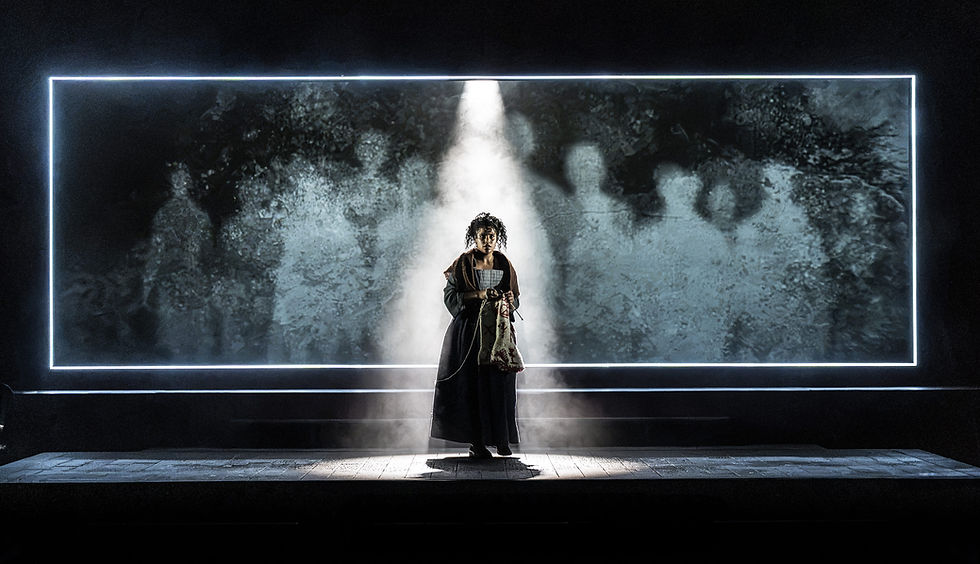
Visually, A Tale of Two Cities is a striking production. Max Jones's set design takes a deliberately simplistic approach that can occasionally make it difficult to establish exactly where we are within the story. It is particularly noticeable in a production whose entire premise is built around the contrast between two cities. London and Paris should feel distinct, both physically and atmospherically, and the simplicity of the set does not always make that distinction immediately clear. Where the production really excels visually, however, is in Ben Jacobs's lighting design. The lighting is simply stunning and arguably one of the strongest creative elements of the production. It helps to establish mood, heighten tension and give some of the more dramatic moments a theatrical scale that the set itself does not always provide.
Kinnetia Isidore's costume design is similarly effective. The costumes are appropriate to the period and help establish the world without feeling overly distracting. Barnaby Race's music is another welcome addition. The use of music during transitions works particularly well, helping to bridge some of the gaps between scenes and providing an additional layer of atmosphere. Richard Hammarton's sound design is generally strong too, although there are a few unfortunate moments in the first act when the sound drops away and the actors become difficult to hear. These technical hiccups are relatively brief, but they are noticeable.

Ultimately, A Tale of Two Cities is an ambitious evening of theatre taking on one of Dickens' most demanding novels and attempting to make its huge story work. It does not always succeed, and there are moments when the writing, pacing and transitions make the production harder work than it needs to be but there is plenty here to admire. The cast is strong, Samuel Collings gives a standout performance as Sydney Carton, and the technical design creates some genuinely beautiful moments. When everything comes together, the production demonstrates exactly why Dickens's story continues to fascinate audiences more than 160 years after its publication. To borrow Dickens' own words, this may not be the best of shows, and it certainly isn't the worst of shows but with a committed cast, striking lighting and some memorable performances, there is enough here to make it an enjoyable production.
A Tale of Two Cities plays at Marlowe Theatre until 19th September, and continues its UK tour until 27th February 2027 Tickets from A Tale Of Two Cities Tour Dates & Tickets
Photos by Marc Brenner