


Review: A Month in the Country (Donmar Warehouse)
Review by Sam Woodward
⭐️⭐️⭐️⭐️
After a summer of hot sunshine, heatwaves and drought, for many, the thought of spending a month in the country is an attractive fantasy after dealing with humid tube carriages, clammy hands and sticky clothing. For others, such as the characters of Brian Friel and Ivan Turgenev’s play, A Month in the Country, the reality is quite the opposite. Full of entrapment, boredom and destruction, this play explores family dynamics, love affairs and complex relationships within a beautiful country estate. As tensions rise and communication fractures, the audience is left wondering whether spending time in the country is as idyllic as it first seems.

Originally titled The Student, the play was written by Russian novelist Ivan Turgenev between 1848 and 1850 and first published in 1855 as Two Women. The play did not reach the stage until 1872, when it was performed in Moscow under the title A Month in the Country. In 1992, Brian Friel created his own version of the play. Friel’s version builds on the play’s moments of linguistic misunderstanding and clever dialogue to remind audiences that what they are watching, too, is an act of translation. Much like Friel’s own play, Translations, this version is interested in how words, language and translation can aid, abet and assist the plot almost as though language is a character in its own right. Within an ensemble structure of intersecting relationships and romantic subplots, dialogue becomes even more important than in a typical play setting.
Lyndsey Turner’s direction turns what could be a slightly static play into a much more enthralling watch. By leaning into the farcical parts of Friel’s translation, as well as the comicality behind the sorrow, Turner turns a more traditional display of wealth, family and friendship into something much more zesty. This dichotomy suits the play very well; there are the traditional aspects of a struggling couple squabbling and the distance between members of a hierarchical family, but Turner also toys with ideas of affairs, deception and moments of sensuality. This isn’t a play dusted off from the nineteenth century and put on a stage, but masterfully revived for a contemporary audience. While the sprawling country house may be a far-flung idea for many, the relationships unfolding onstage are familiar, and there is something recognisable in the jealousy, frustration and miscommunication between them. The play becomes both farcical and far removed in setting, yet intimate and resonant in feeling.

This is due in no small part to the phenomenal cast on stage. Made up of twelve characters, from the formidable lady of the estate Natalya Petrovna, played by Sophie Okonedo, and Mark Hadfield’s bumbling German Herr Schaaf, to Patrick Gibson’s tutor Aleksey and Jessica Brindle’s housemaid Katya, the group spans not only classes, but backgrounds, countries, ages and experiences. The mix of people creates a fascinating dynamic. Each performer places their character within this web of relationships. Alistair Petrie provides a calm and considered Michel, eventually pushed to breaking point and almost forced to erupt from his composed shell. Daniel Rigby brings a ludicrous wit to his role of doctor Ignaty. Often used as a moment of comic relief in more tense family moments, Rigby’s priceless humour extends beyond dad-jokes, however, and reveals a more interesting view of his role as a court jester, performing to appease the hierarchy in place.
The star of this performance is Sophie Okonedo, who is hypnotic as Natalya. She moves seamlessly from a stoic grande dame of the estate to an angry and spiteful wife, then to a tender and passionate woman searching for more. Okonedo strikes this balance perfectly, captivating audiences from her very first appearance in a plant-clad golden cage that surrounds the stage. Her use of speech is fascinating, often interrupting or shutting down her counterparts while insisting they respond and engage in conversation. When a voiceover from Okonedo provides an insight into Natalya’s innermost thoughts, or demons, there is a palpable sense that a life of order and restraint is about to fall apart.

Leslie Travers’s design focuses predominantly on the nature surrounding the formidable country estate. The cage-like structure rises from the stage to reveal a mix of grass, greenery and reeds amongst the dated furniture of the house. By not placing the action within a familiar drawing room or saloon, the setting collapses interior and exterior, allowing the action a more natural space to unfold, while Tim Lutkin’s lighting, in the form of scorching sunlight, intensifies the tension. Travers’s costumes, with Sabrina Cuniberto as costume associate, are beautifully constructed, with deep burgundies and burnt oranges contrasting with cream linen hues that are present throughout. These striking colours sit beautifully on the naturally coloured backdrop, and draw the eye not only to the characters themselves but also to the ways they interact with those around them.
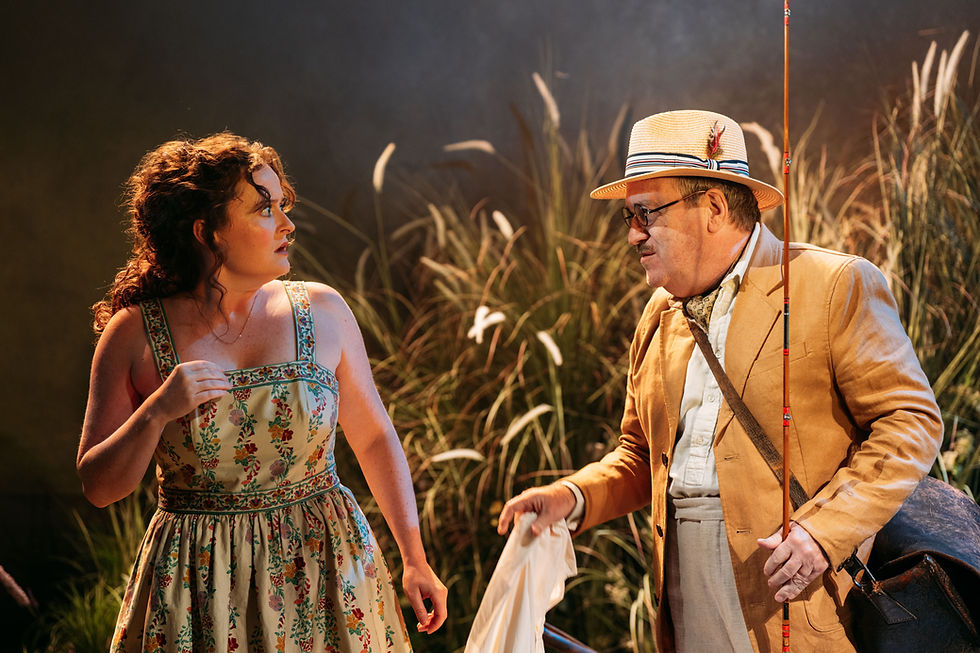
As the monotony of country life becomes clear, and a typical domestic scene turns much heavier, moments of humour and smart dialogue produce a play that is refreshing and bold, while still retaining Turgenev’s interest in Russian class dynamics and questions of morality. A smart revival, this play pulls audiences into moments of familiarity and farce, while evoking a much deeper question of whether the lives these characters have built can ever satisfy what they truly want.
A Month in the Country plays at Donmar Warehouse until 3rd October. Tickets from https://www.donmarwarehouse.com/events/a-month-in-the-country/?instance-type=standard#content-dates-and-times.
Photos by Helen Murray.