


Review: A Midsummer Night Dream (Shakespeare’s Globe)
- Lily - Admin

- May 1
- 5 min read
Review by Jack Casson
⭐️⭐️⭐️⭐️⭐️
A vibrant, hilarious and wonderfully queer celebration of community, the globe's newest production of A Midsummer Night's Dream breathes fresh life into the Jacobean text. Last seen at the Globe in 2021, this newest production has been adapted to include vibrant song and improvised interludes. The cast goes the extra mile to ignite the audience, and through some light-touch audience interaction, we are drawn into the meta-theatrical world of the play and lulled into a state of dream-like whimsy. It may be prudent to outline the plot of this iconic play, given its frequent revival, yet this newest production finds new areas within the text to focus on.
When Hermia defies her demanding father’s wishes to marry Demetrius and runs away with the more charming Lysander, the pair find themselves in a moonlit wood populated by scheming fairies. Puck and Oberon are themselves plotting to trick the fairy queen Titania into falling in love with a beast, using the aid of a magic flower. Through a series of comic mishaps, Titania falls in love with a donkey (the transformed Bottom), while Lysander is ensnared by the flower’s magic and falls at the feet of Helena, who herself is in love with Demetrius. Secondary to this, a raucous group of actors, including Bottom, is preparing a presentation of ‘Pyramus and Thisbe’ to be performed at the wedding of Hippolyta and Theseus, the same day Hermia must decide to follow her father's wishes to marry Demetrius. Whilst this may seem a lot to grapple with in a two and a half hour run time, the cast of this production masterfully takes us through the tale whilst infusing the text with new material that brilliantly parallels and complements this intricate plot.
The first noteworthy change to Shakespeare’s text is a semi-immersive prelude in which audience members are invited to audition for the theatre troop, the ‘mechanicals’. Jamal Franklin as Snug is a highlight here as he sheepishly runs through the audience seeking participants, whilst Adrian Richard’s as Bottom leads selected audience members through a short dance. This is accompanied by a brilliant on-stage band who, throughout the show, add whimsical songs and trill-like orchestration, helping to create a mystic atmosphere.

As we move into Shakespeare’s text, more changes occur. There is a wonderful queerness in the casting of female-presenting Mel Lowe as Lysander. She is a highlight, delivering a brilliantly passionate and effortlessly physical performance as a youthful, sensual bachelor. She infuses the text with brilliant modernity (particularly when mimicking Cynthia Erivo’s ‘Defying Gravity’ riff in a brief moment of song) and stands out as a highlight throughout. Similarly, Romaya Weaver’s Helena draws out an appealing brattiness, resulting in one of the production’s most comical performances. She infuses the character with expressive, whimsical reactions to the absurdity of her situation, leaning into a queer cultural aesthetic in her congenial interactions with Lysander. This charm is in contrast to Sophie Cox as Hermia and Enyi Okoronkwo as Theseus (and later Oberon) who perform their material with a seriousness that grounds the piece and helps the plot along. Okoronkwo gets a little lost in this playful staging, and needs to push his authoritative manner more so in order to give weight to the piece, but otherwise he does exceptional work in this supporting role.

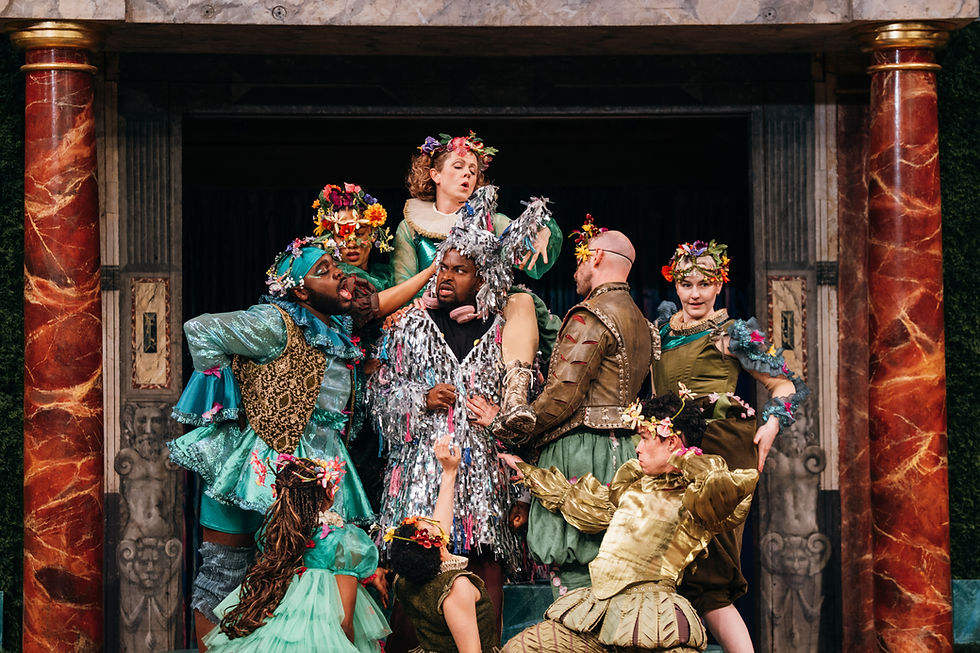
It is within the world of fairy tales that director Emily Lim’s touch can be most felt. Her direction is centred on a focus on community building, and this is incredibly prevalent in the moments of ensemble song and dance primarily performed in the Faye scenes. The natural world feels tactile and warm, the fairies embracing each other in a comically sensual and queer embrace. Alongside choreography by James Cousins, this adaptation leans heavily into folkloric tradition, providing further emphasis on a community spirit inherent within the text. Michael Grady-Hall is exceptional as Puck, reminiscent of a man holding onto the mischief of childhood despite his years and he is given adaptive material to play with the space. From bubble guns to iPhones, Grady-Hall draws the audience into Puck’s chaotic scheming through deliberately out-of-place modern props.
The world of the fairies is similarly a world of queer joy and some comically risqué scenes of implied sex between the nymphs add an extra dimension to Shakespeare’s text. These moments of Faye feel the most culturally relevant and the cast expertly emphasises particular lines to make Shakespeare’s writing feel contemporary. Jamal Franklin for example enters the space as a drag style fairy, adorned in luscious green silk, and speaks of ‘queen Titania’, a glorious drag-inclusive twist on monarchic tradition. Audrey Brisson as Titania is initially given more strait-laced material, but once under the charms of Puck, her performance truly comes to life with fluid physicality and sexual allure.

The final plot thread is that of the play performed at Hippolyta and Theseus’ wedding. This is where the piece reaches its meta-theatrical peak as the audience becomes participants in the performance, acting as the iconic wall that Pyramus and Thisbe speak through in the play. Victoria Moseley as Quince is brilliant in her attempts to hold together this chaotic mess unfolding around her. Jamal Franklin as Snug, is charming in his sheepishness and Adrian Richard’s as the donkey-headed Bottom is relentlessly hilarious in his queer, sexual embrace of the fairy realm.
The design of the piece is where I could find something to critique, but by the end of the piece, all the abstract choices begin to make sense. For example, costume designer Fly Davi dresses the younger characters in the cast in pastels that hold a regal aesthetic with ruffled collars and embroidered blazers. Yet other characters, particularly Bottom, are dressed in contemporary clothing that, at first, feels misplaced. Bottom is the pinnacle of a theatre kid: clad in Hamilton and Cats merchandise, even when topped with a glittering, disco-esque jacket as a donkey. At first I was confused by this direction, but in the final moments of the play, it becomes clear that what the audience is watching unfold is intended to be read as a dream, the fusion of anarchic tradition and modern wear reminiscent of the oddest night time fancies. The set design is similarly brilliant in its vibrant transformation. The gorgeous rainbow of flowers and comical fountains create a fun and hallucinogenic space that is utterly whimsical, and set designer Aldo Vázquez deserves a lot of praise for stretching this space out into the audience.

For me, this is the pinnacle of modern adaptation. An excellent piece to introduce people to Shakespeare, the Globe’s newest production of A Midsummer Night’s Dream is the most convincing and relevant that I have seen and is a complete and utter joy throughout. Never has standing on my feet for so long been such a pleasure.
A Midsummer Night’s Dream plays at Shakespeare’s Globe until the 29th August. Tickets from https://allthatdazzles.londontheatredirect.com/play/a-midsummer-nights-dream-london-tickets
Photos by Helen Murray