


Film Review: Bad Apples
- Sam - Admin

- 2 hours ago
- 5 min read
Review by Sam Waite
⭐️⭐️⭐️⭐️
On the surface, being a teacher can appear to be an almost totally thankless job. Day after day planning and conducting lessons, trying to mine an endless supply of patience all while all least some of those pupils would rather be anywhere else, and may make that abundantly clear. Still, it’s hard not to imagine the euphoria that comes with having truly connected with a student, of feeling that you’ve made a palpable difference to someone that will help guide their still-developing interests. Both of these feelings are central to Swedish director Jonatan Etzler’s English-language debut, Bad Apples.

Maria Spencer is a teacher at Ashton Brook Primary School, whose year six class's individual characteristics have gone largely unnoticed. This is thanks in small part to the cloying, Miss Spencer-worshipping Pauline, and in far larger part to troublemaker Danny. Maria is at the end of her rope, and her inability to control her class has not gone unnoticed by the headteacher, or the constantly complaining parents. Based on a Swedish-language novel by Rasmus Lindgren, the film finds Maria taking her problem pupil captive after an out-of-hours altercation, and faces her with a jarring question: Is her classroom’s rapid improvement worth refusing a young boy his freedom?
Adapted for the screen by Jess O’Kane, Bad Apples’ greatest strength is its willingness to paint neither Danny nor Maria as an innocent victim or a purely monstrous presence. Their individual dysfunctions and troubled life stories are alluded to, some parts in broader detail and others left to the viewers’ imaginations. For Maria, deputy headteacher Sam is soon revealed as her ex, yet to collect his things as his new partner needs the space. Elsewhere, her attempts at contacting Danny’s dad about a violent incident at school suggests how poorly the boy is being cared for at home. Still, each has moments of genuine villainy, from Danny’s joyful reactions to others being injured to Maria’s decision to not only keep him prisoner, but to let him think she has contacted his father.

A first-time actor, Eddie Waller proves almost worryingly adept at taking Danny through the many facets of his personality. In the moments where a genuine tenderness between the pair begins to seem possible, there’s a delicate sensitivity to Waller’s portrayal which is somehow at odds with yet resonates fully with the cruelty he is able to exhibit. His performance is often a thrillingly physical one, and his knack for flipping seemingly on the spot into blind, terrifying rage will serve Waller well should he choose to pursue further acting work. This being a dark comedy, he also proves capable of delivering a withering insult, and manages to match the energy of his far more experienced co-star.
That co-star is none other than Saoirse Ronan, a four-time Oscar nominee barely into her thirties and among the most versatile actors of her generation. Given this praise, I doubt I need to tell you how much I enjoyed Ronan’s performance, which fluctuates perfectly between timidity and intensity, moving swiftly from crippling anxiety to methodical calculations. Having taken on the role out of a want to play an unsympathetic character, there’s a delicious irony to the fact that, in Ronan’s skilled hands, Maria Spencer often becomes easy to sympathise with. Of course, she is a talented enough performer that when it comes time to fear for what she will do next, that discomfort settles over the audience in an instant.
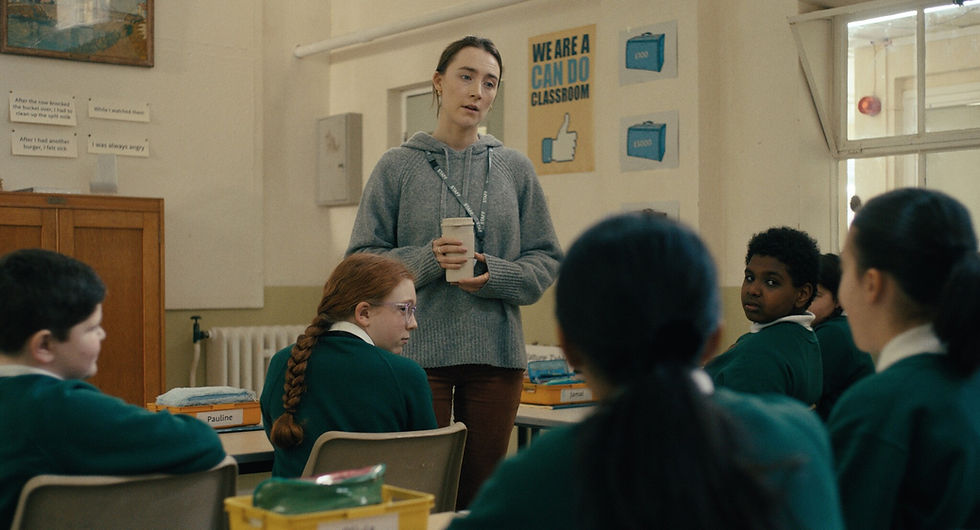
Miss Spencer’s students have their fair share of strong moments, both comedic and dramatic. However, none make quite the impression that the endearingly awkward Pauline does, particularly as her fascination with her teacher brings her dangerously close to the goings-on at home. Nia Brown is consistently winning in her willingness to be weird, and brings a sinister edge to the role as the film progresses, culminatingin a hysterical and horrifying musical climax towards the end. Both Brown and Waller share striking, deliberately stilted chemistries with Ronan, bringing a real sense of discomfort and depth to these inappropriate connections.
O’Kane’s script is frequently sharp, and her and Etzler’s backgrounds in education come through in their understanding of how teachers exist as both undervalued and endlessly scrutinised. If anything, a chief criticism may simply be that the film could be darker, could lean more harshly into the broken spirit of this once-vibrant woman whose life-long dream job has been made so hellish by one pupil. There are glimmers of something more brutal, and a version of the character truly lacking in sympathy, and at times it’s difficult not to wonder what sickening thrills that version could bring. This is not to diminish O’Kane, however, as she has created a trio of truly compelling lead roles, and handles the hints towards difficult home lives for Danny and Pauline particularly well.

Etzler shows a steady hand in his direction, coming into the film with a firm command of the difficult tone and finding a good equilibrium between the harsher elements and the genuine humour of O’Kane’s script. Alongside getting a fine set of performances from his core cast, Etzler has also maintained a sense of visual interest throughout the film, particularly in lingering moments where Miss Spencer nervously watches her class while they blur into the foreground. There are also moments, chiefly in the field-trip-set opening scene, where a sense of grand scale is introduced that gives a feeling of smallness to Maria and a weight to her apparent feelings of being misplaced and seen as incapable or weak.
Several brilliant moments come courtesy of Gabriel Lundh and Jonas Jansson’s sound design, with sound being cut off by closing doors and re-emerging once audible to the characters present. Similarly striking moments come from footage interspersed by Etzler of progressively rotting apples – while this may be superfluous at times and laying on the titular metaphor a bit too thick, the images are undoubtedly unsettling and demonstrate the attractive but unsettling cinematography from Nea Asphäll. Likewise, editor Robert Krantz has helped to shape an affection, sometimes purposefully offputting visual identity for Bad Apples.

Less viciously incisive than it could be in places, Bad Apples still succeeds thanks in large part to a pair of stirring child actors and the always-debendable presence of Saoirse Ronan in its leading role. A strong English-language debut for Jonatan Etzler and an excellent showcase for Jess O’Kane’s subtly insightful writing, the film is touching in places, often disturbing, and yet sickeningly fun. A revenge fantasy about a revenge none should carry out, those willing to see humour within these horrors will find plenty to love, even with characters they may well come to hate.
Bad Apples will be released in UK cinemas on Friday, September 18th
Listings can be found at your local cinema
Watch the Bad Apples official trailer here: https://youtu.be/4nhu80EmVQE?si=SjAA0d_MHL06lvfG